Artwork
Charles II as a Child
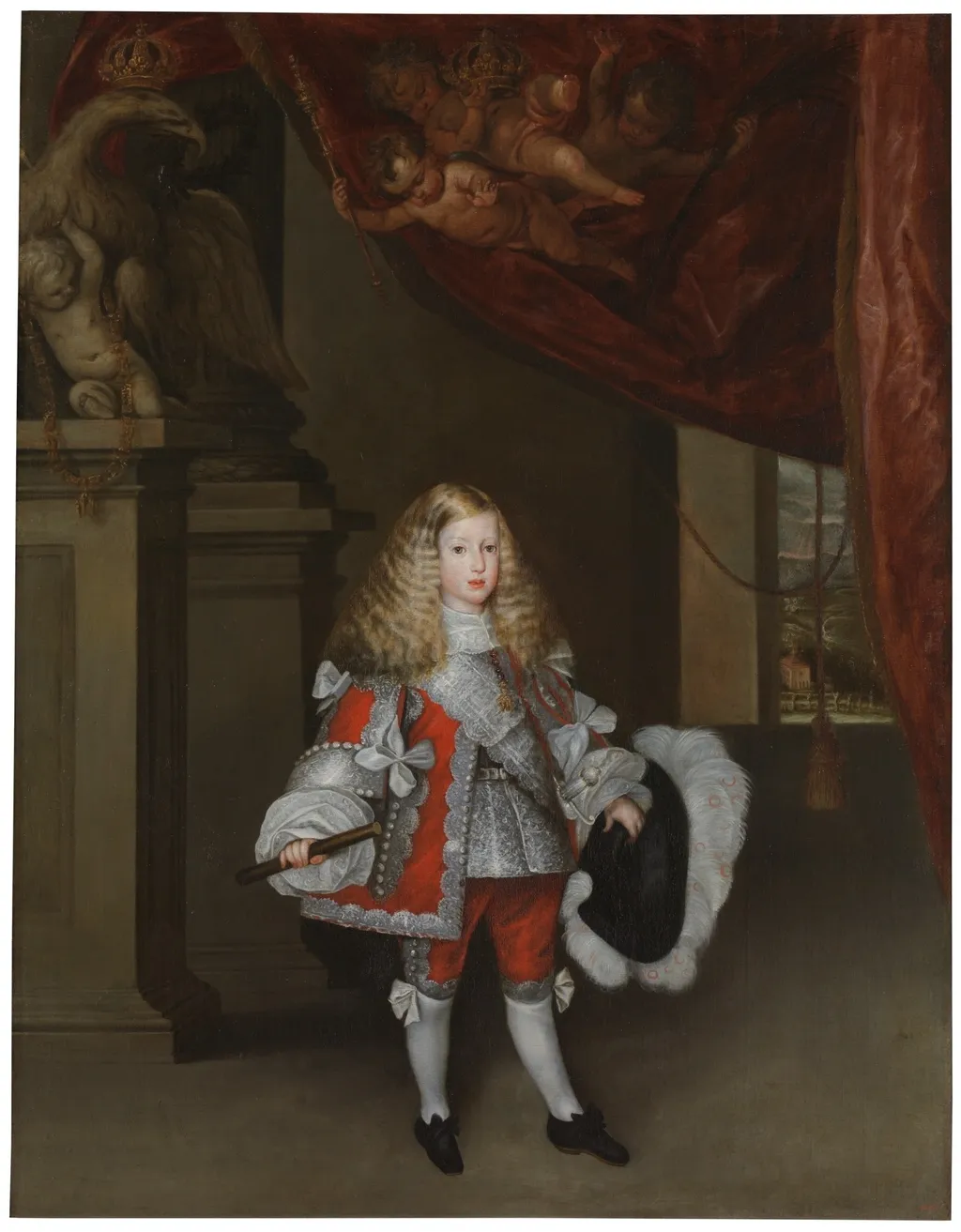
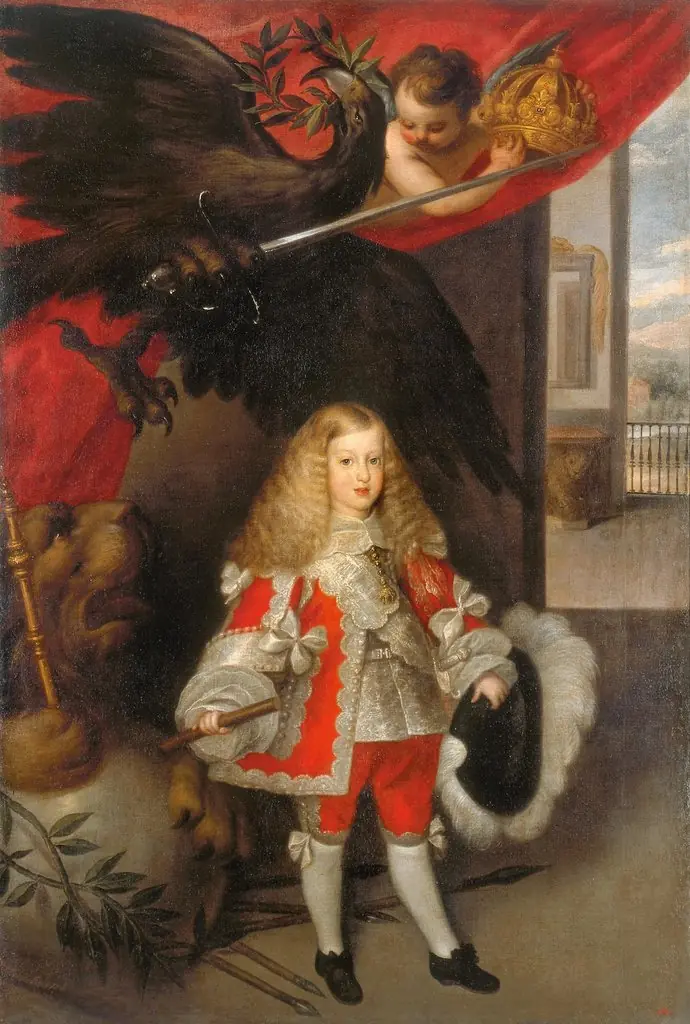
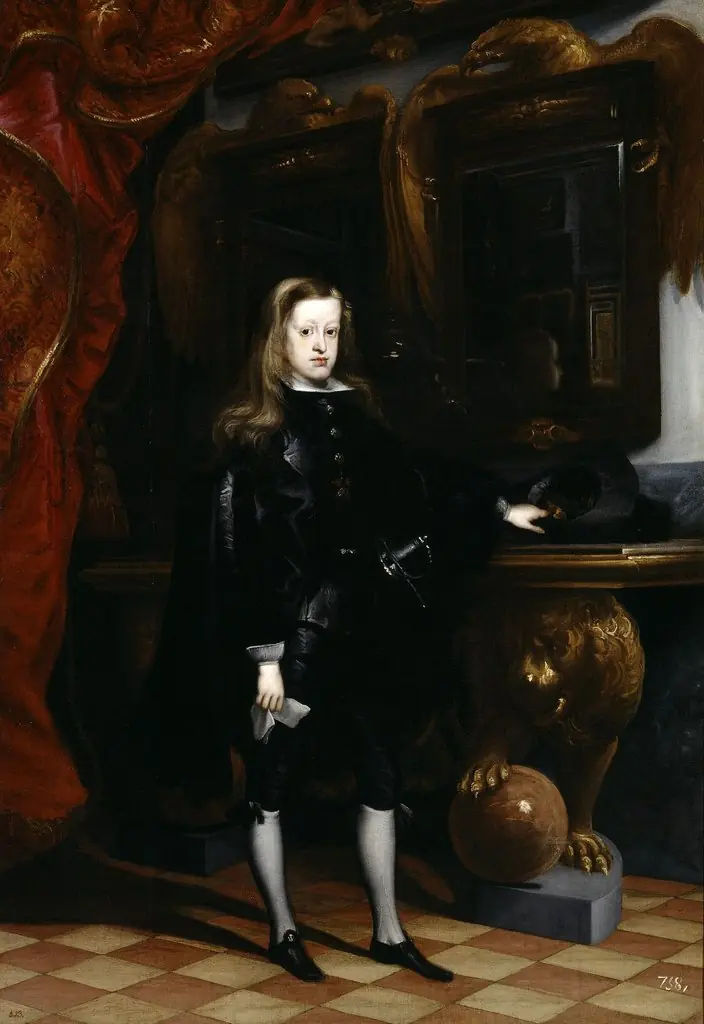
Charles II as a Child is an oil painting by the Early Baroque Italian artist Sebastián Herrera Barnuevo. It dates from 1670 and is held in the collection of the Museo del Prado.
About this work
Subject & Meaning
The painting depicts the young Charles II of Spain, then aged eight or nine, in royal attire that emphasizes his legitimacy and authority.
The painting depicts the young Charles II of Spain, then aged eight or nine, in royal attire that emphasizes his legitimacy and authority. He wears a red and white costume associated with the House of Austria, symbolizing his dynastic lineage. The portrait includes allegorical elements such as the Golden Fleece, sceptre, crown, and a Toisón de Oro collar borne by an angel, alongside an eagle and lion representing sovereign power.
A baton of command in his right hand signifies his role as military leader. The background features a view of the Casa de Campo or the gardens of the Palacio del Buen Retiro, adding symbolic depth. These iconographic choices construct an image of the child monarch as the embodiment of royal authority and Habsburg heritage, reflecting contemporary political messaging through visual tradition.
Technique & Style
Sebastián de Herrera Barnuevo executed Charles II as a Child using oil paint on a canvas support, measuring 185.5 cm in height and 144 cm in width. The work dates to approximately 1669–1670, serving as the primary prototype for a series of royal portraits depicting the monarch at eight or nine years of age. Stylistically, the painting emphasizes the subject's regal status through a luxurious red and white costume, reflecting the colors of the House of Austria.
The composition integrates dense symbolic elements, including an eagle, a lion, and angels holding the crown, scepter, and palm of victory, alongside the collar of the Order of the Golden Fleece. A window in the background provides spatial depth, revealing a view of the Casa de Campo or a hermitage in the Buen Retiro gardens. This approach distinguishes Herrera Barnuevo's typology from other court painters of the era.
History & Provenance
Painted by Sebastián Herrera Barnuevo around 1669–1670, this portrait depicts Charles II of Spain at approximately eight or nine years of age. The dating relies on the monarch's apparent age and the existence of a derivative canvas explicitly dated 1670. Herrera Barnuevo served as court painter from 1667 until his death in 1671, making this work one of his official royal portraits created during that brief tenure.
The painting's early ownership history remains largely undocumented. During the twentieth century, it belonged to the Gil collection and was deposited at the Museum of Barcelona between 1918 and 1950. Originally misattributed to Claudio Coello, the work was correctly identified as Herrera Barnuevo's by historian Diego Angulo Íñiguez.
In 2014, the Spanish Ministry of Education, Culture and Sport acquired the canvas and assigned it to the Museo del Prado.
The painting Charles II as a Child is held by the Museo del Prado in Madrid. It bears the inventory number P00968 and has been on display in the museum's collection galleries since its acquisition. The work was acquired by the Ministry of Education, Culture and Sport in 2014 and formally incorporated into the Museo del Prado's holdings.
It was previously part of the Gil collection and was on deposit at the Museu de Barcelona from 1918 to 1950. The attribution to Sebastián Herrera Barnuevo was confirmed by art historian Diego Angulo Íñiguez, ending earlier misattribution to Claudio Coello.
Context
Sebastián Herrera Barnuevo served as court painter to Charles II from 1667 until his death in 1671, producing official portraits of the monarch during a brief but significant period of royal artistic patronage. The painting known as Carlos II niño, dated to around 1669–1670 based on stylistic analysis and a contemporary canvas bearing the year 1670, exemplifies Herrera Barnuevo’s role in shaping the visual language of Spanish Habsburg monarchy. Its composition employs symbolic elements, such as the red and white attire of the House of Austria, the Golden Fleece collar borne by an angel, and the sceptre of command, to emphasize the child-king’s regal authority and dynastic legitimacy.
The work functions as the prototype for a series of variants depicting Charles II in similar regalia, reproduced across European collections including the Hermitage, the Royal Collection, and the Museo Lázaro Galdiano. While later copies often simplify or omit allegorical details, the Prado version remains the only securely attributed original, distinguished by its complex spatial depth, courtly iconography, and integration of architectural settings referencing Madrid’s royal palaces.
Legacy
The painting holds a notable place within Herrera Barnuevo's surviving oeuvre, counted among the most significant works of his limited output. Its principal legacy is iconographic: it is regarded as the finest version and likely the prototype of an entire series of portraits of the young Charles II distributed across various museums and collections, in which the king's figure is repeated almost unchanged while the backgrounds and allegorical emblems vary. Among the most prominent derivatives are portraits held by the Hermitage Museum in Saint Petersburg and the Royal Collection in the United Kingdom, as well as a high-quality version in Madrid's Museo Lázaro Galdiano.
The Prado canvas is the only one that can be attributed to Herrera Barnuevo himself with any authority, while the others are generally considered workshop copies or variants. The work also established a distinctive typology within the Spanish tradition of royal portraiture, distinguished from that of earlier and later court painters through its symbolic apparatus.
Overview
Sebastián Herrera Barnuevo’s 1670 oil on canvas portrays the future monarch Charles II of Spain as a child. The young prince stands before a darkened fireplace, his elaborate red‑and‑silver costume highlighted by a fur‑lined cloak. A marble statue occupies a ledge behind him, while a group of cherubic figures drift in a clouded sky above, framing the regal figure.
Own this work as a print
Artist & collection
Artist
Sebastián Herrera Barnuevo (1611 or 1619–1671) was a painter, architect, sculptor and etcher, who was born and died in Madrid, Spain.