Artwork
春好斎北洲画 初代浅尾勇次郎・初代市川鰕十郎 『傾城佐野の船橋』|Kabuki Actors Asao Yūjirō as Sano Genzaemon and Ichikawa Ebijūrō I as Miura Arajirō, in the play Keisei Sano no Funabashi
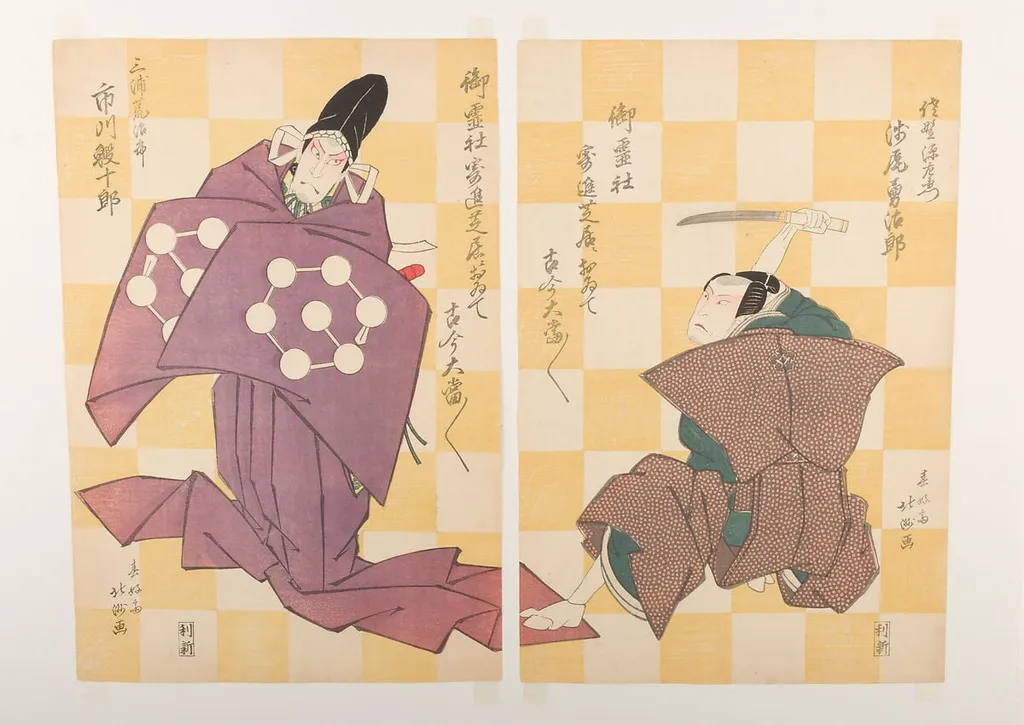
春好斎北洲画 初代浅尾勇次郎・初代市川鰕十郎 『傾城佐野の船橋』|Kabuki Actors Asao Yūjirō as Sano Genzaemon and Ichikawa Ebijūrō I as Miura Arajirō, in the play Keisei Sano no Funabashi is an ink print by the Romanticist artist Shunkōsai Hokushū. It dates from 1822 and is held in the collection of the Metropolitan Museum of Art.
About this work
Overview
It is held in the collection of the Metropolitan Museum of Art, acquired in 2011 through the Friends of Asian Art Gifts in honor of James C.
This diptych of woodblock prints, titled in full Kabuki Actors Asao Yūjirō as Sano Genzaemon and Ichikawa Ebijūrō I as Miura Arajirō, in the play Keisei Sano no Funabashi, was created in 1822 by the Japanese ukiyo-e artist Shunkōsai Hokushū, who was active between 1808 and 1832. The work, a vertical ōban diptych executed in ink and color on paper, measures approximately 15 by 10 inches (38.1 by 25.4 cm) for each panel. It is held in the collection of the Metropolitan Museum of Art, acquired in 2011 through the Friends of Asian Art Gifts in honor of James C. Y. Watt, with the object numbers 2011.126a and 2011.126b. As a prime example of yakusha-e, or actor portrait prints, the work captures a pivotal dramatic moment from an Osaka kabuki adaptation of a puppet play, exemplifying the bold color and theatrical intensity that characterize Hokushū's output during the late Edo period.
Subject & Meaning
The print depicts two kabuki actors in roles from the play Keisei Sano no Funabashi. On the left panel stands Asao Yūjirō in the role of Sano Genzaemon, clad in voluminous purple robes adorned with large white circular emblems arranged in constellation-like patterns, wearing a tall black cap, his face pale with red eye makeup, gazing leftward. The right panel shows Ichikawa Ebijūrō I as the villain Miura Arajirō, crouched in a dynamic pose with a shaved crown and dark side hair, wearing brown patterned robes over green undergarments, wielding a short sword raised above his head in his right hand while his left hand touches the ground. The scene captures the moment immediately before Genzaemon slays Arajirō with his wakizashi inside the Shogun's palace, an act that will lead to Genzaemon's ritual suicide. The yellow and white checkered background against which both figures are set creates a deliberately theatrical, almost abstract space that has been interpreted variously as a stage, a game board, or simply a decorative field that allows the actors to dominate the composition. The vertical columns of black calligraphic text and small red seals near the bottom of each panel complete the design. The inscription indicates that this was a fund-raising performance at the Goryō Shrine Theater and that the play was a major success.
Technique & Style
The work is executed as a diptych of nishiki-e, or full-color woodblock prints, employing ink and color on paper in the vertical ōban format. The technique displays the characteristic flat color areas, crisp outlines, and minimal shading typical of woodblock printing. Hokushū's handling shows particular attention to the dramatic potential of color and pattern: the bright red of the sword hilt contrasts with the strong yellow-checkered background, while the remarkable purple of Miura's robe with its billowing, oversized sleeves and long trousers creates a memorable visual effect. The composition balances the standing figure on the left against the dynamic crouching figure on the right, with both figures seeming to overflow the pictorial field in a manner that suggests uncontainable passion. The fugitive purple pigment has remained largely well-preserved, though light and humidity have slightly affected the lower right area of one sheet where it was previously mounted in an album. The small red seals near the bottom of each panel serve as publisher or censor marks typical of the period.
History & Provenance
The play Keisei Sano no Funabashi was an Osaka kabuki adaptation of the Edo ningyō jōruri puppet play Yūshoku Kamakurayama from 1789. The underlying story was based on actual events from 1784 involving the administrator Tanuma Okitsugu and the killing of his son Okitomo by a bannerman samurai named Sano Zenzaemon. Due to censorship restrictions against portraying current events involving the shogunate, the playwright transposed the narrative to the twelfth century. The print itself dates to 1822, during the late Edo period. The Metropolitan Museum of Art acquired the work in 2011 through a purchase funded by the Friends of Asian Art Gifts, in honor of James C. Y. Watt. The museum assigned it object numbers 2011.126a and 2011.126b. The work is listed as being in the public domain under a CC0 dedication.
Context
Shunkōsai Hokushū was active in Osaka during a period when the city's theatrical culture was producing distinctive adaptations of Edo-based material. The print belongs to the yakusha-e genre of actor portraits, which constituted one of the most commercially significant and artistically developed categories of ukiyo-e. The work's depiction of a fund-raising performance at the Goryō Shrine Theater, explicitly noted in its inscription, places it within the context of religious and community-sponsored theatrical events that were crucial to the economic and social fabric of kabuki production. The play's status as a major hit, indicated by the repeated ôatari in the inscription, suggests the print may have served commemorative or promotional purposes alongside its function as a collectible image. Scholarly references to this design include citations in IKBYS-I, no. 126; SCH, no. 53; TWOP, no. 25; and NKE, p. 716.
Legacy
As a work held by the Metropolitan Museum of Art and released into the public domain, the print has become accessible to global audiences through digital platforms and educational resources. The museum's provision of open access data and images has facilitated its use in research and public engagement. The curatorial interpretation provided by the museum emphasizes the print's capacity to convey theatrical intensity and cultural reflection, highlighting how the exaggerated expressions and gestures were designed to reach distant theatergoers and how the work functions as a document of kabuki's role as a mirror of society's hopes, fears, and forbidden desires. The image's availability through stock image services such as Look and Learn further extends its reach as a representative example of Edo-period theatrical printmaking.
Artist & collection

Artist
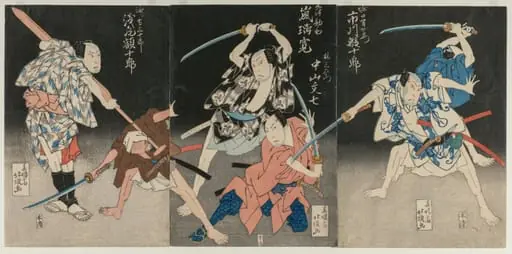
Shunkōsai Hokushū spent his life in Osaka, where the city’s lively theater scene shaped his work.

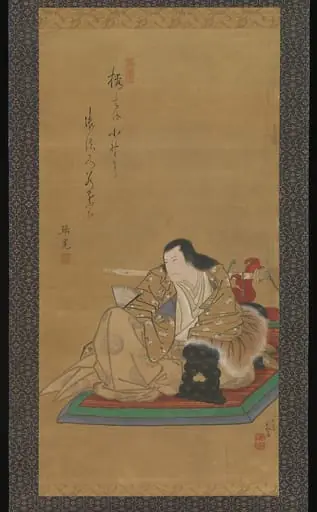 初代嵐橘三郎 (二代目嵐吉三郎) の惟高親王|The Actor Arashi Kitsusaburō I (Kichisaburō II) as Prince Koretaka
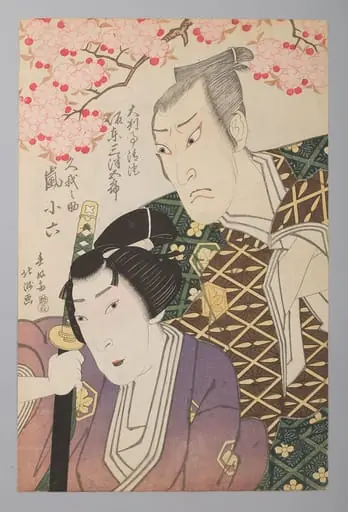 「大判事清澄 坂東三津五郎」(三代)・「久我之助 嵐小六」(四代)|Bandō Mitsugorō III as Daihanji Kiyozumi and Arashi Koroku IV as Koganosuke
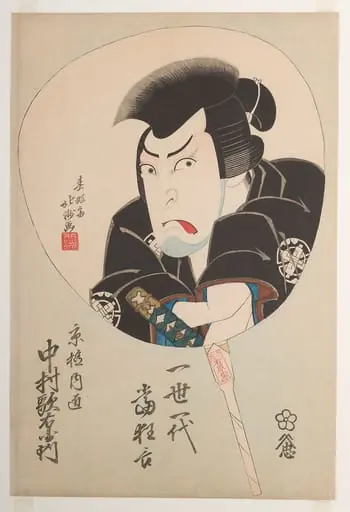 春好斎北洲画 三代目中村歌右衛門 『一世一代当狂言』|Kabuki Actor Nakamura Utaemon III as the Sword Master Kyōgoku Takumi, from the series Issei ichidai atari Kyōgen (Hits of a Lifetime of Kyōgen)
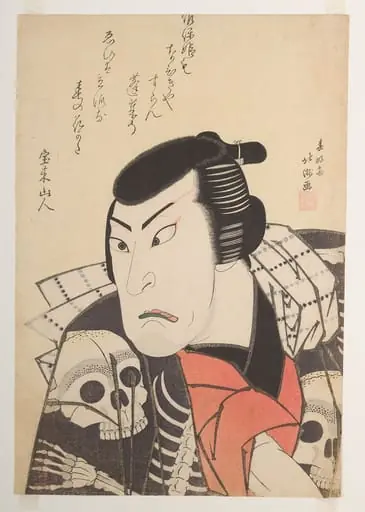 春好斎北洲画 初代市川鰕十郎 「紅紫大坂潤」|Kabuki Actor Ichikawa Ebijūrō I as Tōken (China Dog) Jūbei, in the play Benimurasaki ai de someage (Red and Purple, Rich Dyes of Osaka)
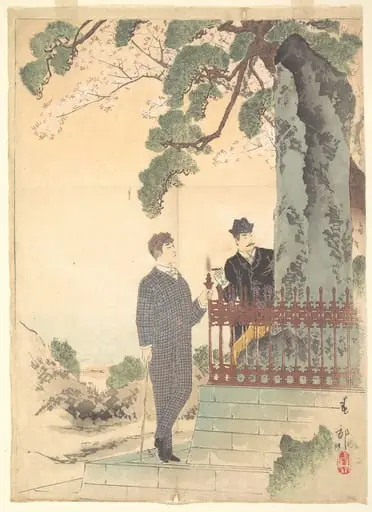 Untitled
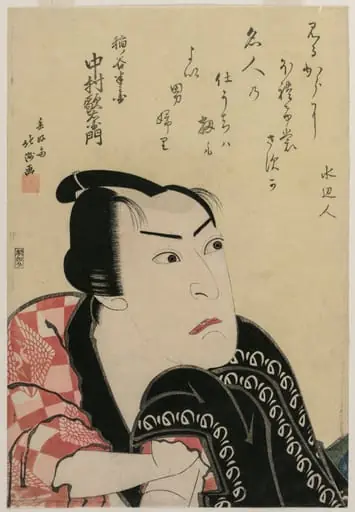 Nakamura Utaemon as Inanoya Hanbei
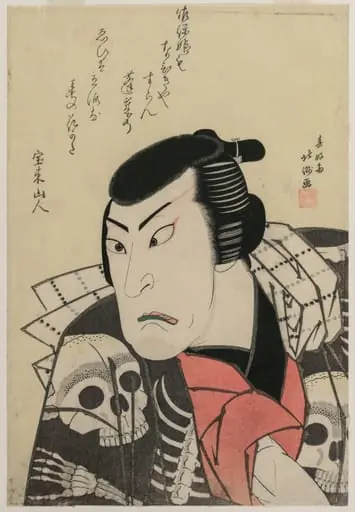 Actor Ichikawa Ebijūrō I as Tōken (China Dog) Jūbei, in the play Red and Purple, Rich Dyes of Osaka (Benimurasaki ai de someage)
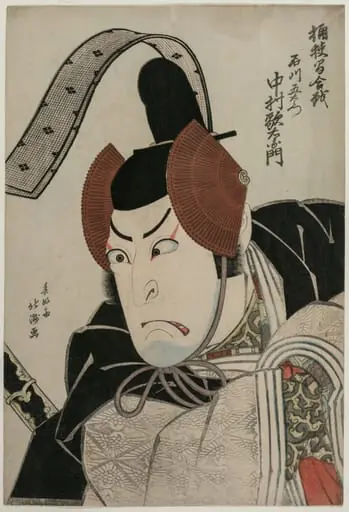 Actor Nakamura Utaemon III (Shikan) as Ishikawa Goemon at the Battle of Okehazama (Okehazama Gassen)
- Ichikawa Ebijūrō II as Horiguchi Manzaemon (right), Arashi Rikan II as Kizu Kansuke, Nakayama Bunshichi III as Hayashi Sanzemon (center), and Asao Gakujurō as the Ferryman Sanjūrō (left) from the Kabuki Play "Eight Views of the Kizu River by Boating Song"
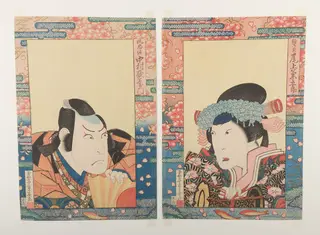 玉柳亭重春画 三代目尾上菊五郎・三代目中村歌右衛門 『義経千本桜』|Kabuki Actors Onoe Kikugorō III as Shizuka Gozen and Nakamura Utaemon III as Kitsune Tadanobu, in the play Yoshitsune senbon zakura (The Thousand Cherry Trees of Yoshitsune)
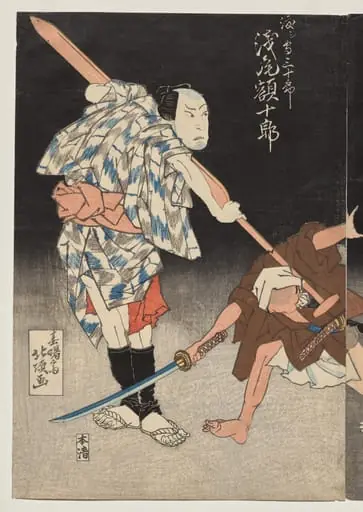 Asao Gakujurō as the Ferryman Sanjūrō from the Kabuki Play "Eight Views of the Kizu River by Boating Song"
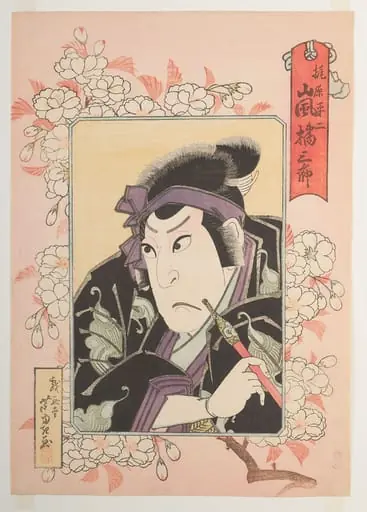 戯画堂芦幸画 二代目嵐橘三郎 「ひらかな盛衰記」|Kabuki Actor Arashi Kitsusaburō II as Kajiwara Heiji, in the play Hiragana seisuiki (Records of the Battles between the Minamoto and Taira Clans in the Japanese Syllabary)
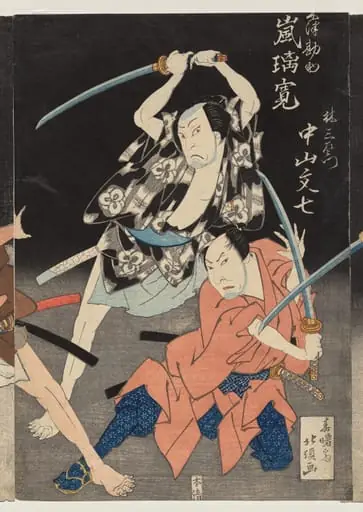 Arashi Rikan II as Kizu Kansuke and Nakayama Bunshichi III as Hayashi Sanzemon from the Kabuki Play "Eight Views of the Kizu River by Boating Song"
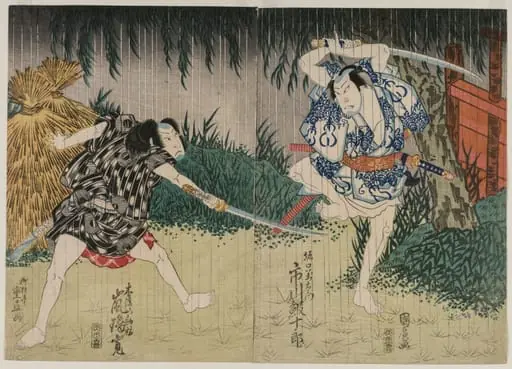 Arashi Rikan II as Kizu Kansuke; Ichikawa Ebijuro II as Horiguchi Manzaemon
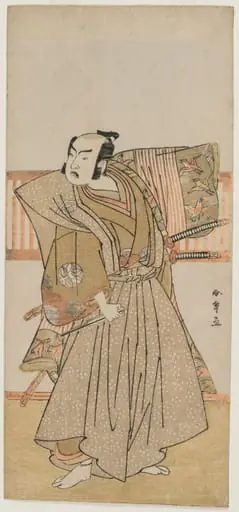 Ichimura Uzaemon IX as Soga no Juro
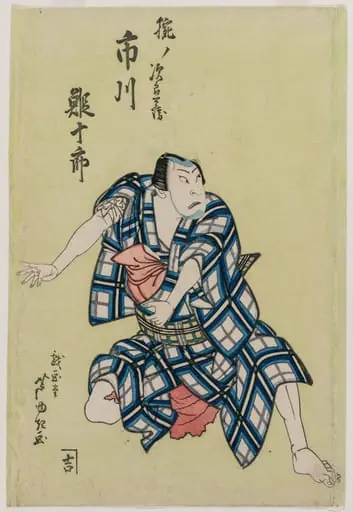 Ichikawa Ebijuro II as Ude no Jirobei
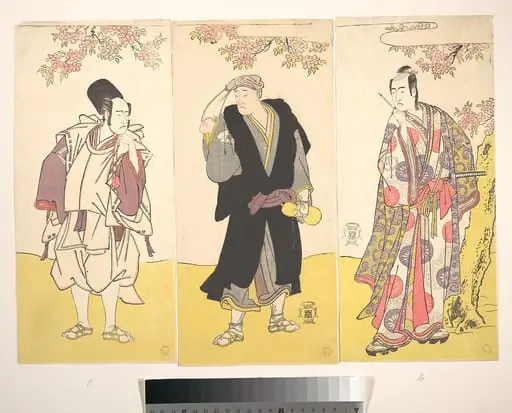 三代目市川八百藏・初代目尾上松助・三代目澤村宗十郎|Kabuki Actors Ichikawa Yaozō III, Onoe Matsusuke I, and Sawamura Sōjūrō III
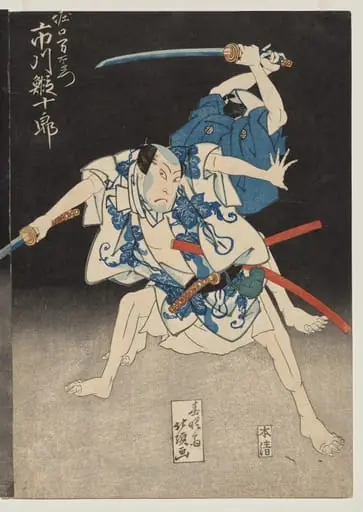 Ichikawa Ebijūrō II as Horiguchi Manzaemon from the Kabuki Play "Eight Views of the Kizu River by Boating Song"