Artwork
Σήμερον ο θάνατος του Τσακιτζή
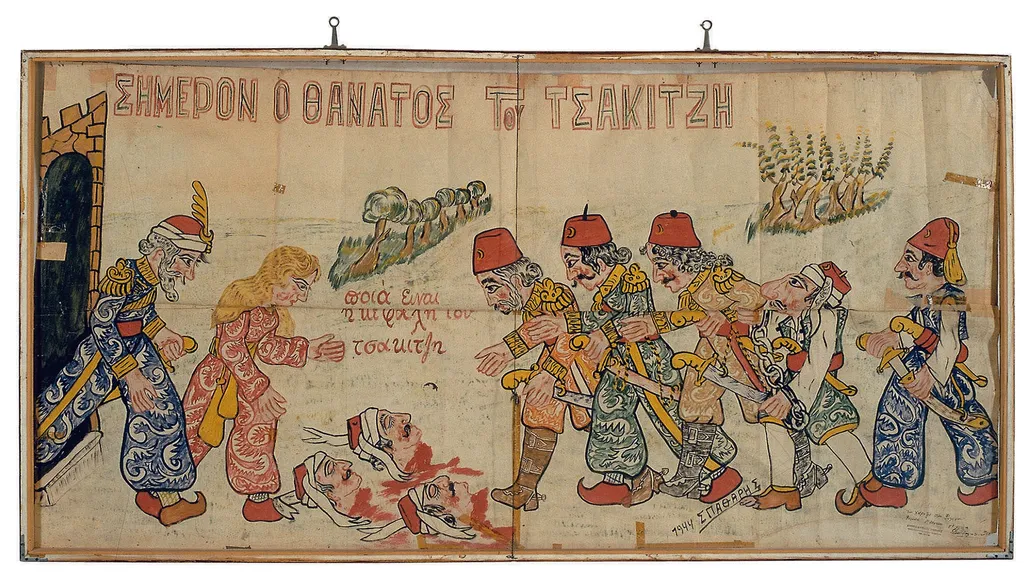
Σήμερον ο θάνατος του Τσακιτζή is a drawing by Sotiris Spatharis. It dates from 1942 and is held in the collection of the Metropolitan Organisation of Museums of Visual Arts of Thessaloniki – MOMus.
About this work
Overview
The work is held in the Museum of Ethnography, where it serves as a record of vernacular artistic practices rather than fine art exhibition.
This drawing by Sotiris Spatharis depicts a dying tailor, rendered in stark, linear strokes typical of Greek shadow puppet theater designs. Created as a visual prop for performance, it reflects Spatharis’s role in crafting imagery for traditional folk theater. The work is held in the Museum of Ethnography, where it serves as a record of vernacular artistic practices rather than fine art exhibition.
Subject & Meaning
The figure represents a tailor, identified by the name 'Tsakitzis,' a common occupational surname. His emaciated form, wrapped in white and attended by a single candle, evokes a moment of quiet mortality rooted in rural Greek life. The scene carries no overt religious symbolism but resonates with folk traditions of death rituals, where simplicity and domestic intimacy marked the passage from life.
Technique & Style
Spatharis employed sharp, incisive lines to model the figure’s gaunt face and hands, emphasizing fragility through contrast and minimal shading. The composition is stripped of background or ornament, focusing attention on the solitary body. This aesthetic aligns with the visual language of shadow puppets, where clarity and symbolic economy were essential for performance under lamplight.
History & Provenance
Spatharis produced this image during the 1930s while collaborating with Athens-based artists including Tsarouchis and Nakis. Though not created for gallery display, his work gained recognition among contemporaries for its authentic connection to folk expression. The drawing entered the Museum of Ethnography’s collection as part of a broader effort to document Greece’s theatrical and material culture.
Context
Spatharis’s work emerged alongside a wider cultural movement seeking to define a modern Greek identity through traditional forms. His shadow puppet designs, including this deathbed scene, were valued by peers for preserving rural motifs amid urban modernization. The 'Armos' group’s inclusion of his work in exhibitions signaled its perceived continuity with earlier folk artists like Theofilos.
Legacy
Though not widely exhibited during his lifetime, Spatharis’s drawings remain significant as artifacts of a disappearing performance tradition. They illustrate how folk art operated outside institutional frameworks, yet influenced modern Greek visual culture. The drawing endures as a testament to the quiet dignity of artisanal life and the role of theater in mediating collective memory.
Artist & collection
Museum
Metropolitan Organisation of Museums of Visual Arts of Thessaloniki – MOMus
Continue through works from the same source collection.