Artwork
朝顔図屏風|Morning Glories
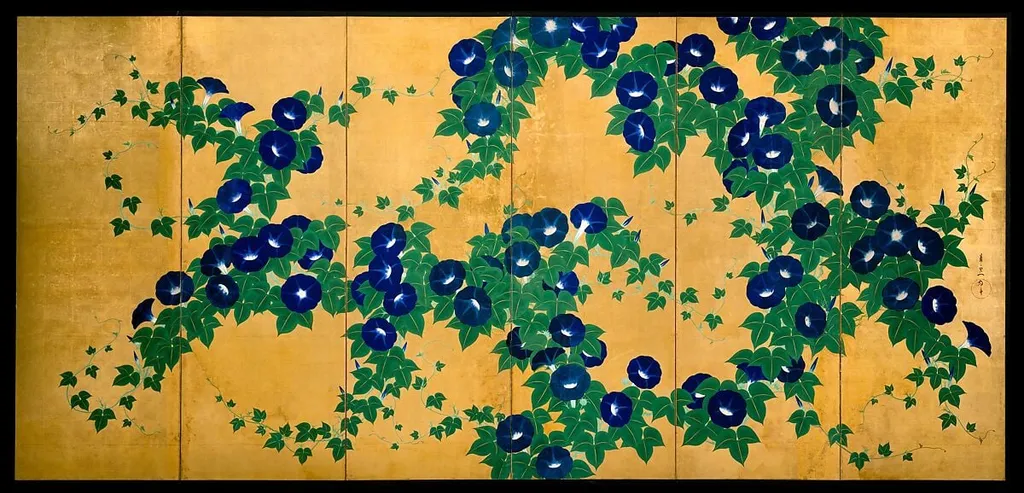
朝顔図屏風|Morning Glories is an ink painting by the Nihonga artist Suzuki Kiitsu. It dates from 1850 and is held in the collection of the Metropolitan Museum of Art.
About this work
Technique & Style
The work depicts flowers and leaves, with the morning glory vines and blooms arranged as the principal subject across the gilded surface.
Morning Glories is executed as a pair of six-panel folding screens using ink, color, and gold leaf on paper, a format that allows the morning glory vines to extend across multiple panels as a continuous composition. The application of gold leaf as a ground is characteristic of the Rinpa school's screen painting tradition, providing a luminous backdrop against which the botanical motifs are rendered in ink and color. The screens measure 178.3 cm in height and 379.7 cm in width, a broad horizontal expanse suited to the paired-screen format.
The work depicts flowers and leaves, with the morning glory vines and blooms arranged as the principal subject across the gilded surface.
History & Provenance
Suzuki Kiitsu's Morning Glories was created in 1850 as a pair of six-panel folding screens executed in ink, color, and gold leaf on paper. The work entered the collection of the Metropolitan Museum of Art, where it remains held. No additional details regarding commission, intermediate ownership, or acquisition history are documented in the available sources.
The pair of six-panel folding screens is held in the collection of the Metropolitan Museum of Art, as recorded in the Wikidata entry for the work.
No specific accession number is provided in the available sources, and no exhibition history is documented.
Overview
Morning Glories is a pair of six-panel folding screens created by Suzuki Kiitsu in 1850. Executed in ink, color, and gold leaf on paper, the work depicts a dense, rhythmic proliferation of morning glory vines and blossoms against a shimmering gold background. Kiitsu renders the flowers with deep blue petals and vibrant green leaves, capturing the ephemeral nature of the bloom which opens briefly in the early summer morning.
The composition fills the entire surface of the screens, creating an immersive environment where the organic forms of the plants contrast with the flat, luminous expanse of gold. This piece exemplifies the Rinpa school tradition of stylizing natural motifs through bold design and decorative materials, while demonstrating Kiitsu's mastery in synthesizing the styles of his predecessors, particularly Ogata Kōrin. As a late work by the artist, who was a leading figure of the Rinpa revival in the mid-19th century, the screens reflect his ability to infuse traditional decorative aesthetics with a fresh, dynamic energy.
The work stands as a significant example of Edo-period screen painting, emphasizing the interplay between nature and luxury materials.
Subject & Meaning
The screens are entirely dedicated to morning glories, featuring deep blue blossoms, bright green leaves, and intertwining vines. Kiitsu captured these flowers during their brief summer bloom, which typically lasts only a few hours each day. The composition deliberately omits human figures or narrative elements, instead focusing on the transient beauty of nature and evoking a sense of serene contemplation.
Artist & collection


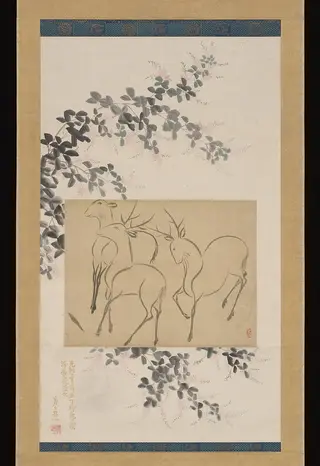
 伝近衛信尋書・伝長谷川宗也絵 葛下絵色紙貼付 『和漢朗詠集』 屏風|Anthology of Japanese and Chinese Poems (Wakan rōeishū) with Underpainting of Arrowroot Vines
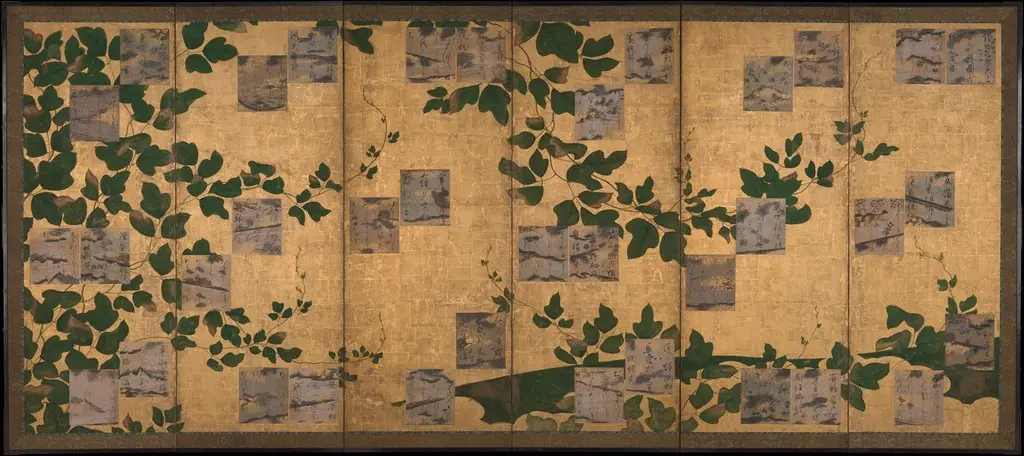 Anthology of Japanese and Chinese Poems (Wakan rōeishū) with Underpainting of Arrowroot Vines
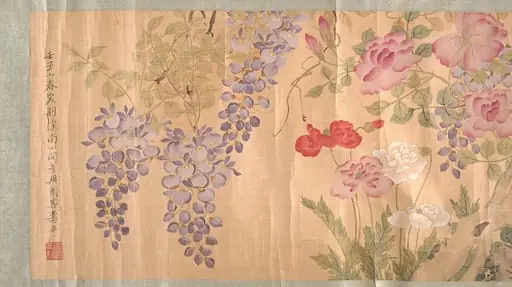 Untitled
 Blue and White Wisteria on a Bamboo Trellis
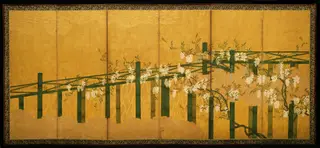 Blue and White Wisteria on a Bamboo Trellis
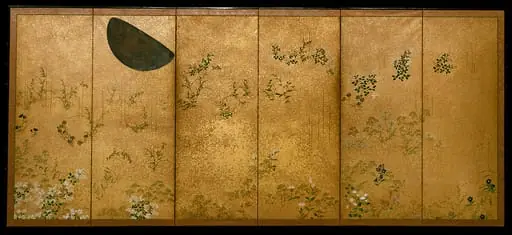 俵屋宗達工房 月に秋草図屏風|Moon and Autumn Grasses
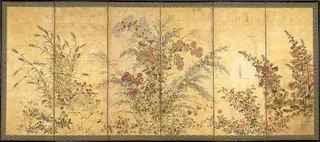 Flowers of All Seasons
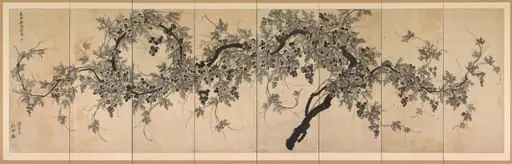 Grapevine
 柳橋水車図屏風|Willows and Bridge
 月に秋草図屏風|Autumn Grasses in Moonlight