Artwork
Untitled
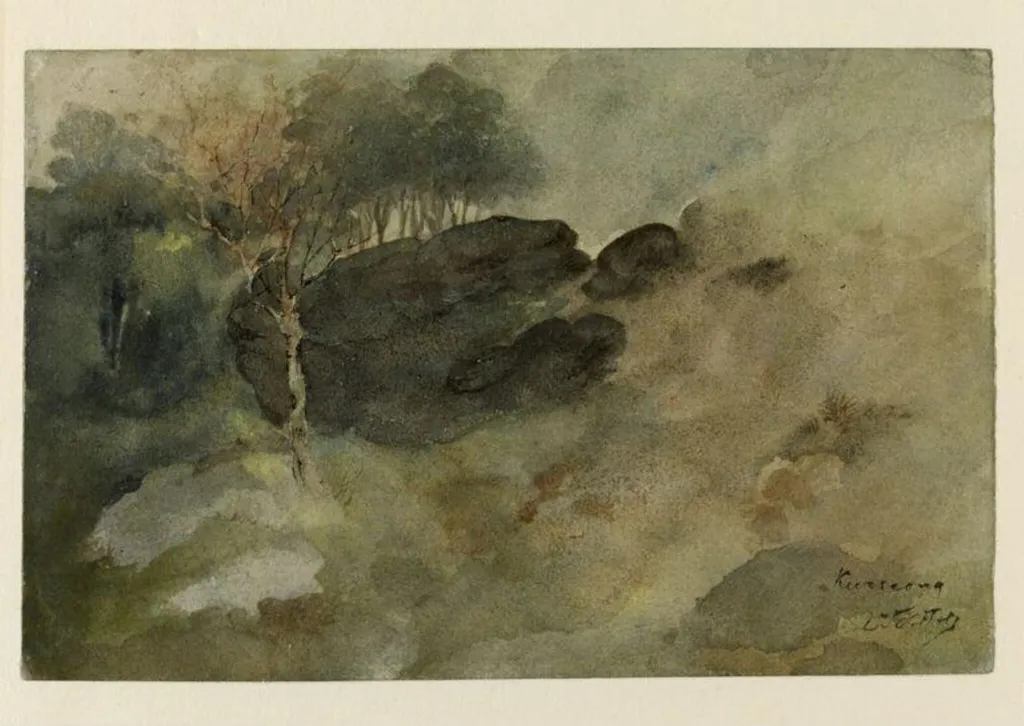
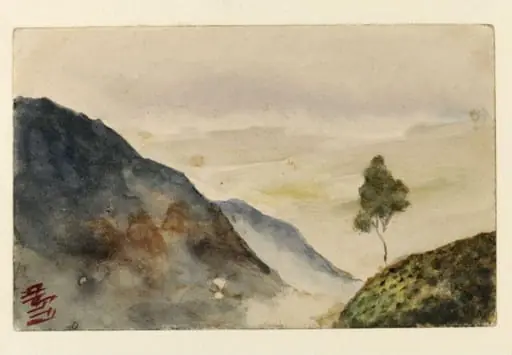
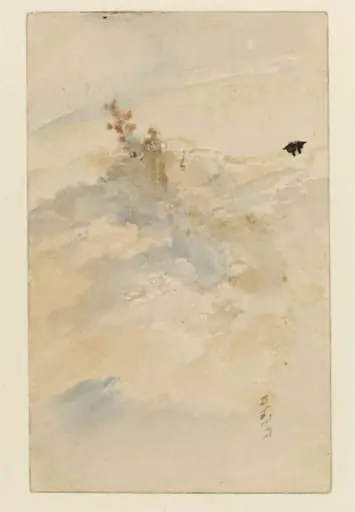
Untitled is a paint painting by the Bengal School artist Abanindranath Tagore. It dates from 1924 and is held in the collection of the Victoria and Albert Museum. This watercolor painting, executed on a postcard, captures a view of Kurseong near Darjeeling.
About this work
To see more of this gentle, sketch-like approach, look up the technique called sfumato.
This is a watercolor of rocky hills and trees in soft greys, greens, and browns. The scene looks like it was painted quickly, right on a postcard.
The artist sent it to a friend in 1924, writing a short note on the back. That makes it feel personal, like a snapshot, not a finished work. The loose, flowing style gives the landscape a quiet, dreamy mood.
To see more of this gentle, sketch-like approach, look up the technique called sfumato.
Overview
This watercolor painting, executed on a postcard, captures a view of Kurseong near Darjeeling. Created by Abanindranath Tagore in October 1924, it was mailed to a friend with a brief personal note. The work’s intimate scale and informal medium distinguish it from formal studio pieces, reflecting a spontaneous engagement with landscape rather than a commissioned or exhibited work.
Subject & Meaning
The scene presents a quiet, elevated view of rolling hills, scattered rocks, and sparse vegetation, rendered without focal emphasis or narrative detail. It conveys a sense of stillness and solitude, aligned with the artist’s broader interest in evoking spiritual tranquility through nature. The absence of human figures or dramatic elements reinforces a contemplative mood, consistent with his rejection of Western realism in favor of introspective aesthetics.
Technique & Style
Tagore employed a watercolor wash technique, layering translucent tones of grey, green, and brown to suggest depth and atmosphere. The brushwork is fluid and economical, with soft edges and minimal detail, echoing East Asian ink traditions he studied under Japanese mentors. This method avoids hard outlines, creating a hazy, atmospheric effect that dissolves boundaries between land, air, and light.
History & Provenance
The painting was sent as a postcard on October 10, 1924, addressed to Roop Krishna Esq., with a handwritten message expressing goodwill and gratitude. The postmark and note confirm its function as a personal correspondence, not an artwork intended for public display. Its survival as a physical artifact offers rare insight into Tagore’s private interactions and daily artistic practice beyond formal exhibitions.
Context
At the time, Tagore was leading the Bengal School’s effort to redefine Indian art by reviving pre-colonial visual languages. He integrated Japanese and Mughal techniques to distance Indian art from British academic conventions. This postcard exemplifies how his aesthetic principles, subtlety, restraint, and spiritual resonance, extended into everyday life, blurring the line between art and personal expression.
Legacy
Though modest in scale, this work reflects a broader shift in early 20th-century Indian art toward intimate, non-institutional forms of expression. Its preservation underscores how Tagore’s influence permeated personal networks, not just public galleries. The piece remains a quiet testament to the role of correspondence in disseminating new artistic sensibilities beyond formal training institutions.
Own this work as a print
Artist & collection

Artist
Abanindranath Tagore was an Indian painter who was the principal artist and creator of the Indian Society of Oriental Art in 1907.