Artwork
Mountain scene at Kurseong
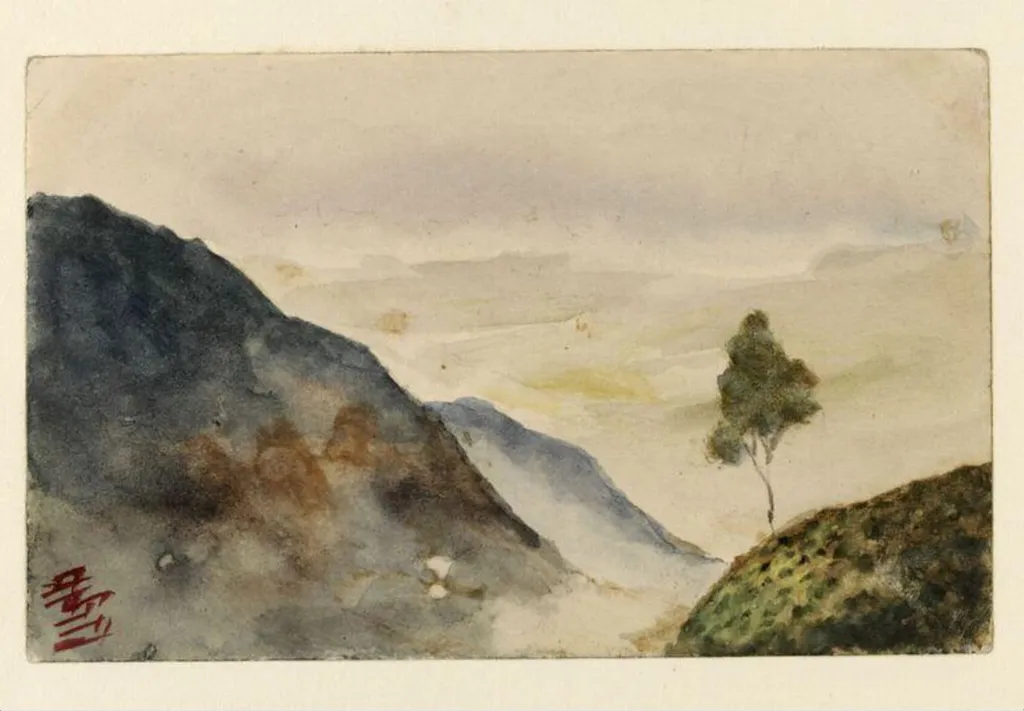
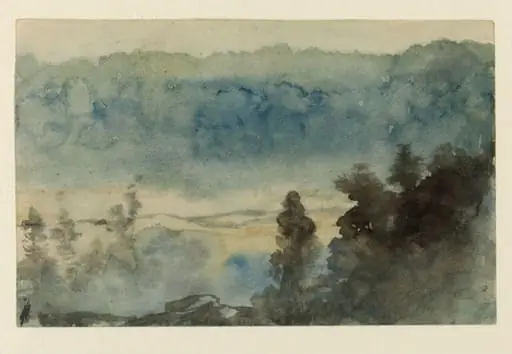
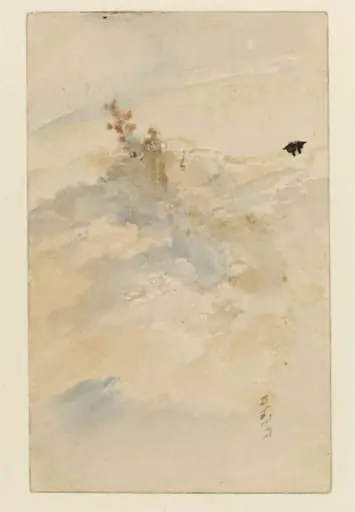
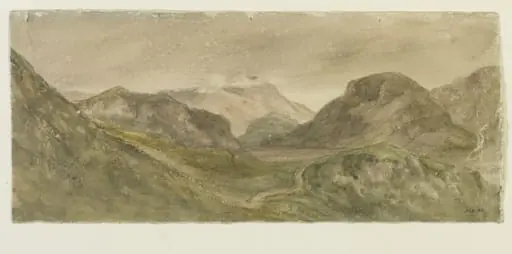
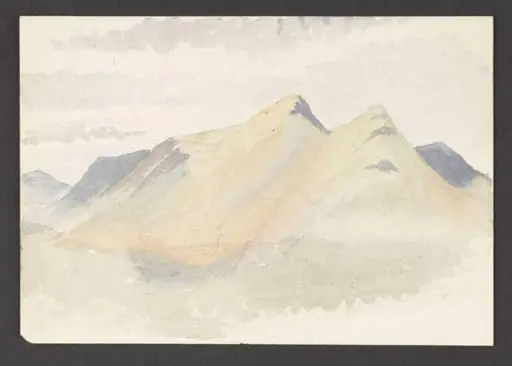
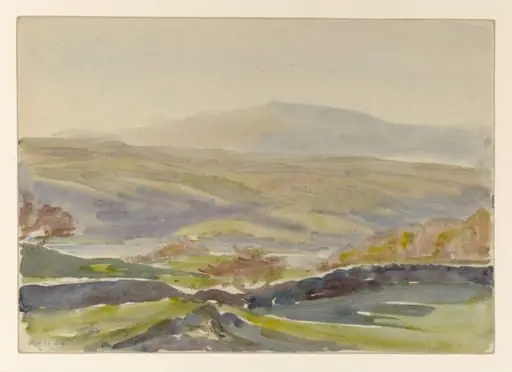
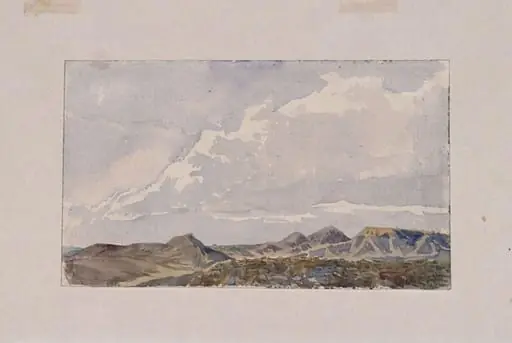
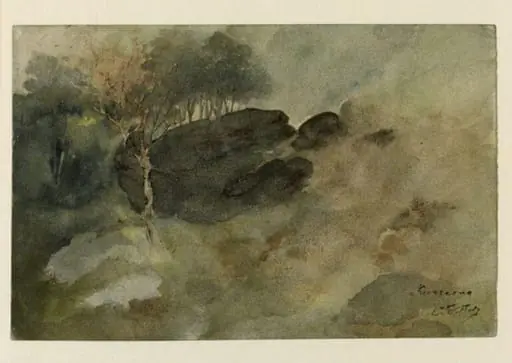
Mountain scene at Kurseong is a paint painting by the Bengal School artist Abanindranath Tagore. It dates from 1920 and is held in the collection of the Victoria and Albert Museum. This watercolor painting, executed on a postcard, captures a quiet mountain view from a hotel room in Kurseong, near Darjeeling.
About this work
Overview
This watercolor painting, executed on a postcard, captures a quiet mountain view from a hotel room in Kurseong, near Darjeeling.
This watercolor painting, executed on a postcard, captures a quiet mountain view from a hotel room in Kurseong, near Darjeeling. Created by Abanindranath Tagore, it reflects his engagement with East Asian aesthetic principles during a period when he was redefining Indian art beyond colonial academic styles. The work’s modest scale and ephemeral quality suggest a personal, spontaneous moment rather than a formal composition.
Subject & Meaning
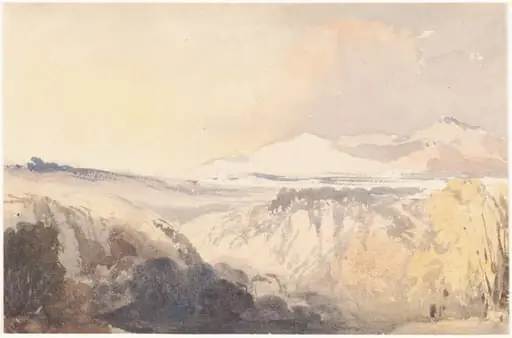
The scene presents a hazy, receding landscape of blue-tinged hills and sparse trees, rendered with minimal detail to evoke stillness and distance. It is not a topographic record but a meditative impression, conveying the atmosphere of solitude and transience. The inclusion of a personal letter indicates the painting functioned as a tactile extension of correspondence, bridging emotional and physical separation.
Technique & Style
Tagore employed a watercolor wash technique, allowing the paper’s texture to show through and softening edges between forms. This method, influenced by Japanese ink painting, emphasizes atmosphere over definition. The faint, layered pigments create a sense of depth through subtlety rather than contrast.
The red Japanese inscription, meaning 'drawn by,' signals his deliberate adoption of East Asian conventions as an alternative to Western realism.
History & Provenance
The painting was mailed to Roop Krishna in April, likely 1908, accompanied by a brief note referencing companionship, illness, and personal updates. Its survival as a mailed object underscores its role in intimate communication rather than public display. The postmark’s incomplete date and fragile paper reflect its journey through postal systems, preserving the work as both artifact and letter.
Context
At the time, Tagore was leading the Bengal School’s effort to revive indigenous Indian artistic traditions in opposition to British academic norms. His study of Japanese art with Taikoan and Hilsida introduced him to ink wash techniques, which he adapted to express spiritual and natural themes. This work exemplifies how cross-cultural exchange informed a new, nationally resonant visual language.
Legacy
Though small and privately circulated, such works helped establish a distinct Indian modernism rooted in Asian aesthetics rather than European models. Tagore’s use of wash, calligraphic signature, and poetic restraint influenced generations of artists seeking to decolonize Indian art. The postcard format itself became a quiet testament to art’s capacity to exist beyond institutional frameworks.
Own this work as a print
Artist & collection

Artist
Abanindranath Tagore was an Indian painter who was the principal artist and creator of the Indian Society of Oriental Art in 1907.