Artwork
The third suitor, who is an archer, shoots the wicked fairy who has imprisoned Zuhra. He rides on a magic horse prepared by the second suitor and is led to the spot by the divining prowess of the first, from a Tuti-nama (Tales of a Parrot): Thirty-fo
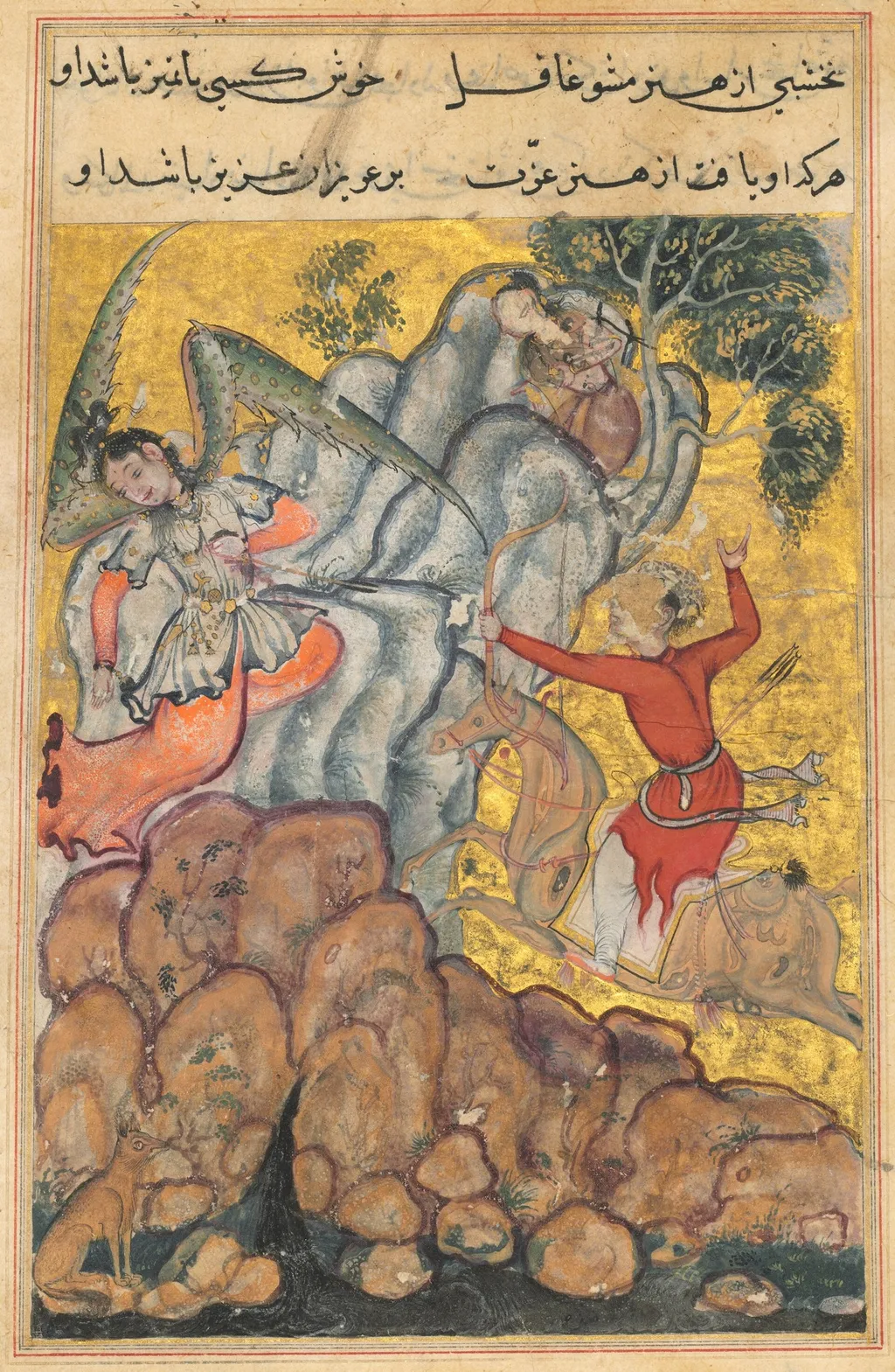
The third suitor, who is an archer, shoots the wicked fairy who has imprisoned Zuhra. He rides on a magic horse prepared by the second suitor and is led to the spot by the divining prowess of the first, from a Tuti-nama (Tales of a Parrot): Thirty-fo is an unspecified painting. It dates from 1560 and is held in the collection of the Cleveland Museum of Art. The work depicts a nocturnal combat tableau drawn from a narrative in the Persian illustrated manuscript Tuti‑nama (Tales of a Parrot).
About this work
Subject & Meaning
The central iconography features an archer mounted on a magic horse, an animal prepared by the second suitor, as he shoots a wicked fairy.
The painting illustrates a narrative episode from the Tuti-nama (Tales of a Parrot), specifically depicting the third suitor rescuing the imprisoned princess Zuhra. The central iconography features an archer mounted on a magic horse, an animal prepared by the second suitor, as he shoots a wicked fairy. The composition also incorporates the divining prowess of the first suitor, who guides the rider to the precise location of the captive.
Created within the Mughal Empire around 1560, the work represents a moment of heroic intervention and magical cooperation among the suitors to overcome supernatural imprisonment and restore the princess to freedom.
History & Provenance
This painting, created in 1560 within the Mughal Empire, illustrates a scene from the Tuti-nama (Tales of a Parrot) depicting the third suitor shooting a wicked fairy. The work is attributed to an unknown artist and was produced during the mid-16th century. It is currently held in the collection of the Cleveland Museum of Art, where it is cataloged under the accession number 1962.279.226.a.
The painting is held in the collection of the Cleveland Museum of Art, where it is cataloged under accession number 1962.279.226.a. It was created in 1560 within the Mughal Empire and has not been documented in any major exhibition history according to the available record.
Overview
The work depicts a nocturnal combat tableau drawn from a narrative in the Persian illustrated manuscript Tuti‑nama (Tales of a Parrot). Central to the scene is an archer, identified as the third suitor, who releases an arrow at a winged, grey monster that represents a malevolent fairy imprisoning the heroine Zuhra. The composition is crowded with rocks, trees and a dark sky, rendered in vivid, saturated hues.
Technique & Style
Executed in a bold palette, the artist employs strong contrasts of red, white and grey to emphasize the conflict. The figures are outlined with fluid lines, and the night setting is suggested by a deep, uniform sky. The script at the top, rendered in an Arabic‑style calligraphy, integrates text and image in the traditional illustrated manuscript fashion.
Context
In the Tuti‑nama, the tale of the three suitors and the captive Zuhra serves as an allegory of perseverance and cleverness. The archer’s triumph over the fairy underscores themes of heroic virtue and the power of magical assistance, common motifs in Persian narrative art.
Artist & collection

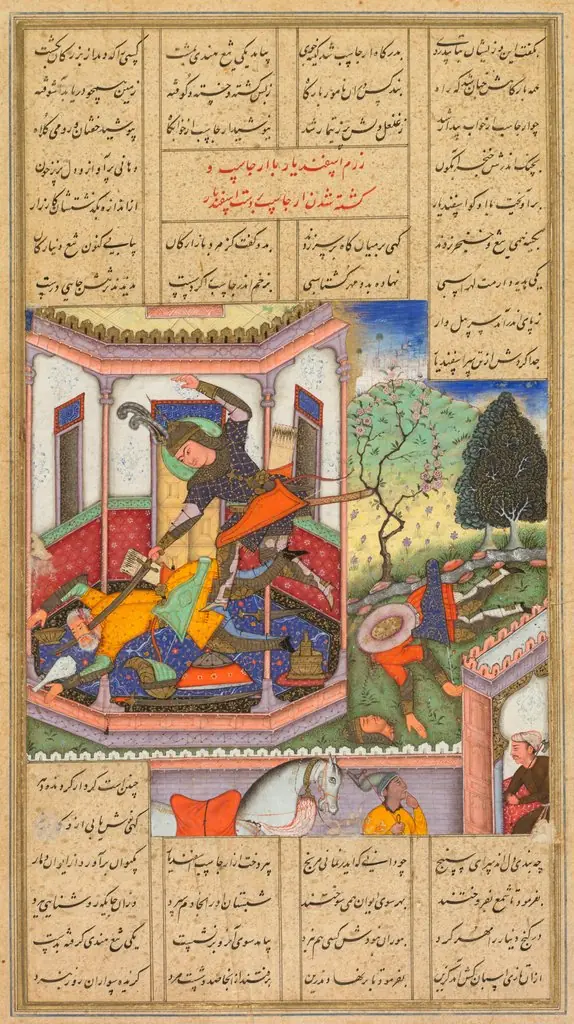 Isfandiyar slays Arjasp, the king of Turan, from a Shah-nama (Book of Kings) of Firdausi (Persian, about 934–1020)
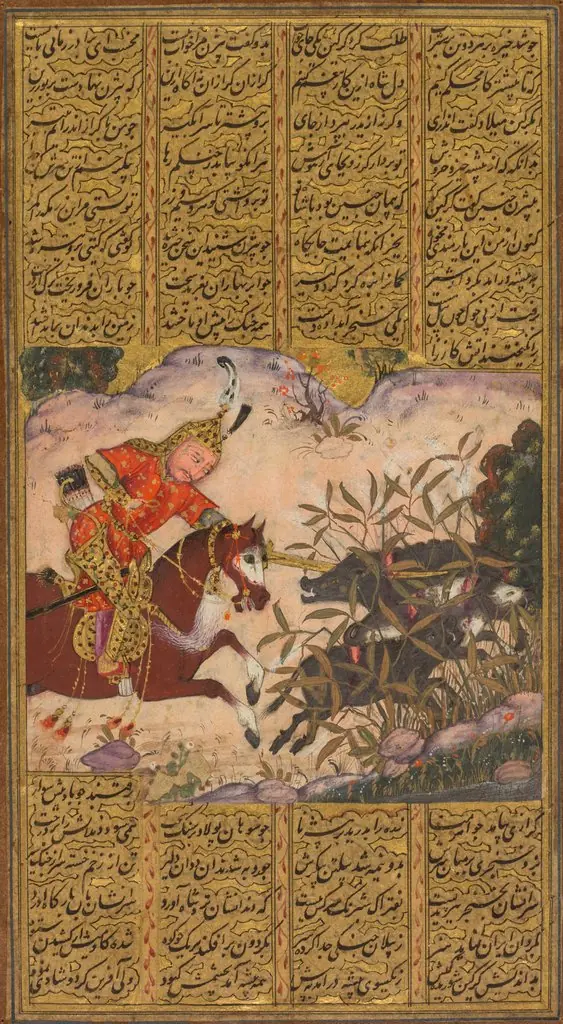 Bijan killing the wild boars of Irman, from a Shah-nama (Book of Kings) of Firdausi (Persian, about 934–1020)
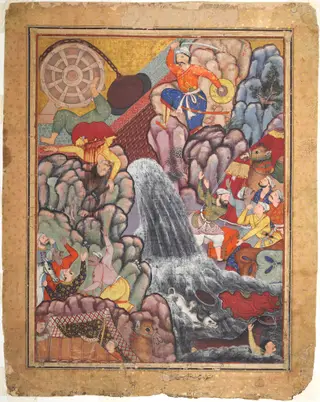 Alamshah cleaving asunder the chain of the wheel, from volume 11 of a Hamza-nama (Adventures of Hamza)
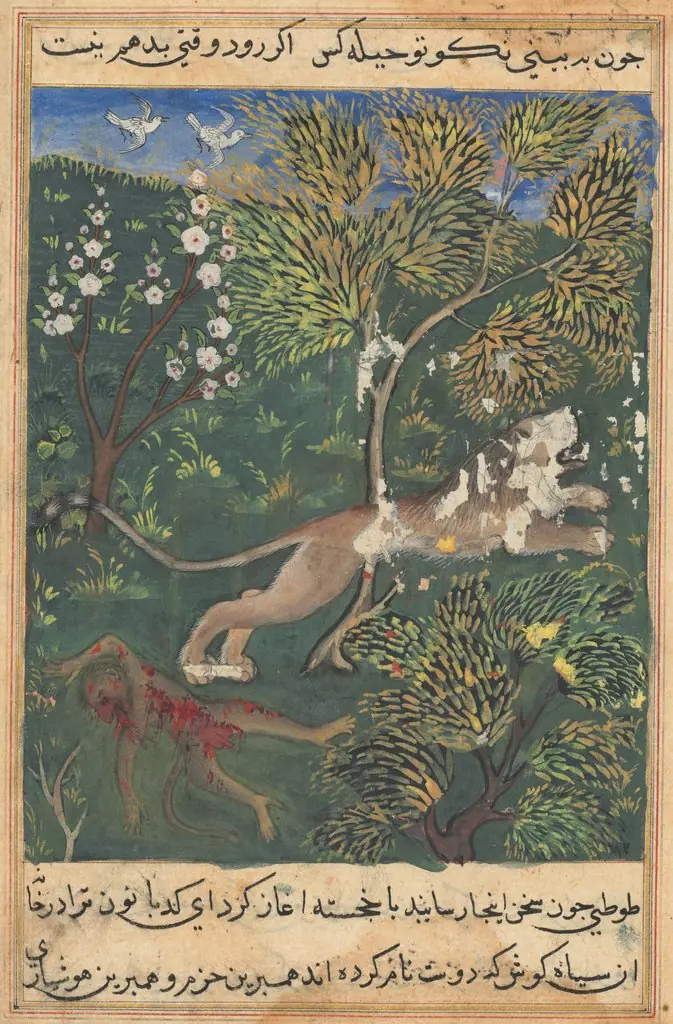 The lion, suspecting treachery on the part of the monkey, slays him and flees, from a Tuti-nama (Tales of a Parrot): Twenty-ninth Night
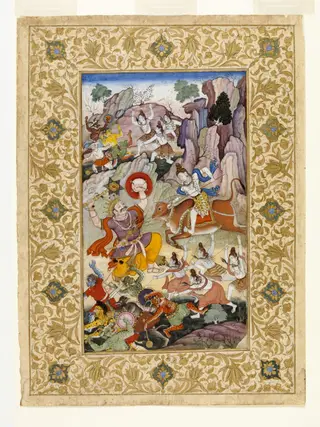 Shiva and Andhaka
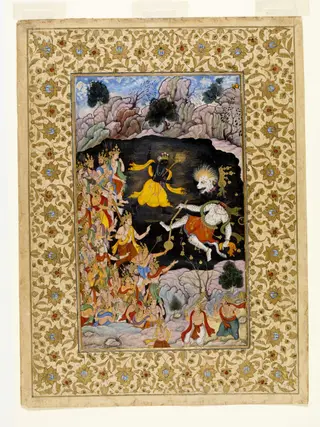 Krishna and Nikumba
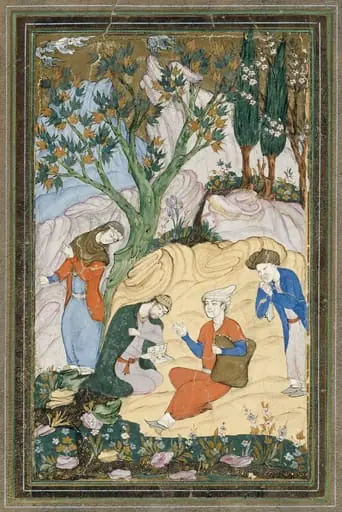 Nuori ruhtinas seurueineen maisemassa, persialainen miniatyyri
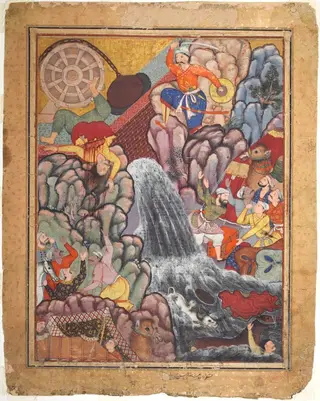 Alamshah cleaving asunder the chain of the wheel, from volume 11 of a Hamza-nama (Adventures of Hamza)
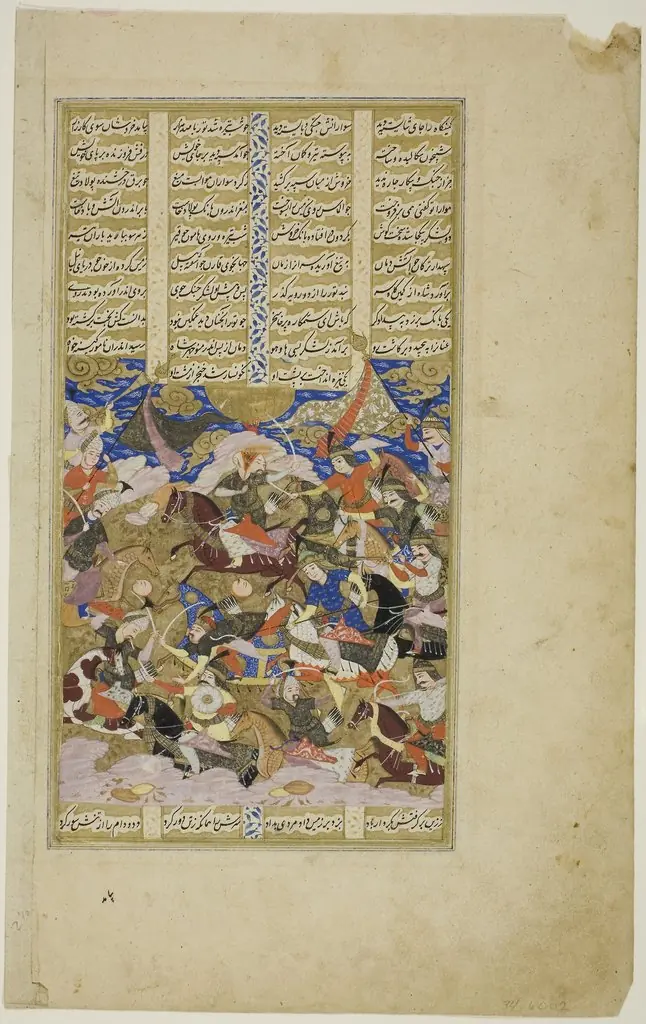 Manuchehr Kills Tur, Manuscript from Shahnama
- The third suitor, who is an archer, shoots the wicked fairy who has imprisoned Zuhra. He rides on a magic horse prepared by the second suitor and is led to the spot by the divining prowess of the first, from a Tuti-nama (Tales of a Parrot): Thirty-fourth Night
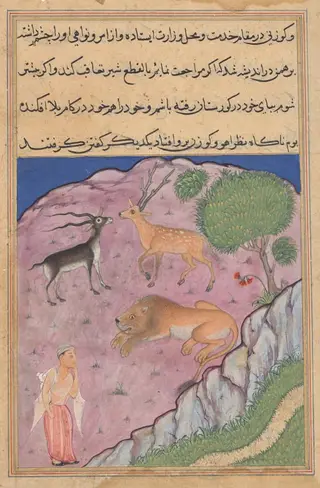 The Brahman comes upon a lion who has a deer and a gazelle as his viziers, from a Tuti-nama (Tales of a Parrot): Twenty-first Night
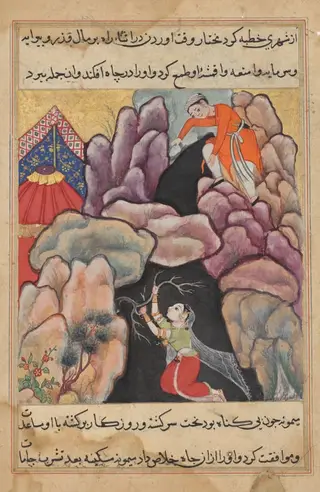 Mukhtar throws his wife Maimuna into the pit, but she saves herself, from a Tuti-nama (Tales of a Parrot): Twenty-fifth Night