Artwork
Vertumnus and Pomona
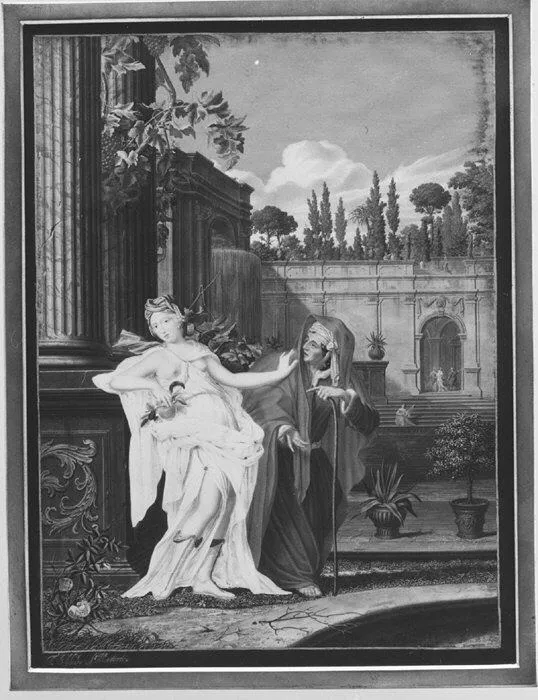
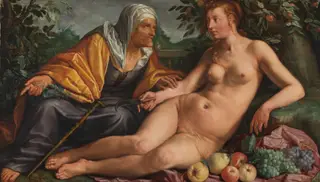
Vertumnus and Pomona is an unspecified painting by the French Classical Baroque artist Thomas Lefèbvre. It dates from 1688 and is held in the collection of the Metropolitan Museum of Art.
About this work
In a garden set against a tall stone wall, columns, and trees under a part-cloudy sky, a woman in flowing robes holds a basket of fruit while an older man in dark clothes points toward her. Her calm face plays against his stern gesture. Thomas Lefèbvre painted the scene in 1688 as a quiet moment held still.
History & Provenance
Classified as a work of mythological painting, the piece depicts the subjects Vertumnus and Pomona within a garden setting alongside a woman.
The mythological painting Vertumnus and Pomona was created by Thomas Lefèbvre in 1688. Classified as a work of mythological painting, the piece depicts the subjects Vertumnus and Pomona within a garden setting alongside a woman. The artwork measures 172 cm in height and 126 cm in width.
Currently, the painting is held in the collection of the Metropolitan Museum of Art. While the specific commission details and earlier ownership chain are not detailed in the available records, the work's inception is dated to 1688, marking its creation in the late 17th century.
Context
Vertumnus and Pomona (1688) is a mythological painting by Thomas Lefebvre, depicting the garden encounter of the god Vertumnus and the nymph Pomona. Classified within the mythology genre, the work exemplifies the artist's focus on classical subjects drawn from literary sources. It is part of the Metropolitan Museum of Art's collection, illustrating the museum's acquisition of 17th-century French mythological paintings.
The painting's composition and subject matter situate it within the broader tradition of mythological art in European visual culture.
Overview
Thomas Lefèbvre's painting, titled Vertumnus and Pomona, was completed in 1688. This mythological work depicts a scene set within a garden, featuring the two titular figures from Roman mythology. The artwork is currently part of the collection at The Metropolitan Museum of Art, where it offers a glimpse into late 17th-century French painting traditions and narrative art.
Subject & Meaning
The painting illustrates an episode from Ovid's Metamorphoses, focusing on the Roman deities Vertumnus, god of seasons and change, and Pomona, goddess of fruit trees and orchards. Pomona is shown holding a basket of fruit, dressed in flowing garments, while an older man, Vertumnus, gestures towards her. Their interaction, set against a backdrop of classical architecture and lush trees, captures a specific moment in their courtship narrative, characterized by a contrast between their expressions.
Technique & Style
Lefèbvre employs a dramatic interplay of light and shadow, known as chiaroscuro, to enhance the emotional depth and visual impact of the scene. The figures are rendered with attention to drapery and expression, particularly the woman's calm demeanor against the man's more assertive gesture. The composition, featuring a tall stone wall, columns, and a partly cloudy sky, contributes to a sense of a quiet, yet theatrically frozen, moment in time, characteristic of Baroque narrative painting.
Artist & collection
Artist
Thomas Lefèbvre (1636–1720) was an artist, born in Brussels metropolitan area.