Artwork
작자미상 화조도 조선|作者未詳 花鳥圖 朝鮮|Golden Rooster and Hen
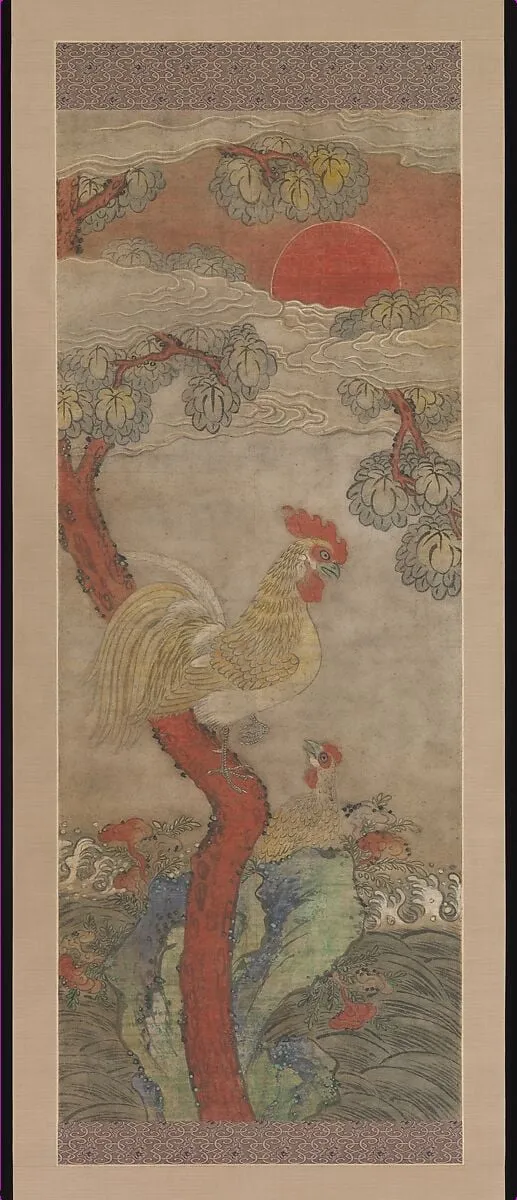
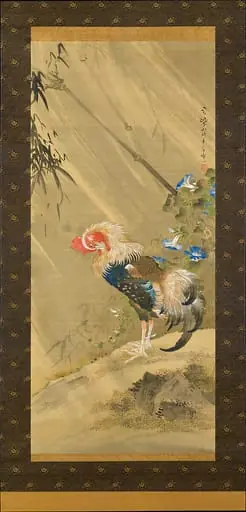
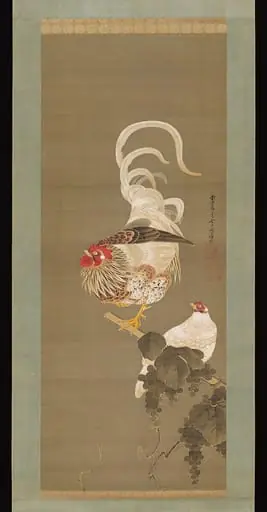
작자미상 화조도 조선|作者未詳 花鳥圖 朝鮮|Golden Rooster and Hen is an ink painting. It dates from 1900 and is held in the collection of the Metropolitan Museum of Art. The painting, titled Golden Rooster and Hen, is an early 19th-century work from Korea's Joseon dynasty.
About this work
Subject & Meaning
The composition is further enriched by ten symbols of longevity: the sun, mountains, rocks, clouds, pine trees, turtles, cranes, deer, and mushrooms.
The painting unites two foundational themes of Korean painting, birds-and-flowers (hwajo), through a central pairing of a rooster perched on a tree and a hen standing on a rock. In traditional Chinese culture, which influenced neighboring Asian societies, the rooster was regarded as a moral animal of excellent qualities, a notion that carried into Joseon-era art alongside other auspicious creatures such as the tiger, dragon, crane, and deer. The composition is further enriched by ten symbols of longevity: the sun, mountains, rocks, clouds, pine trees, turtles, cranes, deer, and mushrooms.
Together, the cock-and-hen pairing signifies fortune and the future, while the surrounding longevity motifs frame the scene as a wish for enduring prosperity and well-being.
History & Provenance
The painting Golden Rooster and Hen (작자미상 화조도 조선) was created by an unknown artist during the Joseon dynasty, with a consensus dating it to the early 19th century, though precise documentation is lacking []. The work entered the collection of the Metropolitan Museum of Art in 1919 as a donation from the Rogers Foundation []. Prior to this acquisition, no verifiable ownership records or commission details have been documented.
Between 1984 and 2015, the painting was loaned for exhibition seven times across multiple U.S. cities, including New York, New Orleans, Honolulu, San Francisco, Tulsa, and Los Angeles [].
The painting is held in the collection of the Metropolitan Museum of Art in New York. It entered the museum in 1919 as a gift from the Rogers Foundation. Since then it has been loaned for exhibition seven times between 1984 and 2015: at the Asia Society Gallery in New York (Dec 8 1983–Jan 22 1984), the New Orleans Museum of Art (Feb 11–Mar 25 1984), the Honolulu Museum of Art (Apr 14–May 27 1984), the Asian Art Museum of San Francisco (Jun 15–Jul 29 1984), the Philbrook Art Center in Tulsa (Aug 18–Oct 14 1984), and the Los Angeles County Museum of Art (Nov 8 1984–Jan 6 1985).
Context
The painting, attributed to an unknown Joseon‑dynasty artist, exemplifies the Korean bird‑and‑flower (hwajodo) tradition while incorporating the ten traditional symbols of longevity, sun, mountains, rocks, clouds, pine trees, turtles, cranes, deer and mushrooms, that were favored in Joseon auspicious imagery. By depicting a golden rooster and hen perched on a tree and rock, the work links the Korean reverence for fortunate creatures such as tigers, dragons, cranes and deer to broader East Asian auspicious symbolism. Held by the Metropolitan Museum of Art since its 1919 Rogers Foundation donation, the scroll has been lent for seven exhibitions across the United States between 1984 and 2015, attesting to its enduring role in the presentation of Korean folk art abroad.
Legacy
The later influence of Golden Rooster and Hen has been shaped by its display history and institutional prominence. Between 1984 and 2015, the painting was lent for exhibition seven times across major U.S. cities, including New York, New Orleans, Honolulu, San Francisco, Tulsa, and Los Angeles, often within Korean folk art presentations at museums such as the Metropolitan Museum of Art and the Honolulu Museum of Art. These loans reflect its sustained recognition as a representative example of Joseon-period bird-and-flower painting, reinforcing its legacy within Korean art discourse.
Its inclusion in such traveling exhibitions has contributed to its reputation as a culturally significant work, particularly in contexts emphasizing traditional Korean symbolism and longevity motifs. The painting’s presence in the Metropolitan Museum of Art’s collection since 1919, following its donation by the Rogers Foundation, further solidifies its legacy as a key example of late Joseon decorative art.
Overview
The painting, titled Golden Rooster and Hen, is an early 19th-century work from Korea's Joseon dynasty. Executed in ink and color on paper as a hanging scroll, its creator remains unidentified. The artwork combines the traditional Korean painting themes of birds and flowers, alongside various symbols of longevity.
It is currently housed in the collection of the Metropolitan Museum of Art in New York. The painted area measures 114.3 cm high by 45.7 cm wide.
Technique & Style
Rendered with ink and color on paper, the artwork showcases meticulous brushwork, particularly evident in the detailed rendering of the birds' plumage. The feathers are depicted using fine strokes and a palette of soft golds and browns, creating a textured and lifelike appearance. The artist chose a plain background, which allows the vibrant figures of the rooster and hen to stand out prominently within the composition of this hanging scroll.
Artist & collection