Artwork
唐/五代 菩薩圖|Banner with Bodhisattva, possibly Mahamayuri
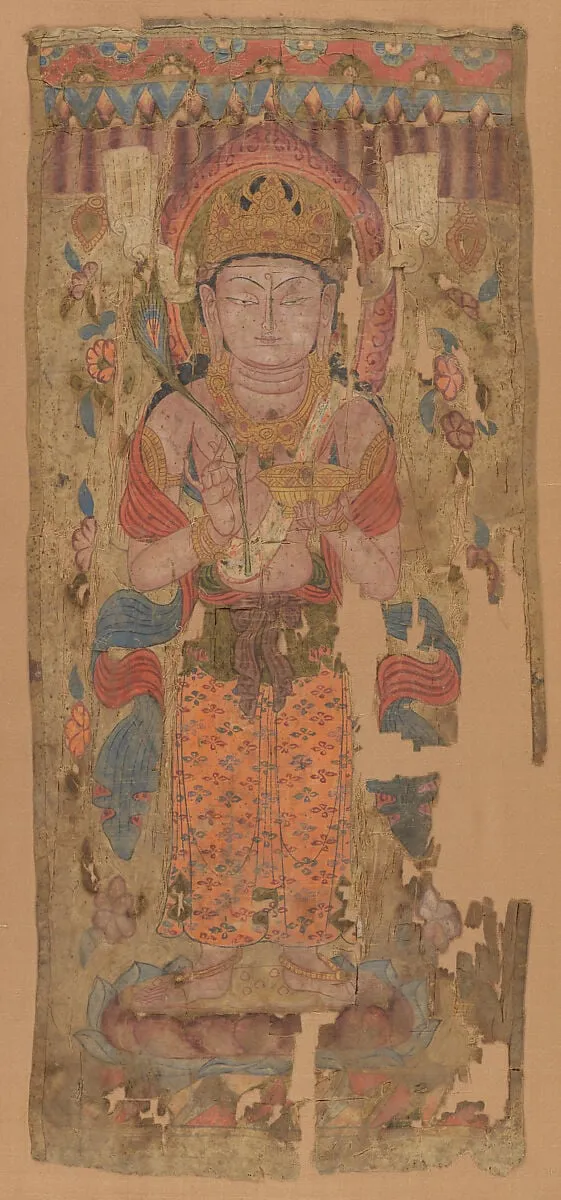
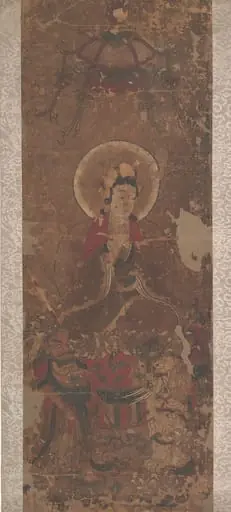
唐/五代 菩薩圖|Banner with Bodhisattva, possibly Mahamayuri is an ink painting. It dates from 900 and is held in the collection of the Metropolitan Museum of Art. This painting, titled Banner with Bodhisattva, possibly Mahamayuri, is rendered with ink and pigment on silk.
About this work
Subject & Meaning
The narrow vertical format, measuring approximately 57 by 28 centimeters, is consistent with banners used as objects of veneration or ritual focus.
The banner depicts a Bodhisattva, with the work possibly representing Mahamayuri, a bodhisattva associated in Buddhist tradition with protection against snake venom and the recitation of sutras. Rendered in ink and pigment on silk, the painting belongs to the religious genre and portrays both a Bodhisattva and a Buddha figure, indicating a devotional function within a Buddhist context. The narrow vertical format, measuring approximately 57 by 28 centimeters, is consistent with banners used as objects of veneration or ritual focus.
The identification as possibly Mahamayuri suggests the figure may carry iconographic attributes linked to wisdom, eloquence, and protection, though specific attributes are not detailed in the available documentation. Held in the Metropolitan Museum of Art, the work reflects the religious painting traditions of Tang and Five Dynasties China, where bodhisattva imagery served both devotional and didactic purposes for practitioners.
Technique & Style
Executed during the ninth or tenth century in China, this religious banner depicts a Bodhisattva, potentially Mahamayuri, alongside a Buddha figure. The work utilizes ink and mineral pigments applied directly onto a silk support, a standard medium for portable devotional paintings of the Tang and Five Dynasties periods. The object functions as a hanging banner, characterized by its vertical orientation with dimensions of approximately 57 cm in height and 28 cm in width.
While the specific handling history and current physical condition are not detailed in the available records, the classification as a painting on silk indicates a delicate surface requiring careful preservation. The stylistic approach aligns with anonymous religious art produced for ritual use, focusing on iconic representation rather than individual artistic signature.
History & Provenance
The banner depicting a Bodhisattva, possibly Mahamayuri, was created in China during the 9th to 10th centuries, corresponding to the Tang or Five Dynasties period. Executed in ink and pigment on silk by an anonymous artist, the work is classified as a religious painting. While the specific commission details and original ownership chain are not documented in the available records, the piece eventually entered the collection of the Metropolitan Museum of Art in New York.
The artwork remains attributed to an unknown painter, reflecting the common practice of anonymous religious art production in medieval China. Its current location is confirmed at the Metropolitan Museum of Art, where it is maintained as part of their holdings of Chinese paintings.
The banner depicting a Bodhisattva, possibly Mahamayuri, is held in the collection of the Metropolitan Museum of Art in New York. Created during the ninth or tenth century in China, this ink and pigment work on silk measures 57 by 28 centimeters. While the piece is attributed to an anonymous painter and classified within the museum's paintings department, the available records do not specify a distinct inventory or accession number for the object.
Furthermore, no information regarding specific past exhibitions or loan history for this banner is provided in the current documentation.
Context
The banner, dated to the 9th–10th century, is an ink and pigment painting on silk housed in the Metropolitan Museum of Art. It portrays a Bodhisattva, possibly Mahamayuri, consistent with the religious iconography of the period. The attribution to an anonymous painter reflects the workshop practice common in Tang and Five Dynasties Buddhist art.
As a religious painting in a major Western collection, it illustrates the transmission of Chinese Buddhist visual culture beyond its original context.
Overview
This painting, titled Banner with Bodhisattva, possibly Mahamayuri, is rendered with ink and pigment on silk. Dating from the Tang or Five Dynasties period, over a millennium ago, it depicts a benevolent Buddhist figure. The artwork originated from the renowned Dunhuang cave complex, a significant site along the historic Silk Road. Despite its age, the banner retains remarkable vibrancy, offering insight into the artistic traditions of its era.
Artist & collection

 Untitled
 Shakyamuni with the Sixteen Benevolent Deities
 Untitled
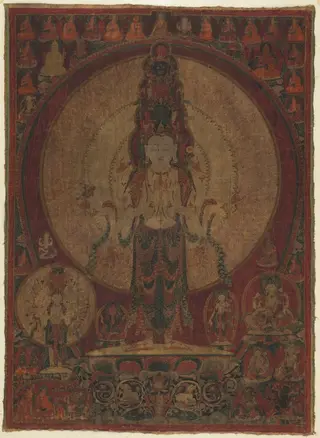 Eleven-Headed, Thousand-Armed Bodhisattva of Compassion (Avalokiteshvara)
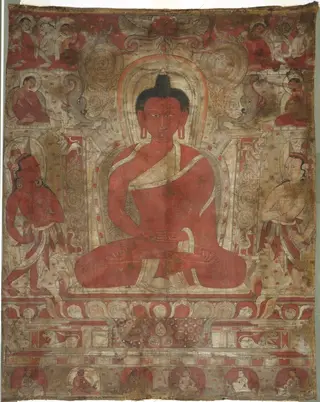 Seated Amitabha with Attendants
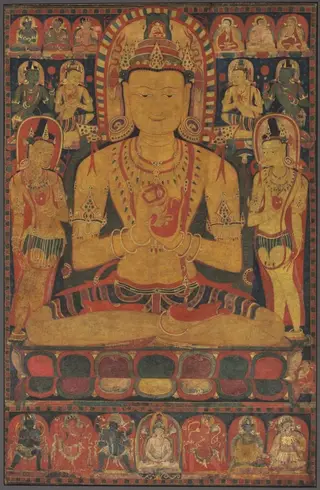 Tantric Buddha Vairochana as Vajrasattva
 Buddha
 十二天像(梵天)|One of the Twelve Devas: Bonten
 Kuan-Yin and Two Attendants
 龍湫周沢写 不動明王二童子像|Fudō Myōō and Two Attendants