Artwork
龍湫周沢写 不動明王二童子像|Fudō Myōō and Two Attendants
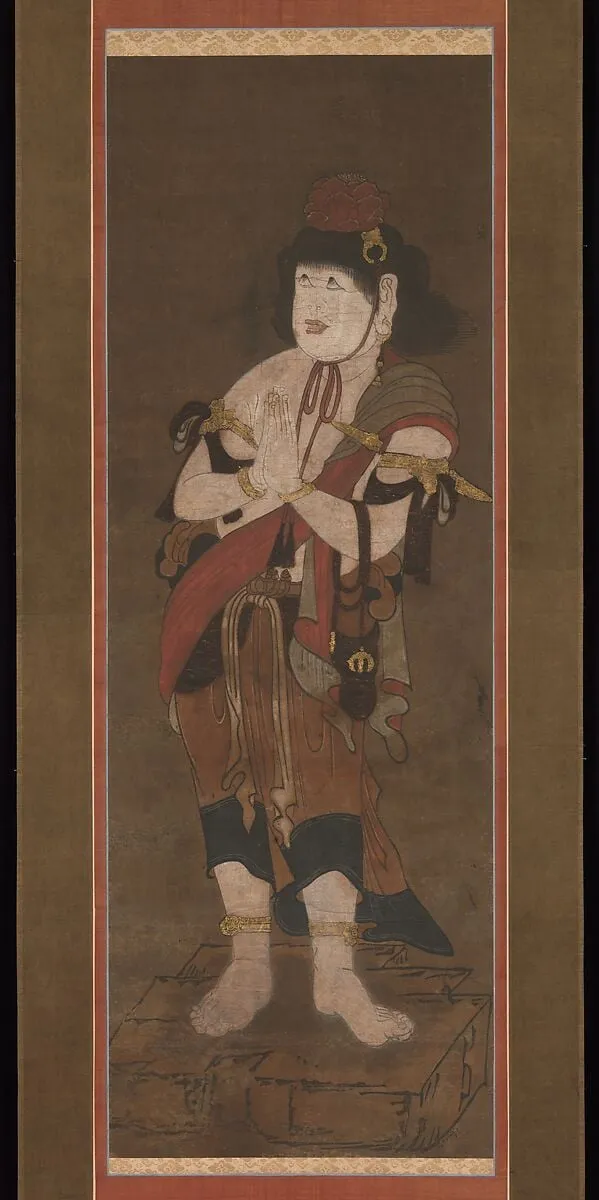
龍湫周沢写 不動明王二童子像|Fudō Myōō and Two Attendants is an ink painting by the Joseon dynasty painting artist Ryūshū Shūtaku. It dates from 1362 and is held in the collection of the Metropolitan Museum of Art.
About this work
Subject & Meaning
Together, the trio embodies the esoteric Buddhist ideal of transcending ignorance through both wrath and compassion.
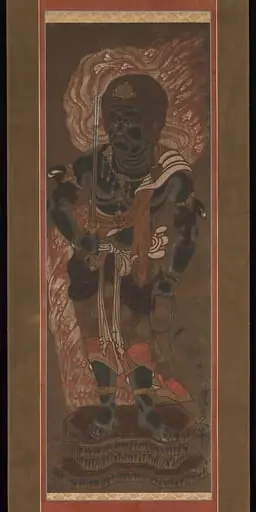
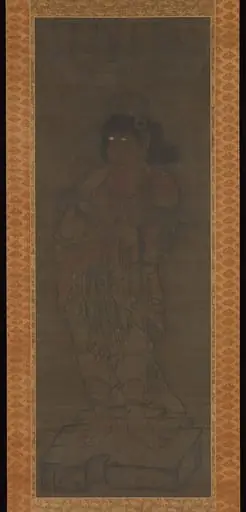
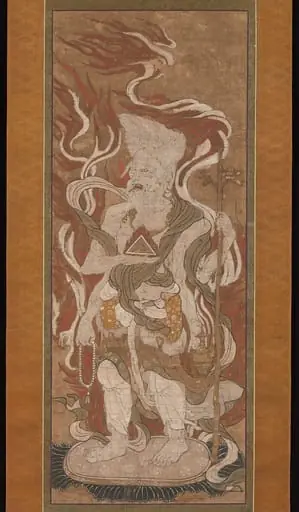
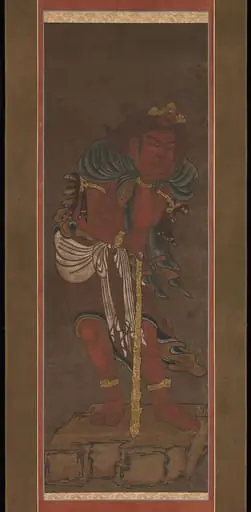
The hanging scroll depicts Fudō Myōō, the immovable wisdom king, flanked by two youthful attendants. Fudō is shown with a wrathful expression, blue-black skin, and a sword of wisdom in his right hand, while flames erupt around his body to signify the burning away of illusion. The two attendant boys, typically identified as Kongara and Seitaka, stand in reverent poses, one holding a vajra and the other a jewel, reinforcing their roles as subduers of evil and bringers of protection.
Their youthful forms contrast with Fudō’s fierce mien, creating a dynamic hierarchy of power and devotion. Together, the trio embodies the esoteric Buddhist ideal of transcending ignorance through both wrath and compassion.
Technique & Style
The work is a hand-coloured woodblock print executed on paper and mounted as one of a triptych of hanging scrolls. The medium combines relief-cut blocks for outlines and flat colour areas with subsequent application of mineral pigments to achieve the gilt haloes, flame nimbus, and drapery patterns. Stylistically the figures are rendered with bold contour lines and flat, unmodulated colour fields, while the fierce Fudō Myōō is shown frontally with a sword and lasso, flanked by two youthful attendants. The print’s crisp lines and saturated hues reflect the period’s revival of Esoteric Buddhist iconography.
History & Provenance
Created in 1362 in Japan, this hand-colored woodblock print on paper depicts Fudō Myōō with two attendants and was executed by the artist Ryūshū Shūtaku, also known as Myōtaku. It functions as one panel within a larger triptych of hanging scrolls dedicated to religious subjects and is held in the collection of the Metropolitan Museum of Art as an example of fourteenth-century Buddhist art. No details regarding the original commissioning body or the intermediate ownership chain are provided in the available records, which also specify no accession number or exhibition history for the piece.
Overview
This artwork, titled Fudō Myōō and Two Attendants, is a hand-colored woodblock print on paper, originally part of a triptych of hanging scrolls. It depicts a formidable blue-skinned deity seated on a rock, enveloped by flames, holding a sword and a rope. Two youthful attendants accompany the central figure, one displaying a serene expression and the other a scowl.
Context
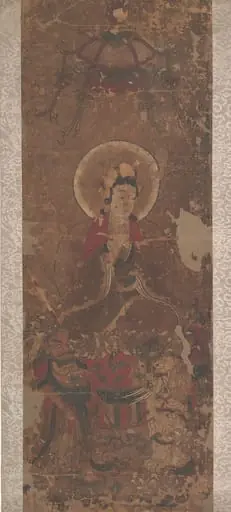
As one component of a triptych, this print illustrates a common approach to depicting Buddhist deities in Japanese art. Such works were instrumental in visualizing spiritual concepts and figures for a broad audience. The representation of Fudō Myōō and his attendants aligns with established iconographic traditions for portraying divine protectors within the Japanese Buddhist pantheon.
Artist & collection

Artist
Ryūshū Shūtaku, a Zen monk, walked Kyoto's backstreets in worn robes, sketching gods on scraps of paper between temple duties.