Artwork
Ecce Homo
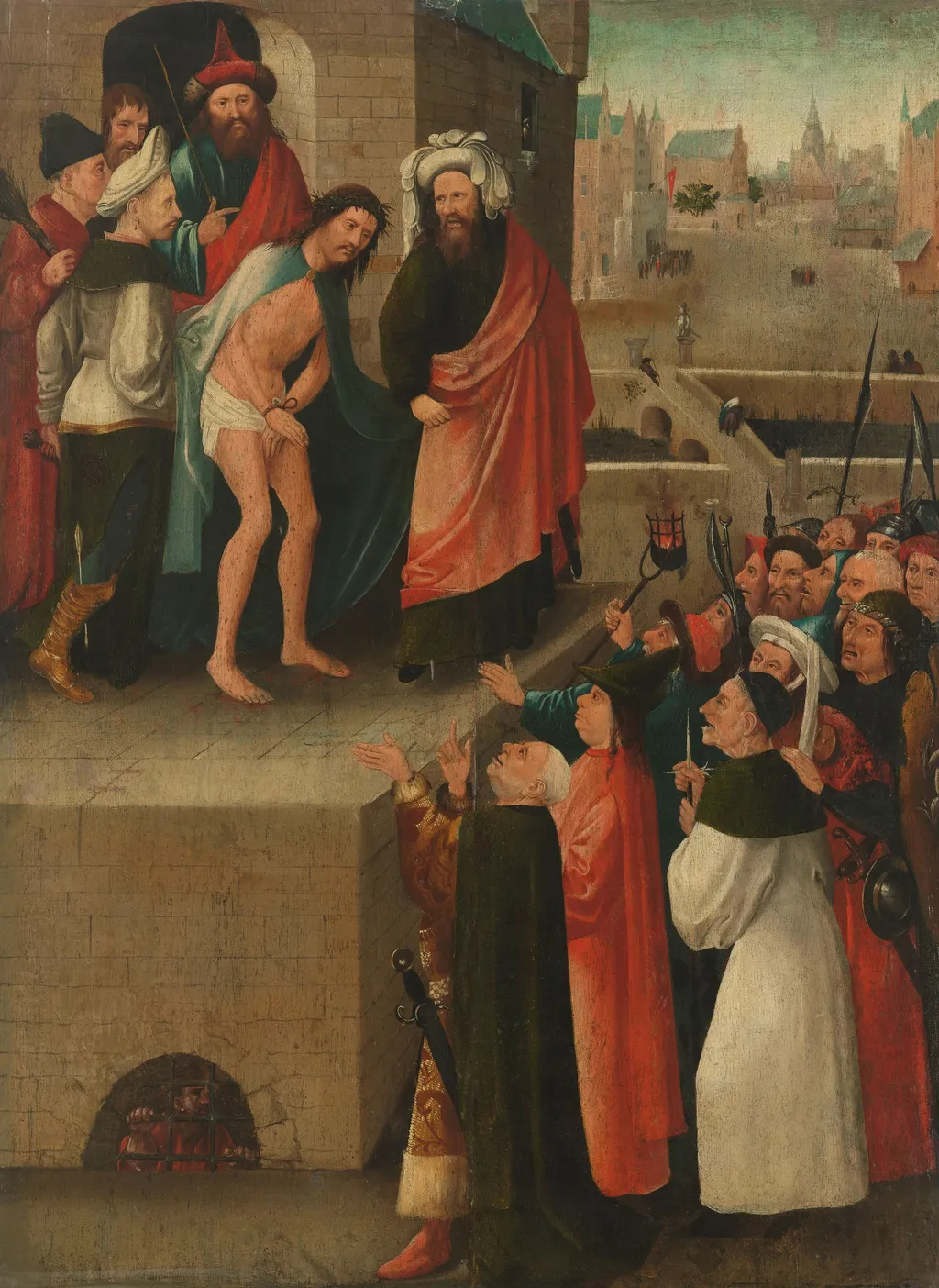
Ecce Homo is an oil painting. It dates from 1530 and is held in the collection of the Rijksmuseum.
About this work
Subject & Meaning
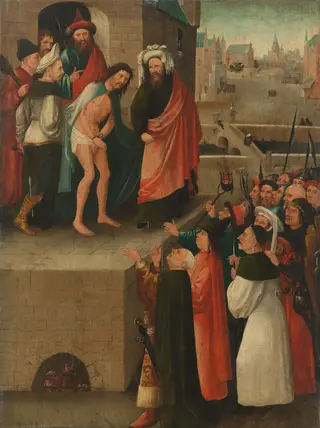
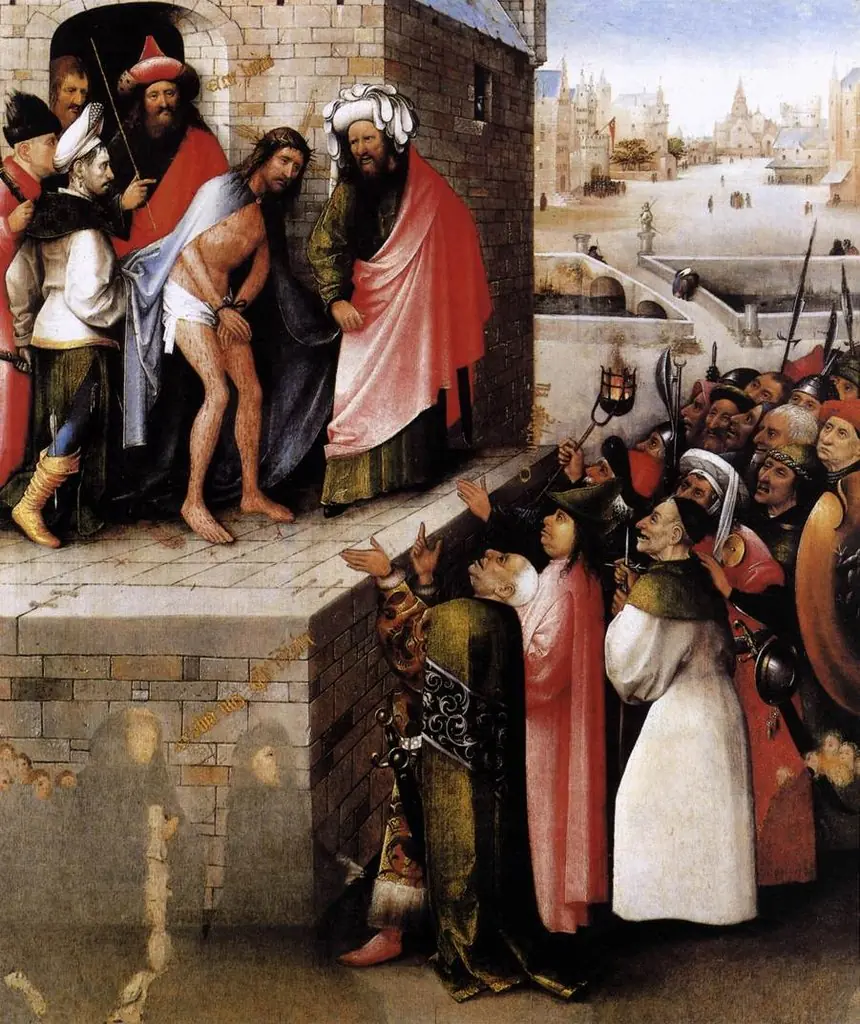
The painting depicts the moment when Pontius Pilate presents Jesus Christ to the Jewish people, a scene known as Ecce Homo.
The painting depicts the moment when Pontius Pilate presents Jesus Christ to the Jewish people, a scene known as Ecce Homo. The composition is a faithful copy of a lost or closely related original associated with the Early Netherlandish painter Hieronymus Bosch, retaining the central biblical confrontation while altering the surrounding figures. The copyist replaced the donor family group that appears at the lower corners of the original with a depiction of Barabbas, the murderer released in Christ's place, thereby shifting the iconographic emphasis from private patronage to the Gospel narrative of substitutionary judgment.
As a religious work, the image conveys the tension between condemnation and sacrifice central to the Passion story, presenting Christ to the crowd as the figure whose fate is weighed against that of a criminal. The substitution of Barabbas for the donor portraits reinforces the theological theme of Christ offered in place of the guilty, framing the viewer as participant in the crowd's choice.
Technique & Style
Created around 1530, this work is an oil painting executed on a wooden panel, adhering to the Early Netherlandish tradition. Dendrochronological analysis indicates the panel could date from as early as 1528. The painting measures 73 cm in height and 54.5 cm in width.
Stylistically, it functions as a highly accurate copy of Hieronymus Bosch's Ecce Homo held in Frankfurt, suggesting the artist likely worked directly from the original. However, specific formal deviations exist: the donor group depicted in the lower corners of the source is omitted here. Instead, the figure in the lower left has been replaced by a depiction of Barabbas. The composition focuses strictly on the biblical moment where Pontius Pilate presents Jesus to the crowd.
History & Provenance
The painting Ecce Homo, created around 1530 as an oil work on panel, is attributed to an anonymous follower of Hieronymus Bosch and was likely produced for the Coudwater cloister in Rosmalen before being moved to the Mariënrefuij cloister in Uden in 1713. It passed through the Netherlands' national historical art collection, eventually entering the Rijksmuseum Amsterdam, from which it was loaned back to the Museum voor Religieuze Kunst in Uden in 1973. The work has been exhibited only once, in a 1967 retrospective of Bosch at the Noordbrabants Museum in 's-Hertogenbosch, listed as item 26.
Its creation history involves a precise copying of Bosch's original Ecce Homo in Frankfurt, with dendrochronological analysis suggesting a date of origin around 1528.
The painting Ecce Homo is held by the Museum voor Religieuze Kunst in Uden, which is part of the Rijksmuseum collection. Its inventory number is not specified in the sources. The work dates to around 1530 and measures 73 cm by 54.5 cm. It was created as a faithful copy of Hieronymus Bosch’s Ecce Homo in the Städel Museum, Frankfurt, omitting a donor family group present in the original and replacing the left-side figure with Barabbas.
Dendrochronological analysis suggests a creation date of approximately 1528. The work’s provenance includes possible commission for the Coudewater monastery in Rosmalen, transfer to the Maria Refugie monastery in Uden in 1713, sale in 1875 to the Netherlands Museum for History and Art in The Hague (later the Rijksmuseum Amsterdam), and a 1973 loan back to the Museum voor Religieuze Kunst in Uden. It was displayed in the 1967 Jheronimus Bosch exhibition at the Noordbrabants Museum in 's-Hertogenbosch, catalog number 26, page 110.
Context
The painting is a closely faithful copy of Hieronymus Bosch's Ecce Homo in the Städel Museum in Frankfurt, and the Uden version is so accurate that scholars assume the copyist worked directly from the original. The copyist omitted the donor family group that appears at the lower left and right of Bosch's panel, replacing the left-hand group with a depiction of Barabbas, the prisoner released in place of Jesus. Dendrochronological analysis indicates the panel could not have been made earlier than around 1528, placing it within the early Netherlandish tradition of Bosch-following production.
The work was included in the 1967 Jheronimus Bosch exhibition at the Noordbrabants Museum in 's-Hertogenbosch, catalogued as number 26, situating it within the scholarly effort to map Bosch's workshop circle and later imitators.
Overview
The oil painting titled Ecce Homo depicts a bustling street scene centered on a half‑naked figure crowned with thorns. He stands on a stone pavement surrounded by a crowd dressed in vivid reds, greens and browns, while a distant cityscape with towers and a river recedes behind them.
Artist & collection