Artwork
集一切福徳三昧経.|Illustrated Frontispiece to the Sutra of Enlightenment through the Accumulation of Merit and Virtue, the So-called Jingoji Sutra
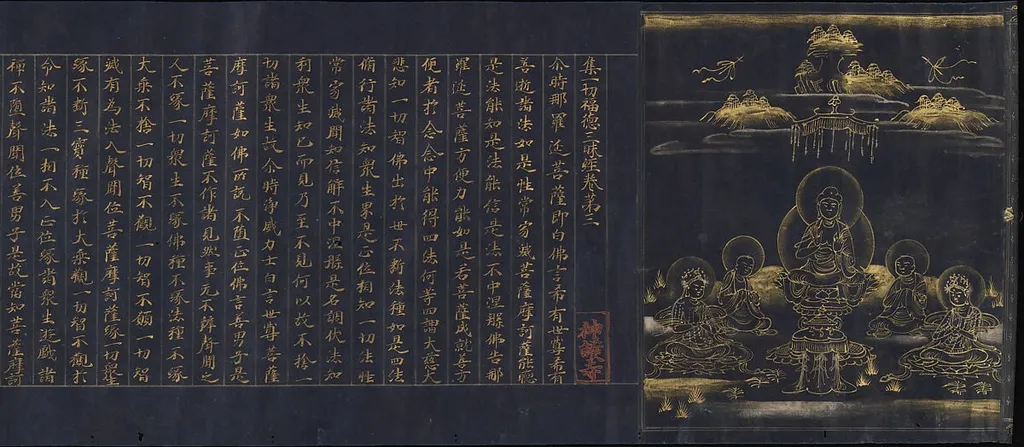
集一切福徳三昧経.|Illustrated Frontispiece to the Sutra of Enlightenment through the Accumulation of Merit and Virtue, the So-called Jingoji Sutra is a silver painting. It dates from 1167 and is held in the collection of the Metropolitan Museum of Art.
- Accession no.
- 1975.268.17
- Credit line
- The Harry G. C. Packard Collection of Asian Art, Gift of Harry G. C. Packard, and Purchase, Fletcher, Rogers, Harris Brisbane Dick, and Louis V. Bell Funds, Joseph Pulitzer Bequest, and The Annenberg Fund Inc. Gift, 1975
About this work
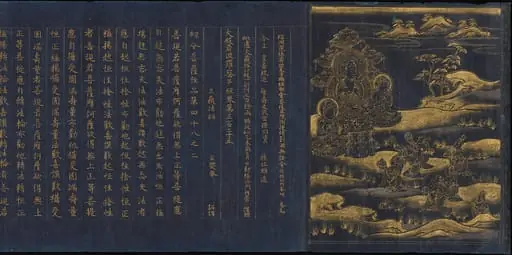
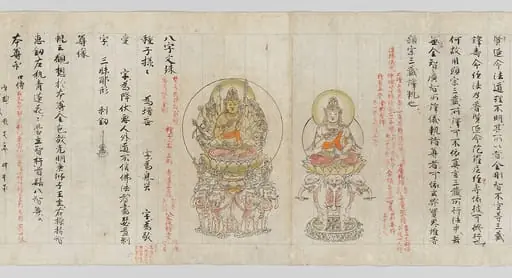
A long strip of deep-blue paper carries tiny gold and silver figures: Buddhas, bodhisattvas, and clouds. Made in Japan around 1167, it uses real gold leaf pressed onto the indigo-dyed paper. The silver has tarnished to black over the centuries, which makes the gold glow all the brighter.
Subject & Meaning
Classified as religious art, the work functions as a devotional frontispiece to a sacred sutra, presenting enlightened beings as the central iconographic focus.
The frontispiece is a religious Buddhist composition depicting a Buddha and Bodhisattva figures rendered in gold and silver on indigo-dyed paper. Classified as religious art, the work functions as a devotional frontispiece to a sacred sutra, presenting enlightened beings as the central iconographic focus. The pairing of a Buddha with attendant Bodhisattvas is a standard Buddhist visual formula signifying the transmission of Buddhist teachings and the spiritual hierarchy of awakened beings.
As a frontispiece to the Sutra of Enlightenment through the Accumulation of Merit and Virtue, the imagery visually introduces the sutra's themes of merit, virtue, and the path to enlightenment, serving as a sacred threshold marking the beginning of the holy text.
Technique & Style
The work is executed as a handscroll painted on indigo‑dyed paper, employing gold and silver leaf to heighten the luminous quality of the Buddhist figures. The support is paper, and the format follows the traditional Japanese handscroll layout, measuring approximately 25.8 cm in height and 839.7 cm in width. The anonymous painter rendered a frontispiece populated by a Bodhisattva and Buddha within a religious narrative, using stylized outlines and decorative patterning typical of Heian‑period Buddhist illustration.
The piece, dated 1167, is part of the Metropolitan Museum of Art’s collection and reflects the religious art genre of its time.
History & Provenance
The handscroll titled 集一切福徳三昧経, also known as the Illustrated Frontispiece to the Sutra of Enlightenment through the Accumulation of Merit and Virtue (the Jingoji Sutra), is housed in the collection of the Metropolitan Museum of Art in New York. The work, dated 1167 and executed in gold and silver ink on indigo‑dyed paper, is classified as a religious painting depicting bodhisattvas and buddhas. The available documentation lists the museum as the current holding institution but does not provide a specific accession or catalogue number. Furthermore, the cited sources contain no record of any exhibition history for this piece.
Context
The work is recognized as a religious manuscript illumination produced in Japan in 1167, now held by the Metropolitan Museum of Art. As an anonymous painting associated with the Jingoji Sutra, it exemplifies the integration of Buddhist narrative imagery with luxurious materials such as gold and silver on indigo-dyed paper. Its inclusion in a major museum collection underscores its significance within the study of Heian-era Buddhist art and the role of elite patronage in commissioning illustrated sutras.
The piece contributes to understanding of anonymous workshop practices and the diffusion of Buddhist iconography in late 12th‑century Japanese visual culture.
Overview
This handscroll serves as an illustrated frontispiece for the Sutra of Enlightenment through the Accumulation of Merit and Virtue, also known as the Jingoji Sutra. Created in Japan approximately 850 years ago, it features a long strip of deep-blue paper adorned with numerous minute figures. These intricate depictions, rendered in lustrous gold and silver, portray Buddhas, bodhisattvas, and celestial clouds, setting a reverent tone for the sacred text it introduces.
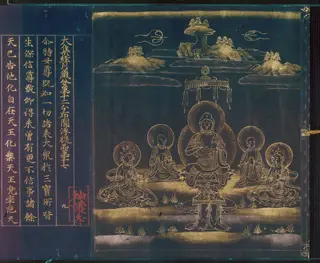
Artist & collection

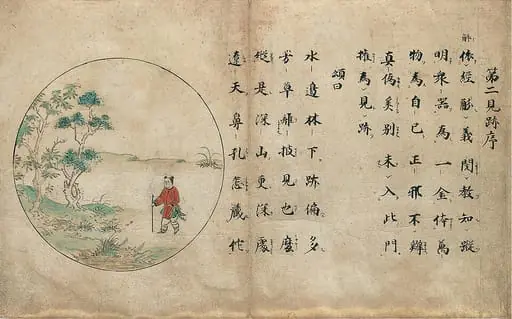 十牛頌図巻|Ten Verses on Oxherding
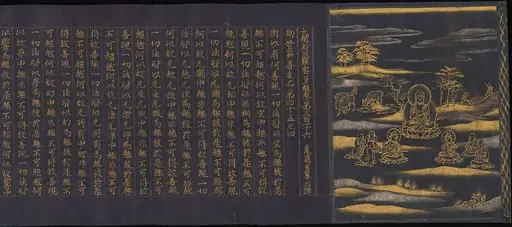 大般若経(中尊寺経)|Great Wisdom Sutra (Daihannya-kyō), from the Chūsonji Temple Sutra Collection (Chūsonji-kyō)
 大般若経(中尊寺経)|Great Wisdom Sutra (Daihannya-kyō) from the Chūsonji Temple Sutra Collection (Chūsonji-kyō)
 Calligraphy with Willow and Swallows
 瑞巖龍惺・竹香全悟・九淵龍賝・南江宗沅・ 翺之慧鳳賛 東坡笠屐図|Su Shi (Dongpo) in a Bamboo Hat and Clogs
 Calligraphy with Willow and Swallows
 The Emperor's Attendance at the Horse Race: Episode from the Tale of Eiga (Eiga Monogatari)
- Jingoji Sutra
 『過去現在絵因果経』 断簡 (松永本)|Scene from The Illustrated Sutra of Past and Present Karma (Kako genzai e-inga-kyō; Matsunaga Version)
 법화경변상도 고려|Illustrated manuscript of the Lotus Sutra (Miaofa lianhua jing), Volume 2
 伝九条兼実書 『法華経』 の内|Segment of the Lotus Sutra (Hoke-kyō)
 真言諸尊図像抄|Scroll from the Compendium of Iconographic Drawings (Zuzōshō)