Artwork
Madonna of the Catholic Monarchs
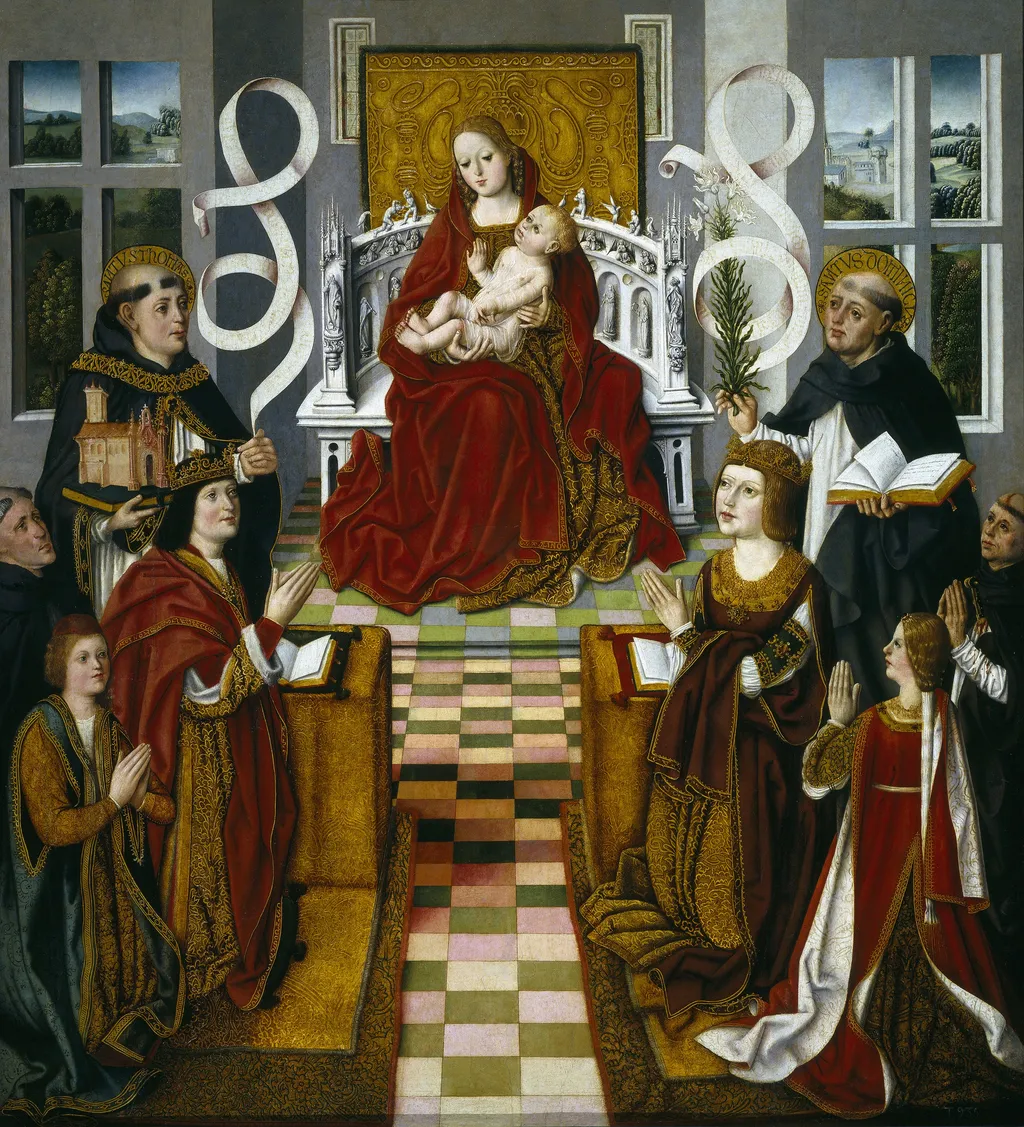
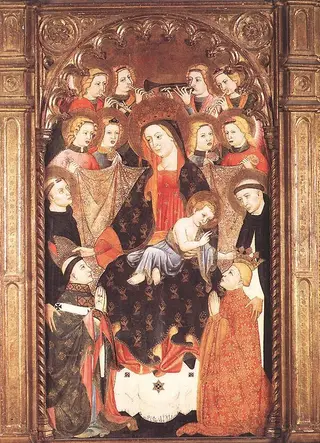
Madonna of the Catholic Monarchs is a mixed painting. It dates from 1496 and is held in the collection of the Museo del Prado. This painting, executed on wood, depicts the Virgin Mary enthroned with the Christ Child.
About this work
Subject & Meaning
In the lowest register, the Catholic Monarchs Ferdinand II and Isabella I kneel as donors alongside two of their children, likely John and Isabella.
The work depicts a sacra conversazione set within an interior room featuring windows that open onto a conventional Flemish-style landscape. The Virgin Mary and Christ Child occupy a throne on an upper level, flanked below by standing Dominican saints: Saint Dominic, holding a book and a lily symbolizing his devotion to the Virgin and the rosary, and Saint Thomas Aquinas, who holds a book and a model of the Royal Monastery of Saint Thomas in Ávila.
In the lowest register, the Catholic Monarchs Ferdinand II and Isabella I kneel as donors alongside two of their children, likely John and Isabella. They are accompanied by two friars identified as Tomás de Torquemada and a second figure variously interpreted as Saint Peter Martyr, Peter Martyr d'Anghiera, or Pedro de Arbués. The composition integrates royal piety with Dominican identity, reflecting the painting's original function in the monastery's royal oratory.
Technique & Style
The painting is executed in a mixed technique of oil and tempera on a wooden panel, measuring 123 × 112 cm, typical of late‑15th‑century Spanish religious art. Its support is a solid wood board, and the work belongs to the Gothic painting tradition, employing a sacra conversazione arrangement with the Virgin and Child enthroned, flanked by Saints Dominic and Thomas Aquinas, and donor figures of the Catholic Monarchs and their children. The composition uses a somewhat forced linear perspective, with tiled flooring and windows opening onto a conventional Flemish landscape, creating a structured yet slightly flattened spatial depth. These formal qualities reflect the anonymous Hispano‑Flemish style identified in the Prado’s collection.
History & Provenance
Commissioned for the Royal Monastery of Saint Thomas in Ávila, this mixed-technique painting on wood originally adorned the oratory of the royal chamber within the complex. While early scholar Valentín Carderera dated the work to 1484 based on the apparent ages of the royal children, modern analysis suggests a later execution between 1491 and 1493, attributing the figures' youth to artistic idealization rather than literal portraiture at the time of the monastery's founding.
Following the Spanish ecclesiastical confiscations of 1836, the panel was transferred to the Museum of the Trinity before entering the collection of the Museo del Prado, where it remains. Although historically linked to anonymous masters or figures like Michael Sittow and Pedro Berruguete, preliminary research announced in 2016 by Alicia Canto proposes the involvement of at least three painters, specifically identifying Fernando Gallego and Master Bartolomé through hidden signatures.
The work is housed in the Museo del Prado in Madrid, where it is listed in the museum's collection. Its provenance traces back to the oratory of the royal bedroom of the Real Monasterio de Santo Tomás in Ávila, from which it was removed during the 1836 desamortización and transferred to the Museo de la Trinidad (es), later entering the Prado's holdings. Since the mid‑19th century the painting has been exhibited in the museum’s display spaces, currently shown in Prado Hall 051A.
Context
Scholarship on this Hispano-Flemish work has long debated its authorship and dating. While Valentín Carderera originally proposed 1484 based on the depicted ages of the royal children, current consensus places execution between 1491 and 1493, attributing the youthful features to idealization rather than literal portraiture. Historical attributions have ranged from Pedro Berruguete and Michael Sittow to various anonymous masters associated with Fernando Gallego.
A 2016 preliminary study by Alicia Canto suggested a collaborative effort involving at least three painters, specifically identifying Fernando Gallego and Master Bartolomé through hidden signatures. Conversely, official museum records have occasionally listed Fray Pedro de Salamanca with a date around 1497, highlighting ongoing discrepancies in cataloging. The painting is recognized as a key example of late Gothic religious art in Spain, originally commissioned for the Royal Monastery of Saint Thomas in Ávila.
Overview
This painting, executed on wood, depicts the Virgin Mary enthroned with the Christ Child. She is surrounded by a group of figures, likely patrons or saints, all richly attired. The composition is set within an interior space featuring a tiled floor and a window offering a glimpse of an exterior landscape.
The artwork employs a subdued color scheme, primarily featuring reds, golds, and browns, contributing to its solemn and devotional atmosphere.
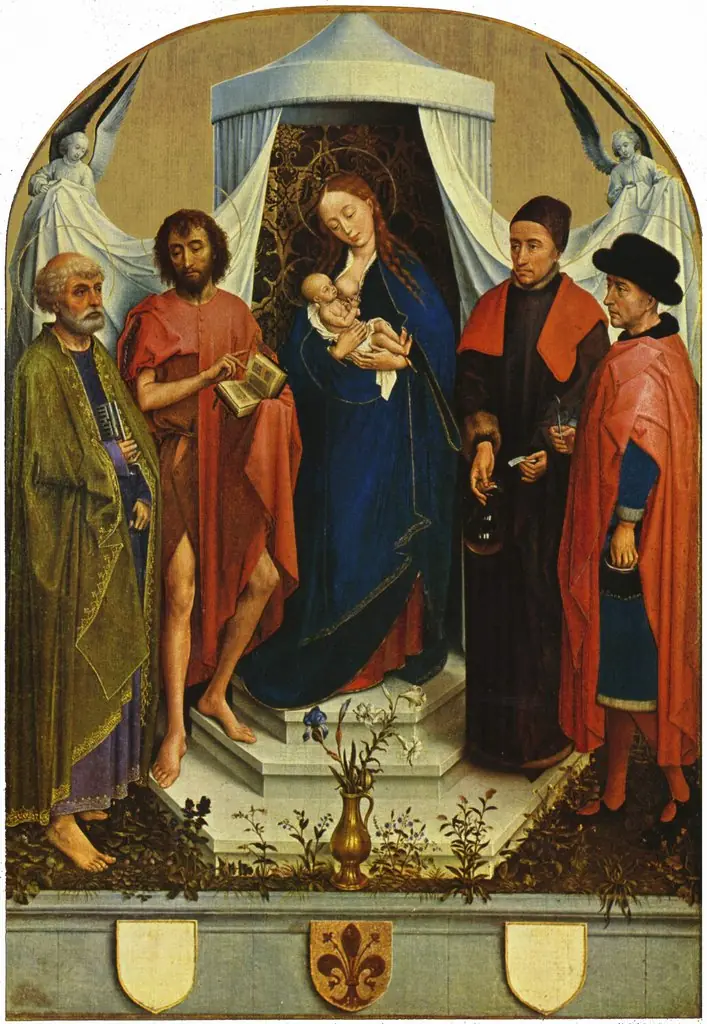
Artist & collection

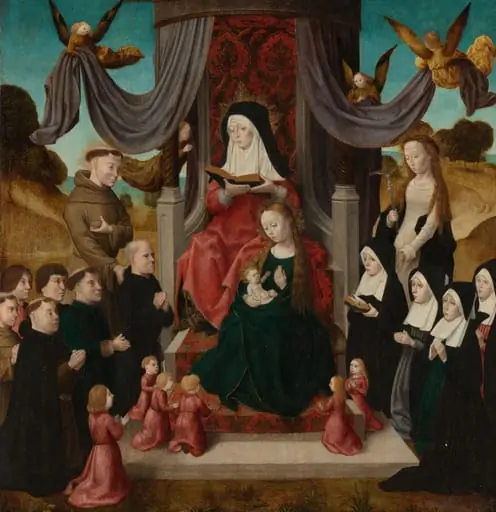 Virgin and Child with Saint Anne and Saints Francis and Lidwina, with Donors (Anna Selbdritt)
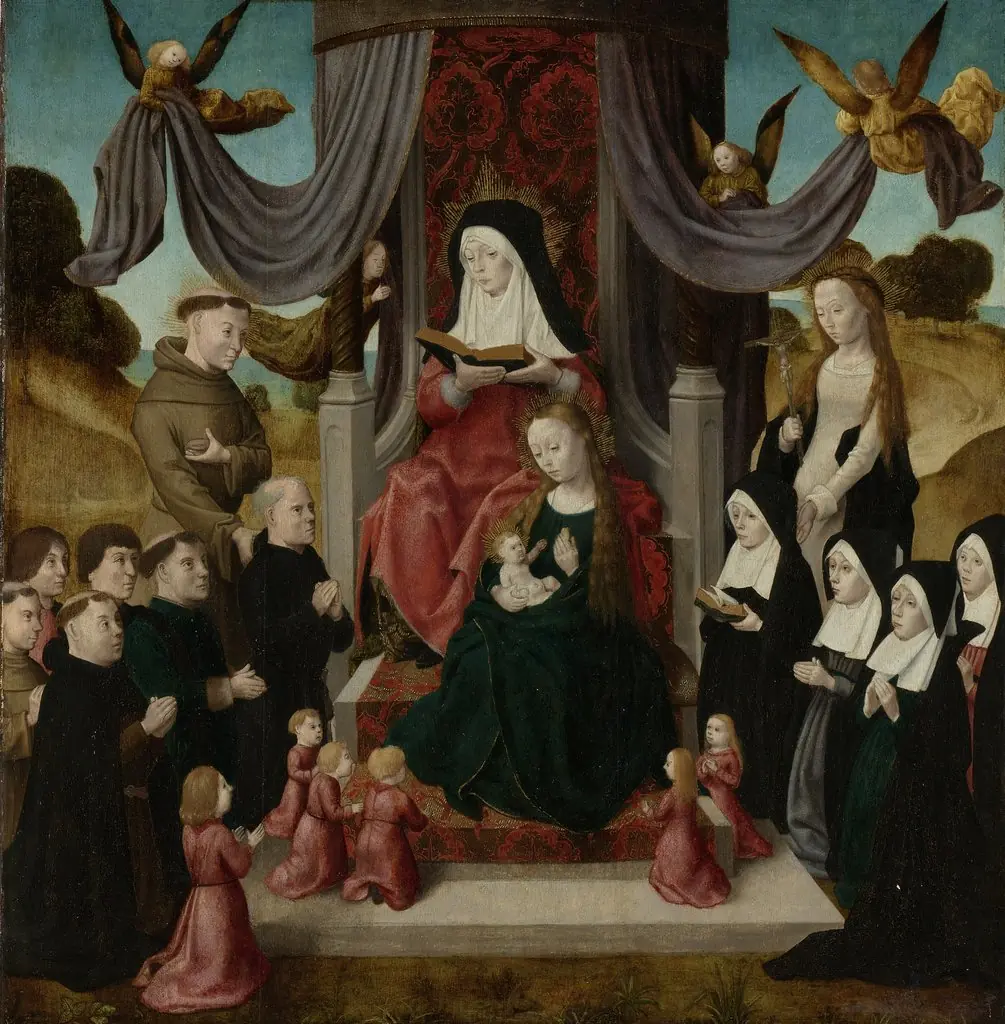 The Virgin and Child with St Anne, donors and Sts Francis and Lidwina
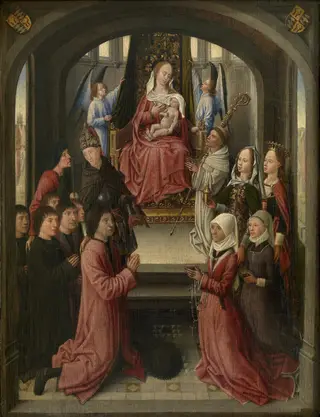 Lactatio of Saint Bernard of Clairvaux with Donors
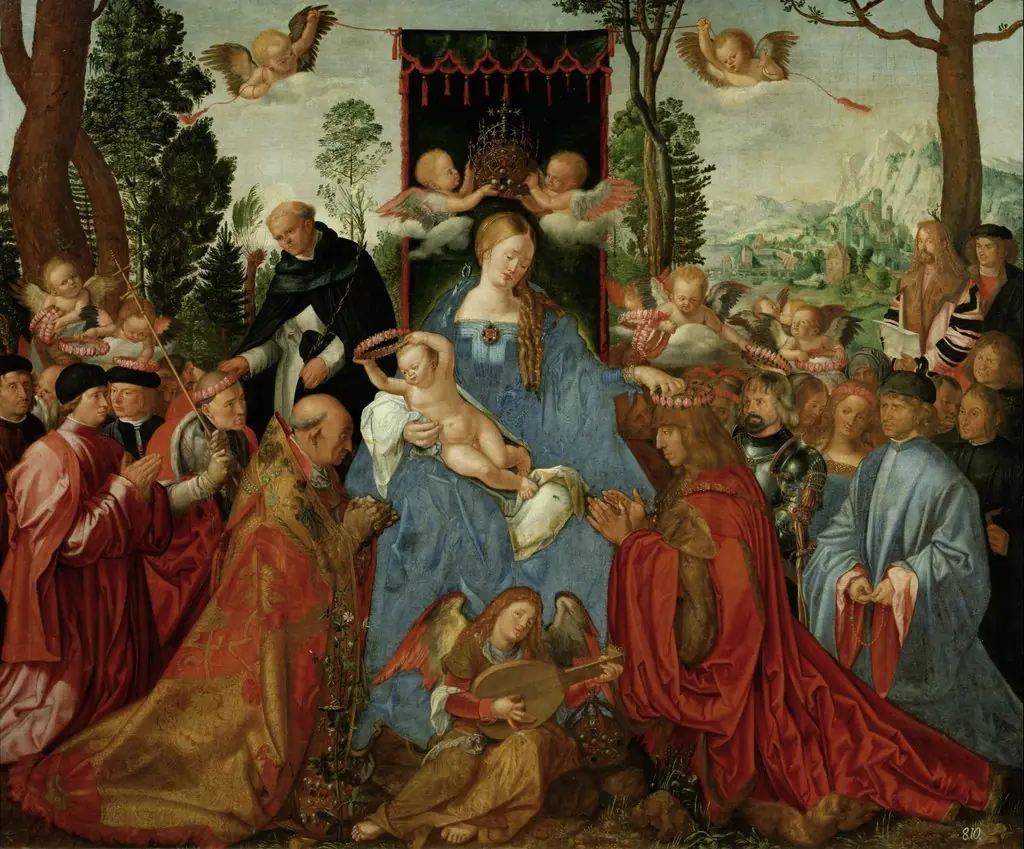 Rosenkranzfest
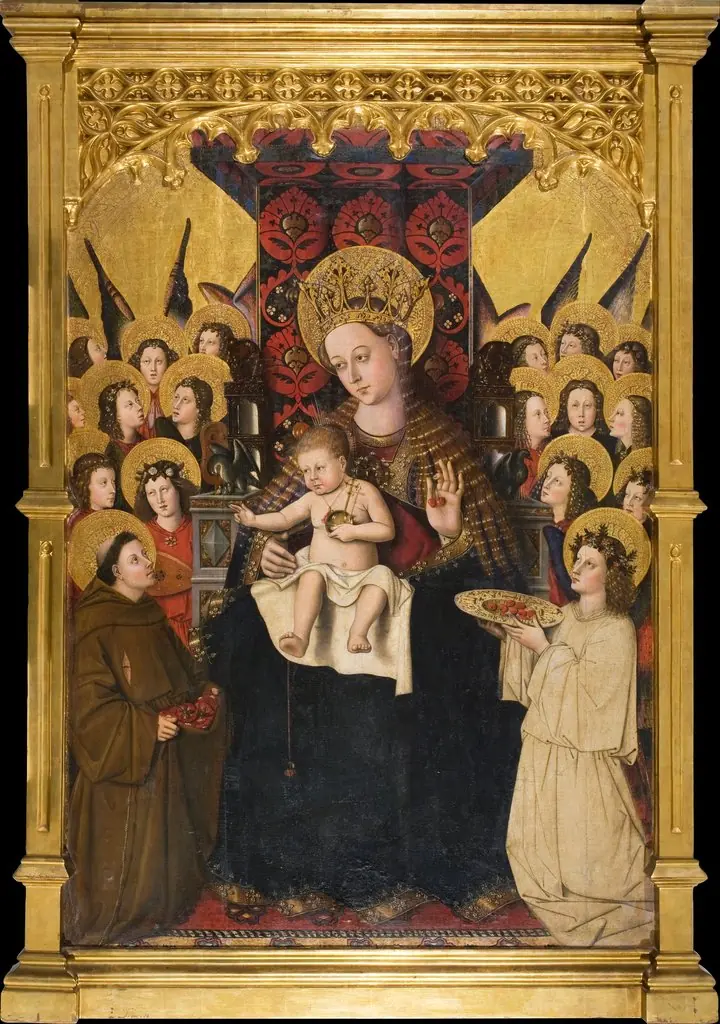 Virgin of the Porziuncola
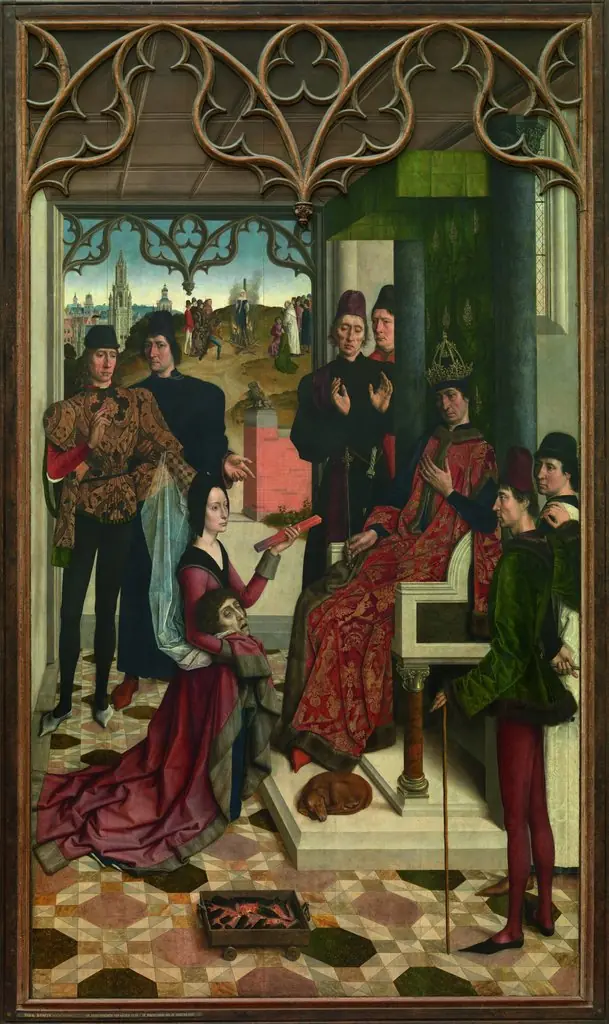 Justice of Emperor Otto III: The Trial by Fire
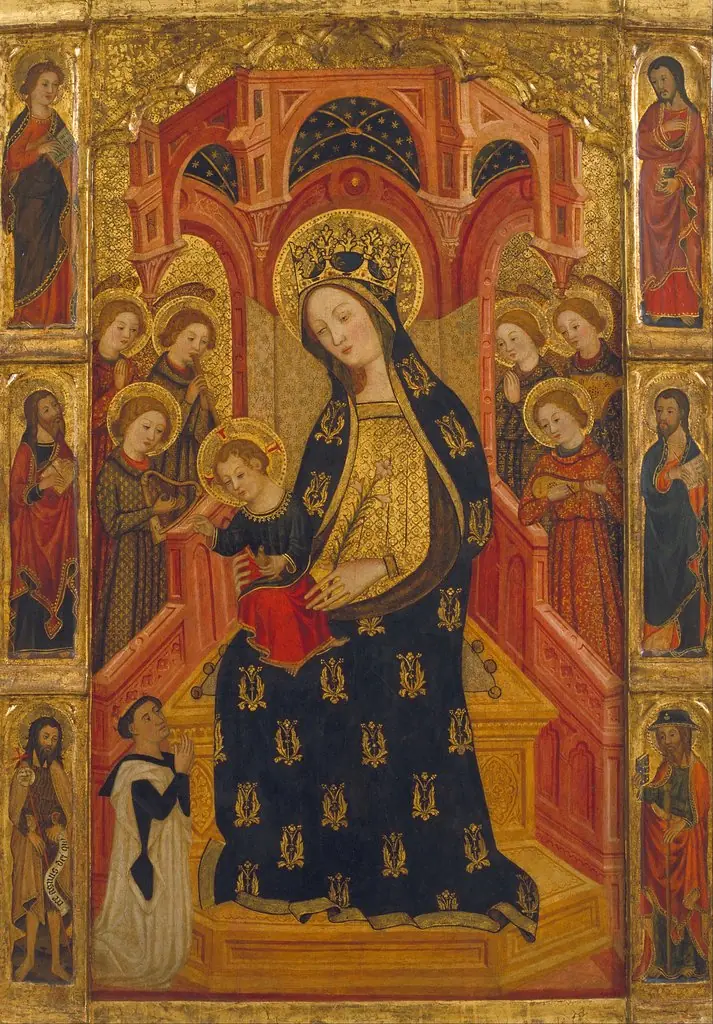 Virgin of the Angels
 Virgin and Child with Angels and Saints
- Medici Madonna