Artwork
Royal Woman Holding a Flower
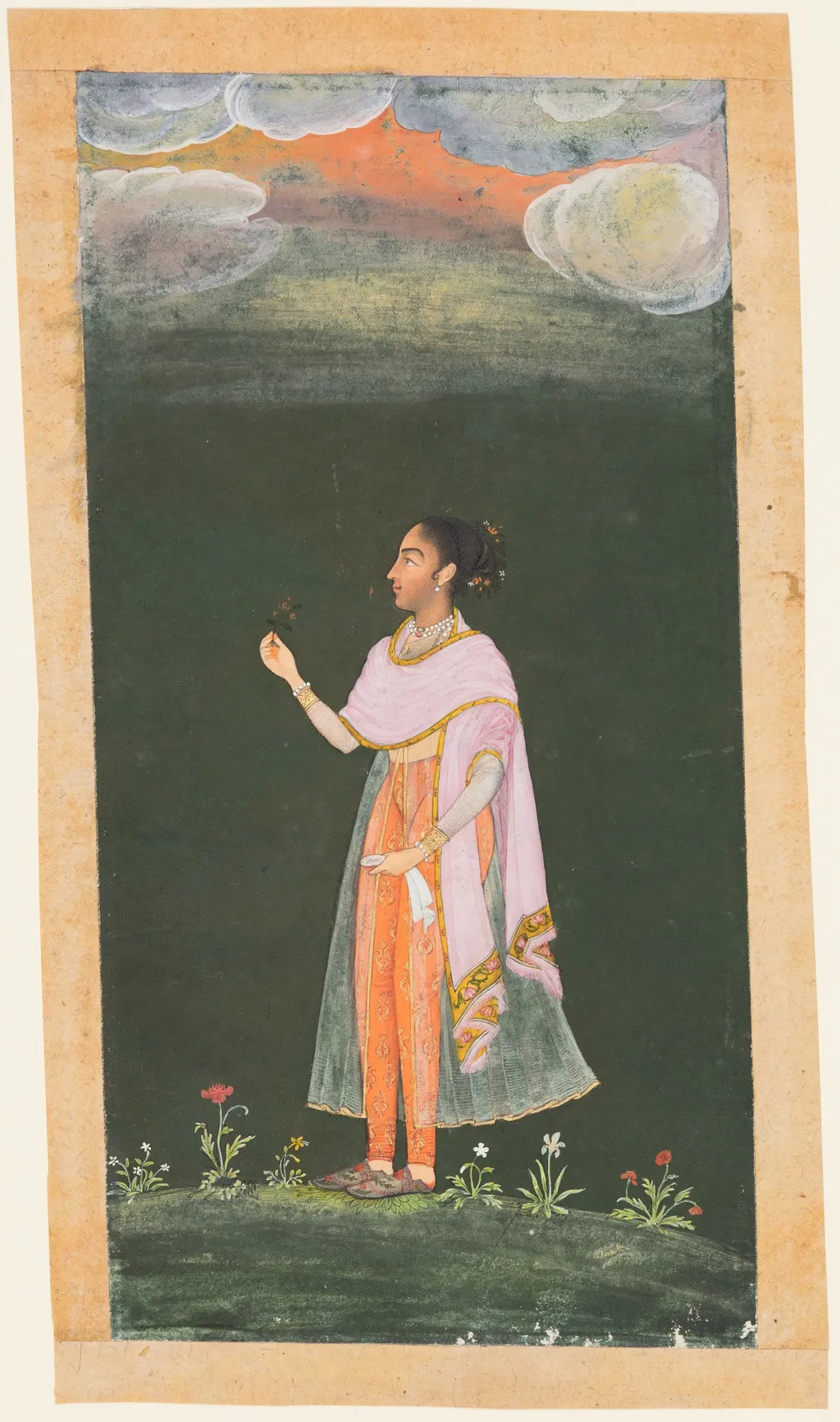
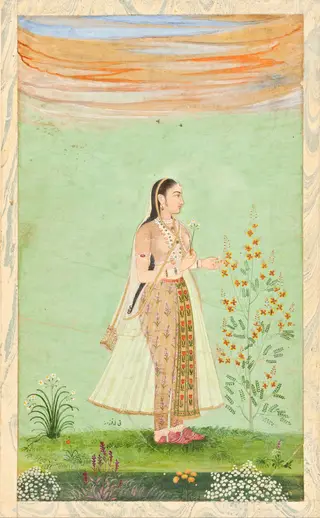
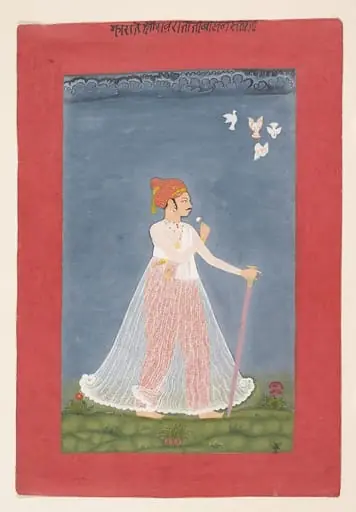
Royal Woman Holding a Flower is an unspecified painting. It dates from 1690 and is held in the collection of the Cleveland Museum of Art. The work portrays a woman standing amid a floral landscape, clutching a single blossom in her right hand.
About this work
Technique & Style
The painting was created using oil on canvas in 1680 at Bikaner State, depicting a royal woman holding a flower with precise brushwork and delicate color modulation that reflects Rajasthani miniature traditions while maintaining European compositional balance.
The work is executed on a rectangular canvas support with visible priming layers, showing minor craquelure across the surface but retaining overall structural integrity. Formal analysis notes the figure's frontal pose and flattened spatial treatment characteristic of Mughal-influenced court painting, with gold leaf accents highlighting the subject's jewelry and garment details.
Condition assessment records slight pigment darkening in the background foliage and minor abrasions along the lower edge, though the painted surface remains largely stable with no evidence of flaking or previous restorations.
History & Provenance
It was acquired by the Cleveland Museum of Art, which documents its provenance and current location in their collection records.
The painting Royal Woman Holding a Flower was created in 1680 in Bikaner State and was painted by an unknown artist. It entered the collection of the Cleveland Museum of Art, where it remains on display as part of their holdings.
The work dates to 1680, aligning with its creation history in the Bikaner region of India. It was acquired by the Cleveland Museum of Art, which documents its provenance and current location in their collection records.
Context
Scholarship on Royal Woman Holding a Flower situates the work within the late 17th-century Bikaner courtly tradition, where portraiture served as a tool of dynastic affirmation. The painting’s meticulous detailing of textiles and jewelry aligns with regional conventions of representing elite women, emphasizing status through adornment rather than individualized likeness. While unattributed, its execution reflects the workshop practices of Bikaner’s royal ateliers, where artists produced works for aristocratic patrons under strict stylistic guidelines.
Critical reception has focused on its role in illustrating the fusion of Mughal and Rajput aesthetics, a hallmark of post-Akbar period painting. The Cleveland Museum of Art’s acquisition in 2018 underscores its significance as a rare example of Bikaner’s understudied school, prompting renewed attention to the region’s contributions to Indian miniature painting.
Overview
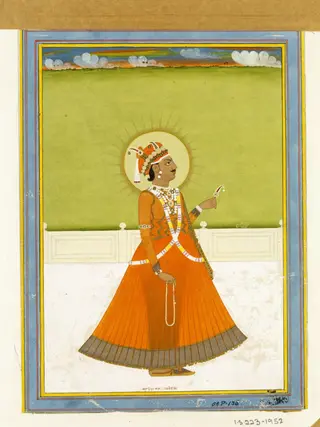
The work portrays a woman standing amid a floral landscape, clutching a single blossom in her right hand. She wears a long, flowing robe of pink and orange tones, complemented by a green shawl draped across her shoulders. The backdrop consists of a deep green field punctuated by a few clouds in the sky, creating a contrast with the vivid foreground.
Subject & Meaning
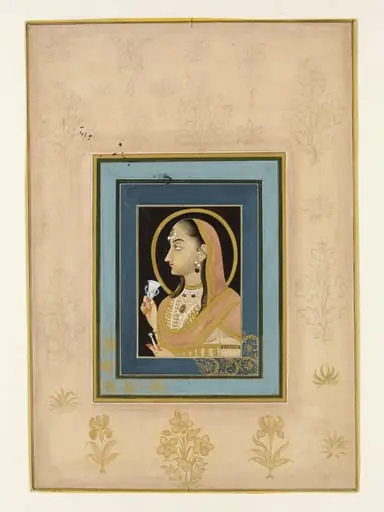
The central figure appears to be a royal or noble woman, suggested by the richness of her garments and the dignified pose. Holding a flower may symbolize fertility, beauty, or a ceremonial offering, themes commonly explored in courtly portraiture of the period.
Artist & collection