Artwork
Untitled
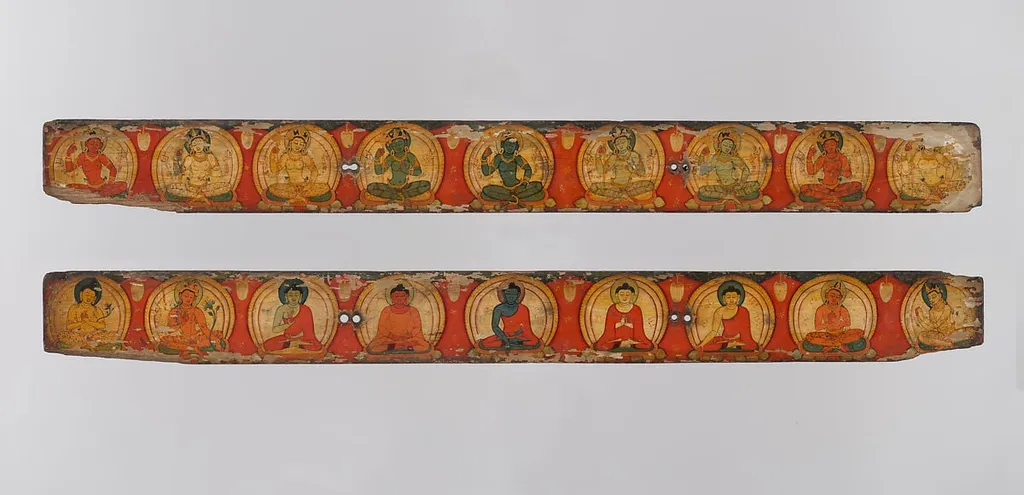
Untitled is a distemper painting. It dates from 1085 and is held in the collection of the Metropolitan Museum of Art.
- Accession no.
- 1976.192.1, .2
- Credit line
- Fletcher and Rogers Funds, 1976
About this work
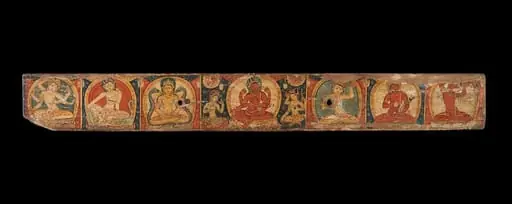
A golden, four-armed deity sits on a lotus against a red ground, wearing a tall crown and holding a small vase, a book, and two other objects. Made around 1100 in Nepal's Kathmandu Valley, it is one of the earliest surviving Buddhist paintings from the region, its bright color built from distemper, pigment mixed with glue, on wood.
Subject & Meaning
The work titled Untitled, dating to 1085, portrays a divine figure identified as a deity, reflecting its religious context within Himalayan Buddhist tradition.
The work titled Untitled, dating to 1085, portrays a divine figure identified as a deity, reflecting its religious context within Himalayan Buddhist tradition. Executed in distemper on wood, the painting measures roughly 5.4 × 56.2 cm and was created in Nepal before entering the collection of the Metropolitan Museum of Art. Its iconography aligns with canonical depictions of celestial beings, emphasizing spiritual authority rather than individualized portraiture.
The anonymous execution underscores the devotional function of such objects, where the visual representation serves as an aid to meditation and ritual focus. The composition's formal qualities and symbolic content communicate the transcendental nature of the subject, reinforcing its role as an object of veneration.
Technique & Style
The work is executed in distemper on wood, a medium typical of eleventh-century Nepalese panel painting. The handling is linear and hieratic, with precise contouring of the deity's form and minimal modeling to convey volume. The composition is symmetrical and frontal, adhering to canonical iconographic conventions. The palette is restrained, dominated by earth tones and mineral-based whites and reds.
History & Provenance
The work is held in the collection of the Metropolitan Museum of Art in New York. Its accession numbers are recorded as 1976.192.1 and 1976.192.2. The piece, created in 1085 in Nepal, is classified as a religious painting depicting a deity.
While the specific exhibition history is not detailed in the provided records, the work remains part of the museum's permanent holdings under these inventory identifiers.
Overview
This untitled painting, created around 1100 in Nepal's Kathmandu Valley, depicts a multi-armed golden deity. Rendered in distemper on wood, the artwork showcases a figure seated on a lotus, set against a vibrant red ground. It represents an early example of Buddhist art from the region, offering insight into the visual traditions of the period.
Artist & collection

- Untitled
 Untitled
 Manuscript of the Perfection of Wisdom in Eight Thousand Lines (Ashtasahasrika Prajnaparamita-sutra)
 Perfection of Wisdom in Eight Thousand Lines: Ashtasahasrika Prajnaparamita: Back Cover
 Untitled
 Untitled
 Pair of Buddhist Manuscript Covers
 Untitled
 Perfection of Wisdom in Eight Thousand Lines: Ashtasahasrika Prajnaparamita: Top Cover
 Untitled