Artwork
Manuscript of the Perfection of Wisdom in Eight Thousand Lines (Ashtasahasrika Prajnaparamita-sutra)

Manuscript of the Perfection of Wisdom in Eight Thousand Lines (Ashtasahasrika Prajnaparamita-sutra) is an unspecified painting. It dates from 1119 and is held in the collection of the Cleveland Museum of Art.
About this work
Subject & Meaning
As a religious painting dated to 1119, it embodies the doctrinal emphasis on emptiness and compassion, serving as a visual guide to the path of enlightenment.
The illuminated manuscript of the Perfection of Wisdom in Eight Thousand Lines (Ashtasahasrika Prajnaparamita-sutra) presents the Buddhist doctrine of prajnaparamita, or the perfection of wisdom, as its central subject. Iconographically it is framed by lotus motifs and stylized floral patterns that symbolize spiritual purity and the unfolding of insight. The text, composed in India and illuminated at Vikramaśīla University before being painted in Nepal, conveys the Mahāyāna ideal of transcendent knowledge that dispels ignorance.
As a religious painting dated to 1119, it embodies the doctrinal emphasis on emptiness and compassion, serving as a visual guide to the path of enlightenment.
Technique & Style
This 1119 manuscript is classified as a painting and a religious artwork. It was written in India and subsequently illuminated in Nepal, with its production linked to Vikramaśīla University. The work depicts flowers among its imagery.
The manuscript is held in the collection of the Cleveland Museum of Art. Beyond these classifications and provenance details, the sources do not specify the particular materials, support, handling, or condition of the object, nor do they elaborate on its formal or stylistic qualities in detail.
History & Provenance
The Ashtasahasrika Prajnaparamita-sutra manuscript was produced circa 1119 at Vikramaśīla University, where it was written in India and subsequently illuminated in Nepal, reflecting a regional collaborative scriptorial practice. Its creation aligns with the religious painting genre of the period, serving as a textual embodiment of Mahāyāna doctrine. Following its composition, the manuscript entered the collection of the Cleveland Museum of Art, which now holds and exhibits the work, marking the culmination of a provenance that traces from its place of manufacture to its present institutional stewardship.
The manuscript is held by the Cleveland Museum of Art, as recorded in its collection records. According to the Wikidata entry, its location is listed as the Cleveland Museum of Art. The sources do not provide a specific inventory or accession number for the work.
Likewise, no exhibition history is documented in the available references, leaving that aspect of its provenance unrecorded in the consulted materials.
Overview
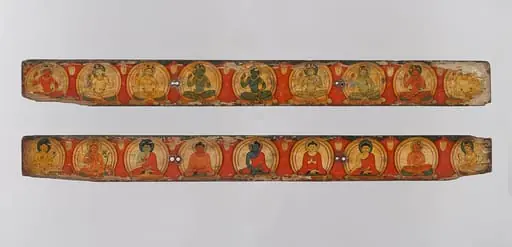
This painting, titled Manuscript of the Perfection of Wisdom in Eight Thousand Lines (Ashtasahasrika Prajnaparamita-sutra), features a series of eight Buddhist figures. Rendered on a long, narrow wooden panel, each figure is depicted in a meditative posture. The composition emphasizes a linear arrangement, with individual figures framed by elaborate decorative elements.
The work's intricate details and use of specific colors suggest its origin within a particular cultural and religious tradition.

Artist & collection

 Untitled
 Perfection of Wisdom in Eight Thousand Lines: Ashtasahasrika Prajnaparamita: Back Cover
 Perfection of Wisdom in Eight Thousand Lines: Ashtasahasrika Prajnaparamita: Top Cover
 Four bodhisattvas and two attendants flanking Vajrasattva, bottom cover, from a Manuscript of the Perfection of Wisdom in Eight Thousand Lines (Ashtasahasrika Prajnaparamita-sutra)
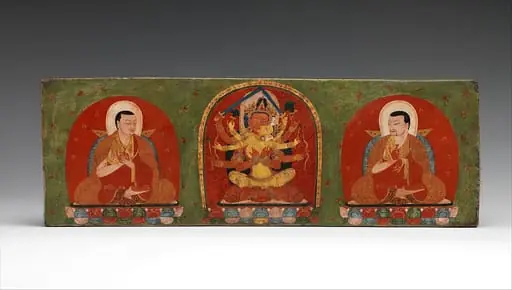 Untitled
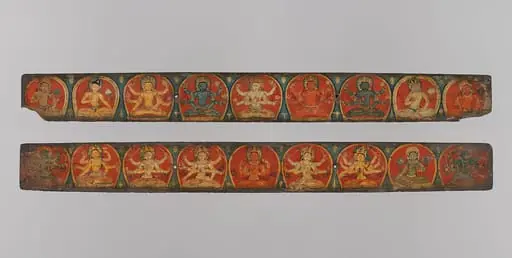 Untitled
 Bodhisattva Manjushri with two forms of Avalokiteshvara, folio 348 (recto) from a Gandavyuha-sutra (Scripture of the Supreme Array)
 Folio 348 from a Gandavyuha-sutra (Scripture of the Supreme Array): Bodhisattva Manjushri with two forms of Avalokiteshvara (recto); Bodhisattva Samantabhadra purifies the path to enlightenment, with Manjushri (verso)
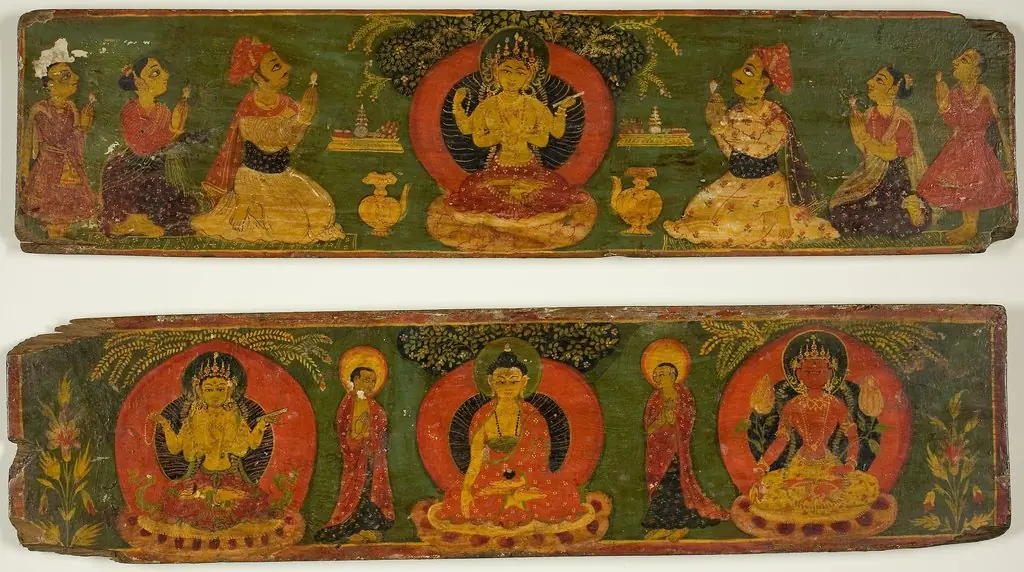 Pair of Buddhist Manuscript Covers
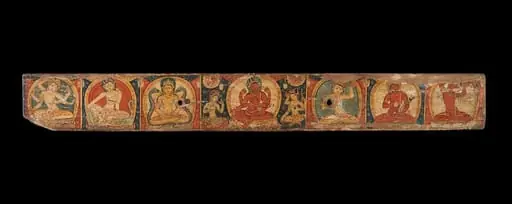 Untitled
- Perfection of Wisdom in Eight Thousand Lines: Ashtasahasrika Prajnaparamita
 Text, folio 3 (recto), from a Manuscript of the Perfection of Wisdom in Eight Thousand Lines (Ashtasahasrika Prajnaparamita-sutra)