Artwork
Perfection of Wisdom in Eight Thousand Lines: Ashtasahasrika Prajnaparamita: Top Cover

Perfection of Wisdom in Eight Thousand Lines: Ashtasahasrika Prajnaparamita: Top Cover is an unspecified painting. It dates from 1119 and is held in the collection of the Cleveland Museum of Art. This painting, titled Perfection of Wisdom in Eight Thousand Lines, served as the top cover for a significant Buddhist manuscript.
About this work
Subject & Meaning
The work depicts the Buddhist scripture known as the Ashtasahasrika Prajnaparamita, a text that expounds the doctrine of perfect wisdom.
The work depicts the Buddhist scripture known as the Ashtasahasrika Prajnaparamita, a text that expounds the doctrine of perfect wisdom. As a religious painting produced circa 1119 at Vikramaśīla University, it serves as the upper cover of a manuscript and visually conveys the theme of transcendent insight. The piece belongs to the broader tradition of Buddhist art that uses symbolic representation to communicate spiritual concepts, functioning as a visual embodiment of the Buddhist teaching on wisdom.
History & Provenance
The top cover of the Perfection of Wisdom in Eight Thousand Lines was created in 1119 at Vikramaśīla University. Attributed to an unknown artist and classified as a religious painting, it is held in the collection of the Cleveland Museum of Art, where it is catalogued under the accession number 1938.301.1. The provided sources do not document a specific exhibition history for this object.
Overview
This painting, titled Perfection of Wisdom in Eight Thousand Lines, served as the top cover for a significant Buddhist manuscript. Its elongated, narrow format features a series of eight circular vignettes arranged horizontally. Within each roundel, a figure is depicted in a serene, seated posture, contributing to the overall contemplative nature of the work.
The artwork's function as a protective cover for sacred texts underscores its integral role in the transmission of religious knowledge.
Technique & Style
The painting's aesthetic is characterized by its directness and subdued palette. A dominant red background frames the circular scenes, which are further delineated by gold and green borders. The seated figures exhibit varied expressions, ranging from solemnity to gentleness, despite areas where the paint has faded over time. This straightforward artistic approach emphasizes clarity in conveying its spiritual subject matter.

Artist & collection

- Perfection of Wisdom in Eight Thousand Lines: Ashtasahasrika Prajnaparamita: Back Cover
 Manuscript of the Perfection of Wisdom in Eight Thousand Lines (Ashtasahasrika Prajnaparamita-sutra)
 Perfection of Wisdom in Eight Thousand Lines: Ashtasahasrika Prajnaparamita: Decorated Leaf
 Prajnaparamita flanked by two female figures, folio 1 (verso), from a Manuscript of the Perfection of Wisdom in Eight Thousand Lines (Ashtasahasrika Prajnaparamita-sutra)
 Perfection of Wisdom in Eight Thousand Lines: Ashtasahasrika Prajnaparamita
 Perfection of Wisdom in Eight Thousand Lines: Ashtasahasrika Prajnaparamita: Decorated Leaf (recto)
 Text, folio 4 (recto), from a Manuscript of the Perfection of Wisdom in Eight Thousand Lines (Ashtasahasrika Prajnaparamita-sutra)
 Text, folio 186 (recto), from a Manuscript of the Perfection of Wisdom in Eight Thousand Lines (Ashtasahasrika Prajnaparamita-sutra)
 Ratnasambhava, Akshobhya, Vairochana with attendants, Amitabha, and Amoghasiddhi, Top cover, from a Manuscript of the Perfection of Wisdom in Eight Thousand Lines (Ashtasahasrika Prajnaparamita-sutra)
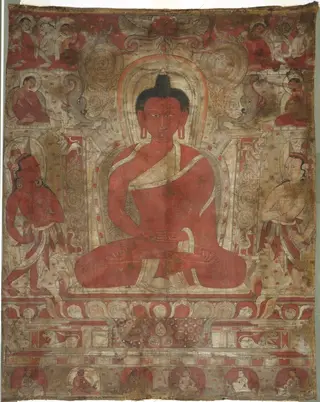 Seated Amitabha with Attendants
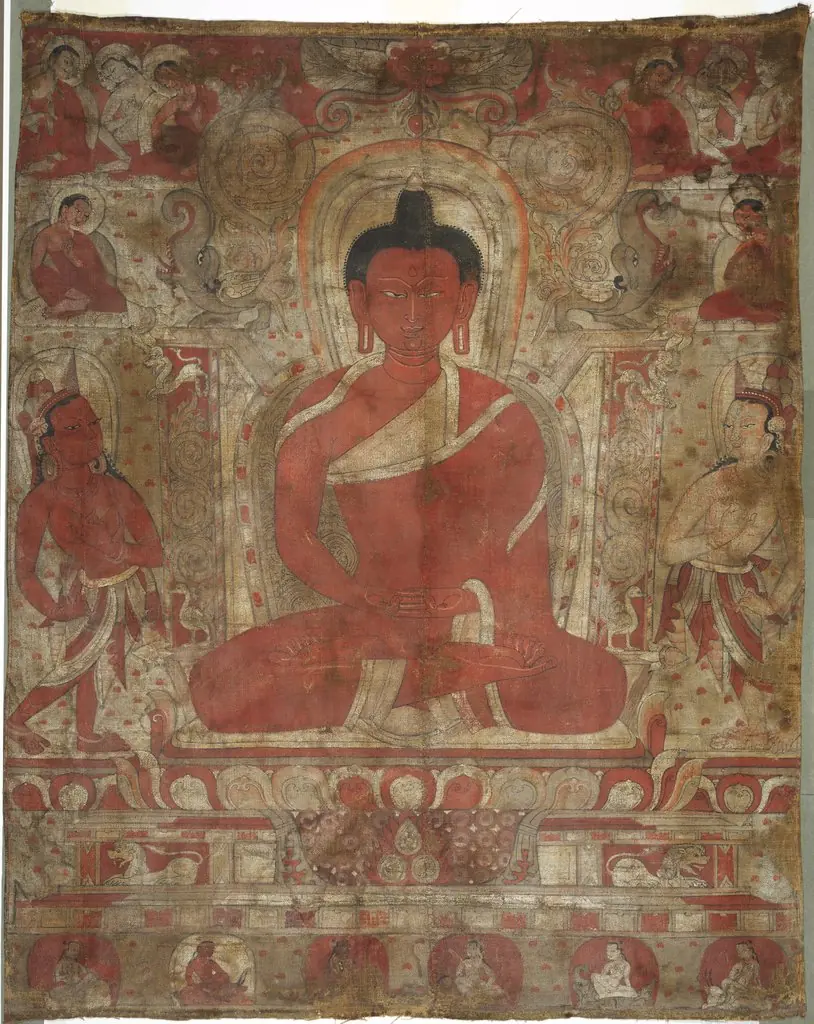 Seated Amitabha with Attendants
 Bodhisattva Manjushri with two forms of Avalokiteshvara, folio 348 (recto) from a Gandavyuha-sutra (Scripture of the Supreme Array)