Artwork
Untitled
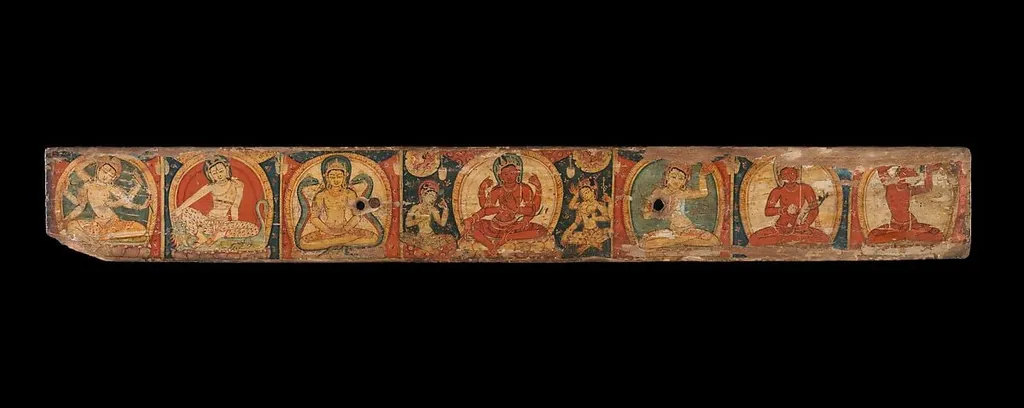
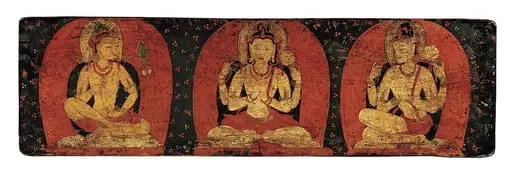
Untitled is a distemper painting. It dates from 1149 and is held in the collection of the Metropolitan Museum of Art.
About this work
Subject & Meaning
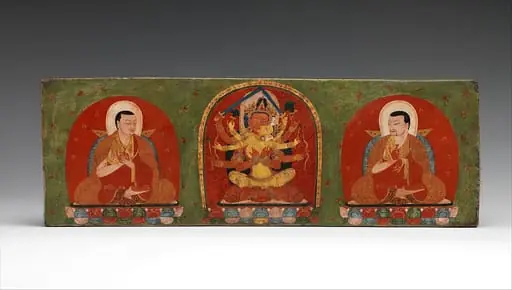
Created in Nepal in 1149, this religious painting depicts Avalokiteśvara, a revered Bodhisattva and deity within Buddhist tradition.
Created in Nepal in 1149, this religious painting depicts Avalokiteśvara, a revered Bodhisattva and deity within Buddhist tradition. As a work of religious art, the image functions as an iconographic representation of this specific divine figure, embodying the spiritual qualities associated with the Bodhisattva path. The composition serves to visualize the deity for devotional purposes, adhering to the iconographic conventions established for portraying Avalokiteśvara during this period in Nepalese art history.
The work's primary meaning is derived from its identification as a sacred image intended to facilitate religious contemplation and worship of the depicted deity.
Technique & Style
The artwork is a distemper painting on a wood panel support, measuring about 5.3 cm high and 44.3 cm wide, and is held in the Metropolitan Museum of Art. Dated to 1149, it depicts Avalokiteśvara, a bodhisattva deity, reflecting the religious iconography of 12th‑century Nepalese Buddhist painting. The medium, distemper (pigment bound with a water‑soluble glue) applied to wood, was typical for portable panel works of the period, allowing relatively quick drying and matte surface qualities. No specific condition or handling details are recorded in the sources.
History & Provenance
The painting known as Untitled is an anonymous work from the mid‑12th century, executed in distemper on wood and dated to 1149. It portrays the Bodhisattva Avalokiteśvara and belongs to the religious art genre. Created in Nepal by an unidentified painter for devotional purposes, the piece later entered the collection of the Metropolitan Museum of Art, where it is catalogued as part of the museum’s holdings.
Its provenance thus moves from a Nepalese workshop to museum acquisition, with no documented intermediate owners. The dating is corroborated by an inception record of 1149‑01‑01, and the work’s physical dimensions (approximately 5.3 × 44.3 cm) further support its identification as a distinct object.
The painting titled Untitled, created in 1149, is part of the permanent collection of the Metropolitan Museum of Art in New York. While the source material identifies the work as being held by this institution and notes its origin in Nepal, it does not provide a specific accession or inventory number for the piece. The available records confirm the artwork's location within the museum's holdings but do not list any specific exhibition history or past display schedules.
The work, classified as a religious painting depicting the deity Avalokiteśvara, remains a significant example of anonymous Nepalese art from the mid-12th century within the museum's collection.
Overview
This untitled painting, rendered in distemper on wood, depicts Avalokiteshvara, a significant bodhisattva. The golden-hued figure is characterized by multiple arms, each holding distinct attributes such as a lotus, a vase, and a string of beads. A serene, almost smiling expression graces the face, and the body appears luminous against a dark backdrop, creating a striking visual presence.
Artist & collection

- Untitled
 Untitled
 Pair of book covers with Buddhist deities
 Untitled
 Manuscript of the Perfection of Wisdom in Eight Thousand Lines (Ashtasahasrika Prajnaparamita-sutra)
 Pair of Buddhist Manuscript Covers
 Bodhisattva Manjushri with two forms of Avalokiteshvara, folio 348 (recto) from a Gandavyuha-sutra (Scripture of the Supreme Array)
 Folio 348 from a Gandavyuha-sutra (Scripture of the Supreme Array): Bodhisattva Manjushri with two forms of Avalokiteshvara (recto); Bodhisattva Samantabhadra purifies the path to enlightenment, with Manjushri (verso)
 Untitled
 Four-armed Maitreya
 Untitled
 Perfection of Wisdom in Eight Thousand Lines: Ashtasahasrika Prajnaparamita: Back Cover