Artwork
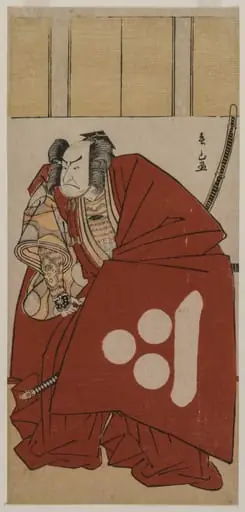
Nakamura Utaemon IV as Ono Sadakuro in Act Five of Kanadehon Chushingura, Naka Theater
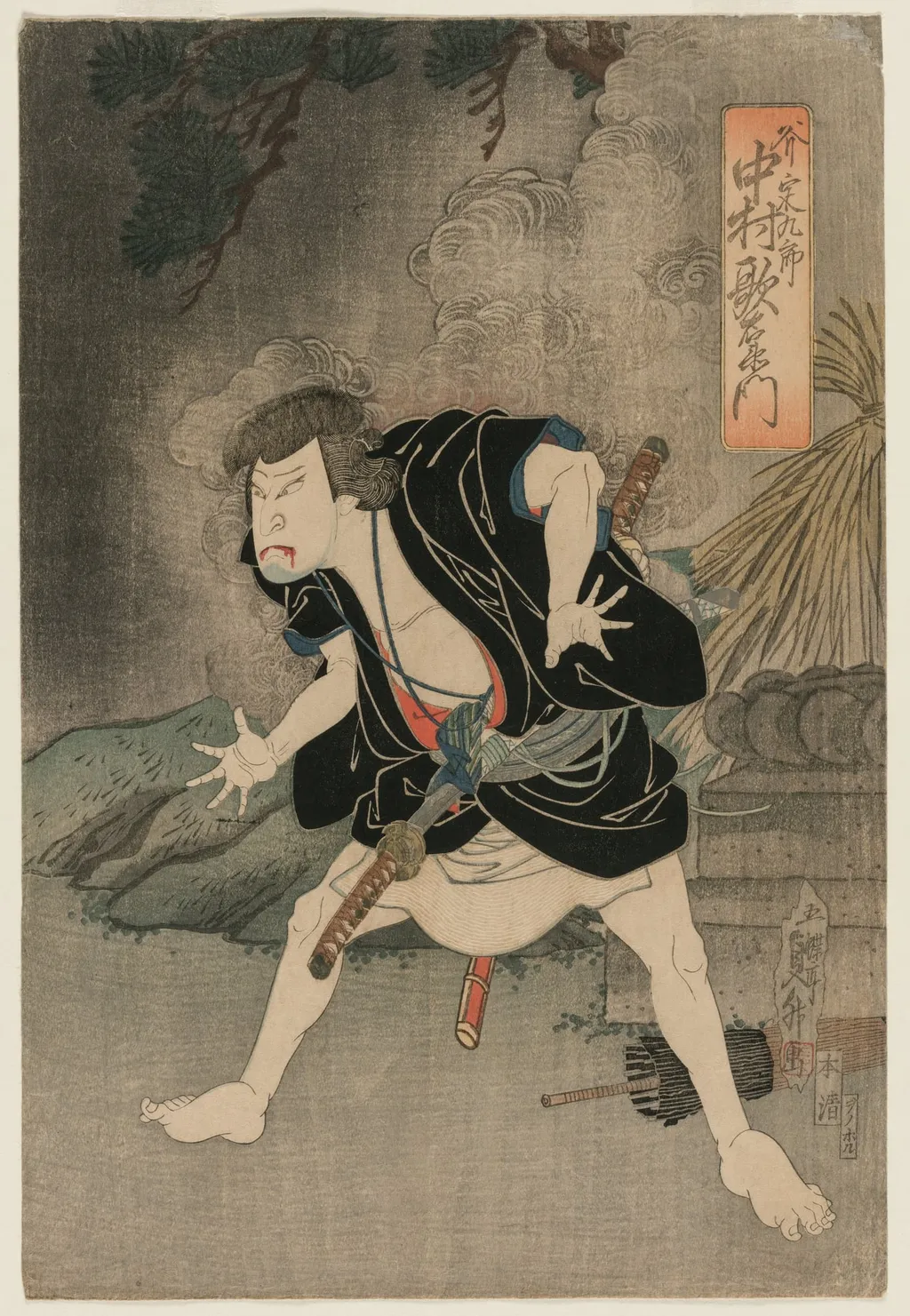
Nakamura Utaemon IV as Ono Sadakuro in Act Five of Kanadehon Chushingura, Naka Theater is a print by the Romanticist artist Utagawa Sadamasu. It dates from 1838 and is held in the collection of the Cleveland Museum of Art.
- Accession no.
- 1980.193
- Credit line
- Edward L. Whittemore Fund
About this work
Overview
In his right hand, he firmly grasps a sword, while his left hand is outstretched, emphasizing the emotional intensity of the scene.
Created in 1838 by Utagawa Sadamasu, this color woodblock print depicts the celebrated kabuki actor Nakamura Utaemon IV in the role of Ono Sadakuro during the fifth act of the play Kanadehon Chushingura. The composition captures a moment of high dramatic tension, with the actor posed dynamically: his right leg is bent while the left extends, conveying a sense of arrested motion. He is dressed in a black robe with a striking red lining, and his hair is tied back in the traditional style of the period.
In his right hand, he firmly grasps a sword, while his left hand is outstretched, emphasizing the emotional intensity of the scene. The background is rendered with a dark, smoky atmosphere and rocky elements, enhancing the theatrical mood. Produced during the height of the Edo period, this work exemplifies Sadamasu's skill in actor portraits (yakusha-e), utilizing silver accents and embossing to add texture and luxury to the print.
It stands as a significant example of mid-19th-century Japanese printmaking, documenting a specific performance and the star power of Utaemon IV within the vibrant kabuki culture of Osaka.
Subject & Meaning
The composition captures the dramatic moment when Ono Sadakuro, a loyal retainer, confronts his adversaries. The actor’s right leg is bent, his left leg extended, and his sword is raised, suggesting imminent action. His open mouth and narrowed eyes convey fierce resolve, while the outstretched left hand adds a sense of pleading or challenge, emphasizing the tension inherent in the tragic narrative of the 47 rōnin.
Technique & Style
Sadamasu employs the ukiyo‑e woodblock technique, using bold line work to define the figure’s muscular posture and the flowing folds of his black kimono with a striking red lining. The background is rendered in muted, smoky tones, with stylized rocks and trees that recede into atmospheric depth. The contrast between the dark foreground and the subtle background enhances the sense of movement and drama.
History & Provenance
Printed in 1838 for promotional use by the Naka Theater, the image circulated as a souvenir for theatergoers. It entered the Cleveland Museum of Art’s collection through a 20th‑century acquisition of Japanese prints, reflecting the museum’s broader effort to represent Edo‑period popular culture. The print remains an example of how commercial theater and visual art intersected in mid‑19th‑century Japan.
Own this work as a print
Artist & collection

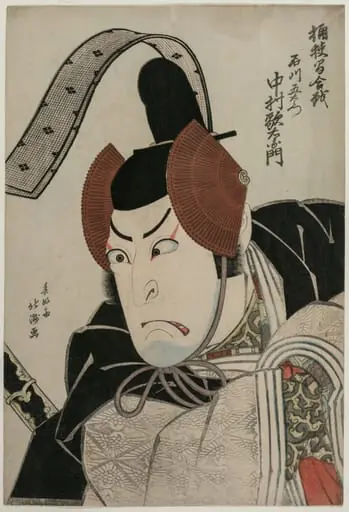
- Actor Nakamura Utaemon III (Shikan) as Ishikawa Goemon at the Battle of Okehazama (Okehazama Gassen)
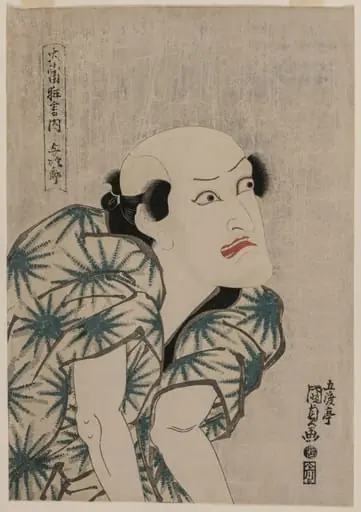 Nakamura Utaemon III as the Monkey Trainer Yojiro (from the series Famous Kabuki Plays)
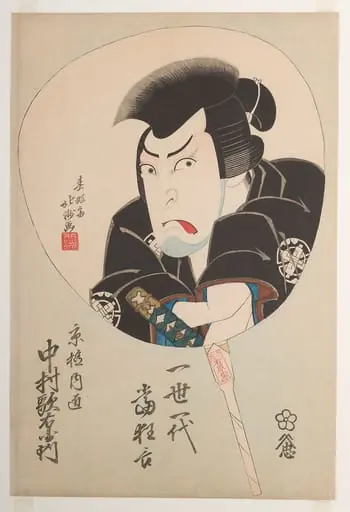 春好斎北洲画 三代目中村歌右衛門 『一世一代当狂言』|Kabuki Actor Nakamura Utaemon III as the Sword Master Kyōgoku Takumi, from the series Issei ichidai atari Kyōgen (Hits of a Lifetime of Kyōgen)
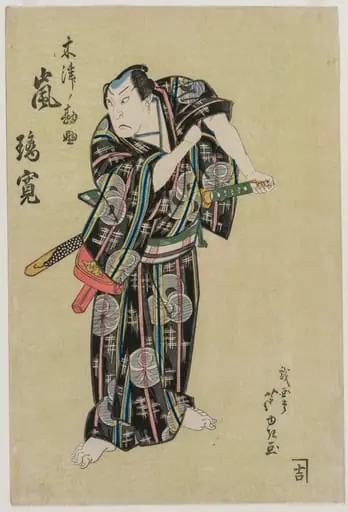 Arashi Rikan II as Kizu Kansuke
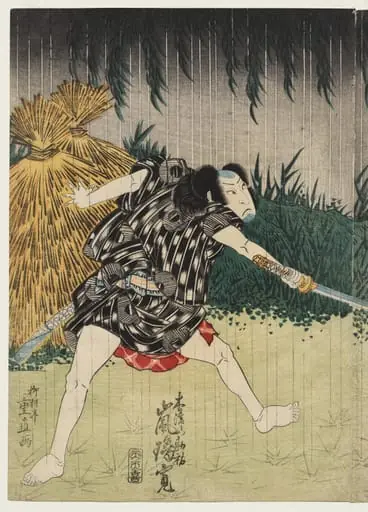 Arashi Rikan II as Kizu Kansuke
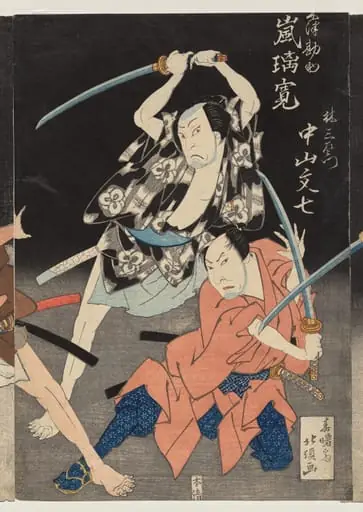 Arashi Rikan II as Kizu Kansuke and Nakayama Bunshichi III as Hayashi Sanzemon from the Kabuki Play "Eight Views of the Kizu River by Boating Song"
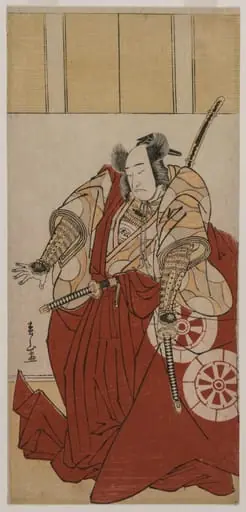 Onoe Matsusuke as Usui Sadamitsu
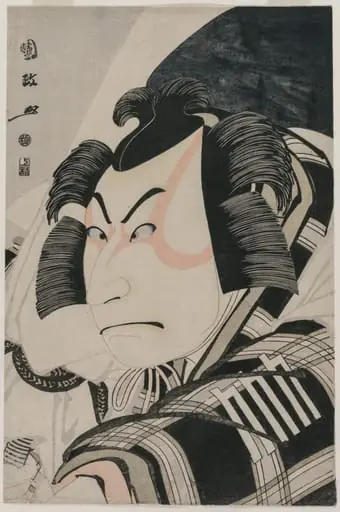 Nakamura Nakazo II as Matsuomaru in the Carriage-Stopping Scene
 Nakamura Nakazo I as Watanabe no Tsuna