Artwork
Peisaj
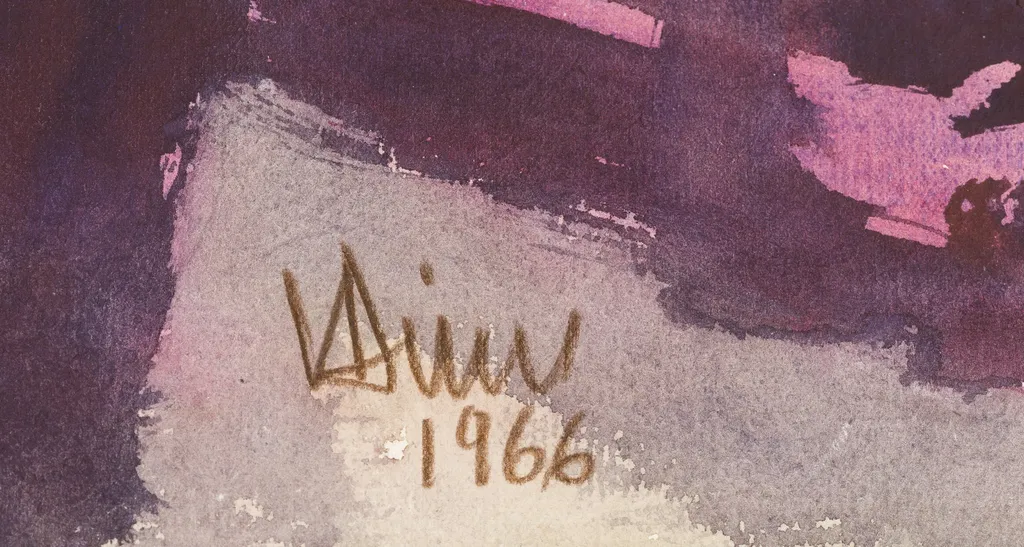
Peisaj is a print by Vasiu Dinu. It dates from 1966 and is held in the collection of the National Museum of Art of Romania.
About this work
The messy texture and handwritten date suggest the artist worked quickly, maybe even a little carelessly.
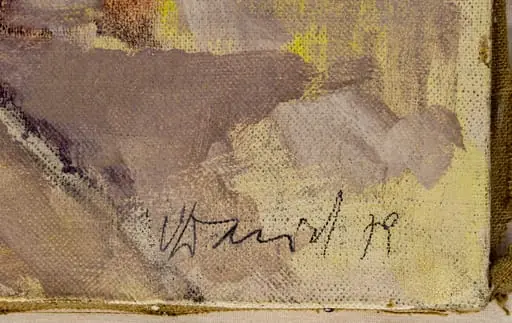
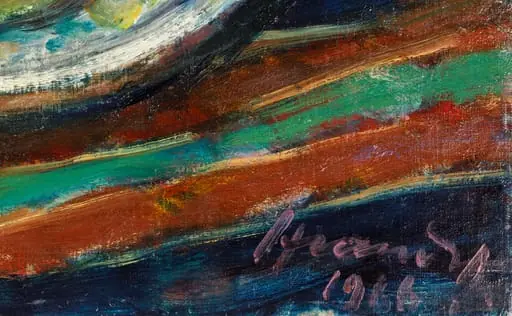
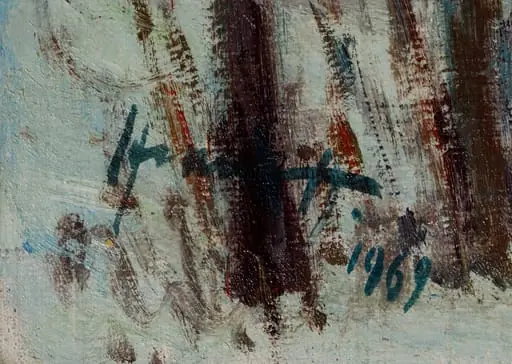
This close-up shows a messy, rough print with thick, uneven strokes. The colors are mostly dark purple, pink, and gray, blending into a smudged look. In the bottom right, the words "Peisaj" and "1966" are scrawled in uneven letters.
The messy texture and handwritten date suggest the artist worked quickly, maybe even a little carelessly. The title means "landscape" in Romanian, but you’d never guess that from the abstract swirls.
If you like this rough, expressive style, look up Vasiu Dinu next.
Overview
Peisaj is a 1966 work by Romanian artist Vasiu Dinu, executed in ink or similar medium on paper. The composition presents an abstracted surface marked by dense, irregular strokes and layered pigments. The title, meaning 'landscape' in Romanian, offers a conceptual anchor rather than a literal depiction, inviting interpretation beyond recognizable forms.
Subject & Meaning
Though titled 'landscape,' the work avoids traditional representation. Instead, it conveys a sense of atmospheric disturbance through chaotic brushwork and muted tones. The absence of horizon, figures, or topographical cues shifts focus to emotional texture, suggesting an internal or memory-based landscape rather than an external scene.
Technique & Style
Dinu applied pigment with rapid, unrefined gestures, creating thick, overlapping marks that bleed and smudge. Dominant hues of purple, pink, and gray interact without clear boundaries, producing a tactile, almost weathered surface. The handwritten inscription in the lower right, dated 1966, reinforces the immediacy of the act, aligning the work with expressive, gestural traditions.
History & Provenance
The work’s documented history begins with its creation in 1966, during a period of increased experimentation among Romanian artists under restrictive cultural conditions. Its survival and recognition stem from private collections and later institutional acquisitions, though public records of its early exhibition are limited.
Context
Created during Romania’s communist era, Peisaj reflects a quiet rebellion against state-mandated realism. Artists like Dinu often turned to abstraction as a means of personal expression, using nonconformist techniques to navigate censorship. This work belongs to a broader, understudied current of Romanian modernism that prioritized inner experience over public narrative.
Legacy
Peisaj remains a representative example of Dinu’s late-career explorations in abstraction. While not widely exhibited, it contributes to the growing scholarly interest in Romania’s postwar nonconformist art. Its raw aesthetic continues to resonate with viewers seeking alternatives to polished modernist norms.
Artist & collection