Artwork
One Begs in Vain at the Door of the Deaf
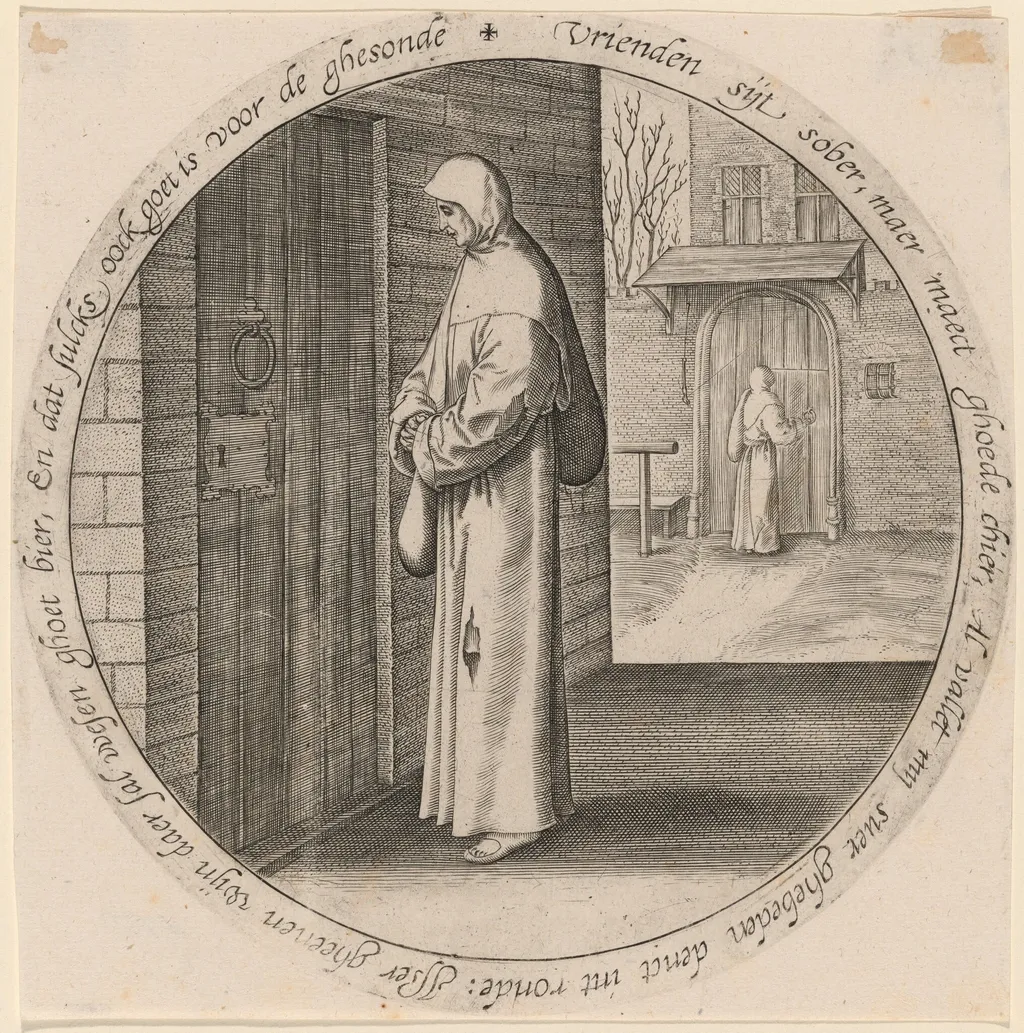
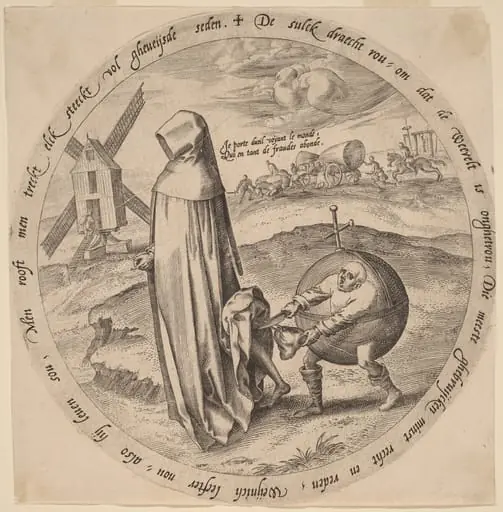
One Begs in Vain at the Door of the Deaf is an ink print by the Renaissance artist Johan Wierix. It dates from 1568 and is held in the collection of the National Gallery of Art.
- Inscription
- Inscribed:in plate, in margin around image: Vrienden sijt sober, maer maect ghoede chier, Al vallet my suer ghebeden denct int ronde: Isser gheenen wijn daer sal wesen ghoet bier, En dat sulcks oock goet is voor de ghesonde. (Be sober, friends, but cut a dash / Although it's hard on me to begging / If there's no wine, there'll be good beer / And that's good for the health too.) [translation by Wouter Bracke from Maarten Bassens and Joris van Grieken, eds., Bruegel in Black and White: The Complete Graphic Works. Brussels: KBR, 2019, p. 269, note 15.]; on verso, in graphite, on hinge / at upper left: no 6; on verso, in graphite, on hinge at upper right: B 177 / H 172; on verso, in graphite, on sheet at lower right: 1550 / Bast 177 / DTTH
- Markings
- Marked:Waldburg-Wolfegg'sches Kupferstichkabinett (Lugt 2542) in gray ink; Albert van Loock (Lugt 3751) in purple ink
About this work
Overview
The composition centers on a monk in a long, hooded habit, hands clasped in a pleading gesture, his head bowed in deference.
Johan Wierix’s copperplate engraving, dated around 1568, depicts a solemn encounter at a doorway. The composition centers on a monk in a long, hooded habit, hands clasped in a pleading gesture, his head bowed in deference. Adjacent to him, a second monk turns his back toward the viewer, positioned before an arched opening. The work is part of the National Gallery of Art’s collection in Washington, D.C.
Subject & Meaning
The image presents a narrative of supplication, suggested by the first monk’s imploring posture at the threshold of a door marked by a prominent ring handle. The presence of a second monk, turned away, introduces a contrast between active petition and passive observation, evoking themes of spiritual appeal and the barriers, both literal and figurative, encountered in religious discourse.
Technique & Style
Wierix employs fine cross‑hatching to model the brick wall, the monks’ robes, and the architectural details, achieving a nuanced sense of texture and depth. The engraving’s linear precision and delicate tonal gradations reflect the Northern Renaissance’s emphasis on meticulous draftsmanship, while the composition’s balanced arrangement underscores the period’s interest in narrative clarity.
History & Provenance
Created in the late sixteenth century, the print has survived in good condition and entered the National Gallery of Art’s holdings through acquisition in the twentieth century. Its attribution to Wierix, a prolific Flemish engraver known for his detailed religious prints, situates the work within the broader output of his workshop during the Renaissance.
Own this work as a print
Artist & collection