Artwork
Nine Songs

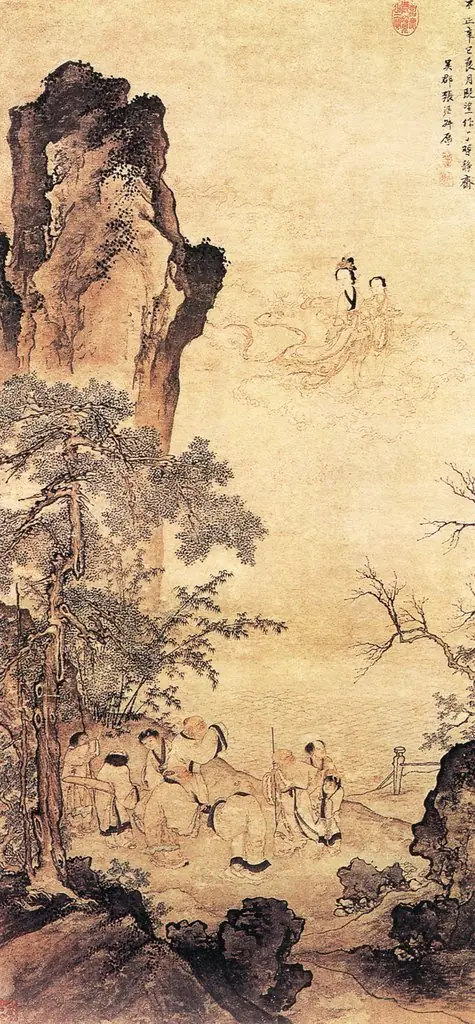
Nine Songs is an unspecified painting by the Yuan dynasty literati painting artist Zhang Wo. It dates from 1361 and is held in the collection of the Cleveland Museum of Art.
- Accession no.
- 1959.138
- Credit line
- Purchase from the J. H. Wade Fund
About this work
It’s one of the few surviving works from the Yuan dynasty that shows how artists mixed poetry and painting.
You see nine tall, wispy figures floating in a misty space, each drawn with thin black ink lines.
This painting illustrates songs from an ancient Chinese poem about shamans and spirits. The artist used baimiao, a style like calligraphy, to make the figures feel light and dreamy. It’s one of the few surviving works from the Yuan dynasty that shows how artists mixed poetry and painting.
To see how other Yuan artists used ink, look up china, yuan dynasty (1271-1368).
Overview
This ink painting, created during the Yuan dynasty, depicts scenes from the 'Nine Songs,' a collection of ancient ritual poems from the Chu region. Executed in the baimiao technique, it employs delicate, uncolored brushstrokes to render nine ethereal figures suspended in a void. The work stands as a rare surviving example of literati painting that unites poetic tradition with visual abstraction, reflecting a shift toward introspective artistic expression in the period.
Subject & Meaning
The 'Nine Songs' originate from shamanic rites of the ancient Chu kingdom, invoking deities and spirits through lyrical incantations. The painting translates these texts into visual form, portraying spectral figures that seem to drift between realms. Rather than illustrating narrative events, the artist evokes the mystical atmosphere of ritual, emphasizing spiritual presence over literal storytelling, aligning with literati ideals of inner resonance over external representation.
Technique & Style
The artist employed baimiao, a monochrome ink technique rooted in calligraphic line, to suggest form without shading or color. Each figure is defined by slender, fluid strokes that convey movement and weightlessness. The absence of background or detail enhances the sense of otherworldliness, while the precision of the brushwork reveals the artist’s mastery over control and rhythm, mirroring the cadence of the original poetry.
History & Provenance
As one of the few extant Yuan dynasty paintings directly inspired by the 'Nine Songs,' this work offers insight into how scholar-artists engaged with classical texts during a time of foreign rule. Its survival is exceptional, given the fragility of ink on paper and the political upheavals of the era. The painting’s transmission through private collections underscores its value to connoisseurs who prized literary allusion and refined brushwork.
Context
During the Yuan dynasty, Han Chinese literati often turned to classical literature as a means of cultural preservation under Mongol governance. Painting became a vehicle for expressing philosophical and poetic ideals when official patronage was limited. The 'Nine Songs' provided a resonant mythic framework, allowing artists to explore themes of transcendence and the unseen, aligning visual art with the scholarly tradition of textual interpretation.
Legacy
This painting exemplifies the literati ideal of integrating poetry, painting, and personal expression into a unified aesthetic. Its influence can be traced in later Ming and Qing works that continued to draw from ancient texts using minimalist ink techniques. Though not widely known outside specialist circles, it remains a key reference for understanding how Chinese artists transformed ritual poetry into meditative visual forms.

Artist & collection
Artist
Zhang Wo (or Zhang Wu, Chinese: 張渥), courtesy name as Shuhou, sobriquet as Zhenqisheng and Jianghaike, is a famed Chinese painter who was active during the Yuan Dynasty.


- The Illustrated Miraculous Origins of the Yūzū Nenbutsu School
 Pure Tones among Hills and Waters
 Untitled
 Leisure Enough to Spare
 Flowers of Four Seasons, with Poems
 The Illustrated Tale of Oishi Hyōroku
 Eight Views of Xiao-Xiang
 The Saltmaker's Story
 The Lantern Night Excursion of Zhong Kui
 The Story of Fukutomi
 S 33 - Peisaj la Sulina (Dunăre și faleză cu tufe de flori grena)
 Peisaj