Artwork
Eight Views of Xiao-Xiang

Eight Views of Xiao-Xiang is an unspecified painting by the Nihonga artist Sesson Shūkei. It dates from 1504 and is held in the collection of the Cleveland Museum of Art.
- Accession no.
- 1979.77
- Credit line
- Gift of Sherman E. Lee in memory of John D. Rockefeller, 3rd
About this work
It’s part of a series called Eight Views of Xiao-Xiang, inspired by old Chinese poems.
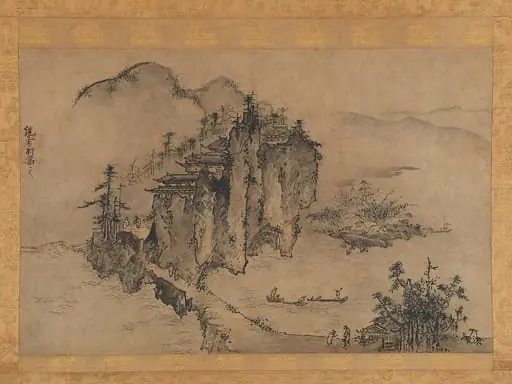
This ink painting shows misty mountains, a lone boat, and distant trees. It’s part of a series called Eight Views of Xiao-Xiang, inspired by old Chinese poems. Artists often painted this scene without ever seeing it. They focused on mood, not exact details.
The brushwork is soft and wet, creating blurry edges. This technique is called sfumato. It makes the scene feel quiet, like a memory half-forgotten.
Try looking up Sesson Shūkei (Japanese, c. 1492–c. 1577) next.
Overview
This miniature ink painting, created during Japan’s Muromachi period, belongs to a series that interprets the traditional “Eight Views of Xiao‑Xiang.” The work presents a mist‑shrouded landscape of mountains, a solitary boat, and distant trees, each scene evoking a specific time of day or atmospheric condition drawn from Chinese poetic conventions.
Subject & Meaning
The eight panels reference distinct moments such as “Wild Geese Descending to Sandbar” and “Night Rain on the Xiao and Xiang,” each title suggesting a seasonal or temporal mood. Rather than documenting the actual geography of the Xiao and Xiang rivers in present‑day Hunan, the artist seeks to capture the lyrical ambience of dim light, mist, and quietude that the poems celebrate.
Technique & Style
Executed in ink wash, the painting employs soft, wet brushstrokes that blur outlines, a method akin to the Chinese technique of sfumato. This approach creates a hazy, atmospheric effect, allowing forms to dissolve into mist and giving the scene a contemplative, almost remembered quality that aligns with Zen aesthetic principles.
History & Provenance
The “Eight Views” motif originated in 11th‑century Chinese poetry and painting, later spreading to Korean and Japanese artists. Japanese Zen monk Shukei Sesson (c.1492‑c.1577) adapted the full set of eight scenes for his shukuzu (miniature) format, despite most artists never having visited the actual river region.
Context
During the Muromachi era, Japanese painters frequently engaged with Chinese literary themes, using them as vehicles for personal expression and spiritual reflection. Sesson’s rendition reflects this cross‑cultural dialogue, integrating Chinese poetic titles with Japanese ink techniques to explore the interplay of nature, transience, and meditation.

Artist & collection

 Myriad Miles of the Yangtze River
 Insects and Flowers
 In the Palace
 Flowers of Four Seasons, with Poems
 Poetic Feeling in a Thatched Pavilion
 The Illustrated Tale of Oishi Hyōroku
 Landscape in the Style of Huang Gongwang
 Snow Coloring the World White
 Water Village
 The Illustrated Miraculous Origins of the Yūzū Nenbutsu School
 Mt. Taibo in the Style of Wang Meng
- Poems and Pictures of the Eight Views of Xiao-Xiang