Art Glossary
Nocturne /NOK-turn/
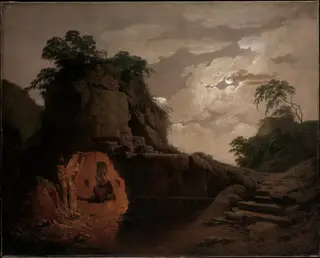
A nocturne is a painting of a night scene, or one that evokes the mood and tonal qualities of night, typically in a restrained palette of dark, cool colours.
The term was borrowed into painting from music, where a nocturne is a quiet, reflective piece evoking the night. James McNeill Whistler adopted it in the 1870s for his atmospheric views of the Thames at dusk and after dark, choosing a musical word deliberately to signal that his pictures were about mood and tonal harmony rather than narrative or topography. He spoke of arranging colour as a composer arranges sound.
A nocturne is defined less by its subject than by its constraints. Night drains colour and contrast, so the painter works within a narrow, near-monochrome range of blues, greys and blacks, with only a few points of artificial or reflected light — a lamp, a window, the moon on water — to anchor the eye. The challenge and the beauty both lie in making so limited a range carry the whole emotional weight of the picture.
Whistler did not invent night painting; the Dutch master Aert van der Neer had specialised in moonlit canals two centuries earlier, and the Romantics painted moonrise as an emblem of the sublime. But Whistler's nocturnes crystallised the idea that night could be a subject in its own right, and the term became a recognised category of tonal, atmospheric painting that fed directly into Tonalism and the mood-driven art of the later nineteenth century.
To read a nocturne, find the single point of light and notice how the painter has organised the surrounding dark around it; that economy of illumination is the essence of the form.
In the collection
Frequently asked
What is a nocturne in painting?
A nocturne is a painting of, or evoking, a night scene, usually in a restrained palette of dark cool colours with a few points of light.
Why is it called a nocturne?
James McNeill Whistler borrowed the term from music — where a nocturne is a reflective night piece — to stress that his paintings were about mood and tonal harmony.