Movement
Catalan Gothic
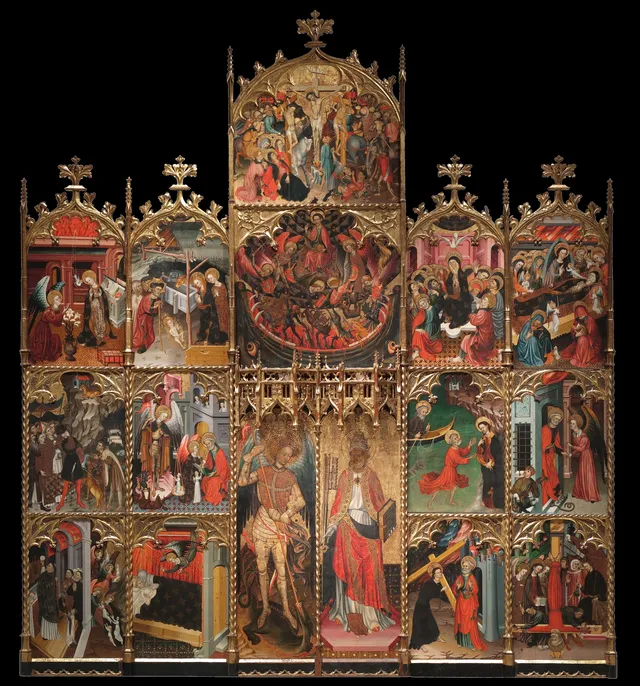
Catalan Gothic is an art movement. The gallery holds 1 work in this movement, including works by Bernat Despuig. Browse Catalan Gothic paintings, portraits, pictures and artworks from the world's public-domain museum collections.
Catalan Gothic was an artistic and, above all, architectural style that flourished in the Principality of Catalonia within the Crown of Aragon between the 13th and 15th centuries, bridging the close of the European Gothic age and the threshold of the Renaissance. It grew out of the commercial and maritime ascendancy of medieval Barcelona and the Aragonese crown, whose merchant guilds, municipal councils and monarchy financed an ambitious campaign of building. Drawing on the constructive methods of the cathedral schools of southern France and tempered by Italian influence, Catalan masons adapted the northern Gothic vocabulary to a Mediterranean setting, producing a regional idiom of unusual restraint and structural clarity.
Its defining characteristic is a preference for horizontal breadth over the soaring verticality of French or English Gothic. Catalan churches balance height against width, favouring vast, hall-like interiors: the nave of Girona Cathedral, at roughly 23 metres, is the widest in the Gothic world, while Manresa reaches about 18 metres, against the 12-to-14-metre naves typical in France. Buttresses are pulled inside the building to frame rows of side chapels, walls are pierced by few windows—the strong Mediterranean light made large glazed expanses unnecessary—and surfaces remain sparsely decorated, with plain pillars and broad vaults crowned by large sculpted, painted keystones. Barcelona's Santa Maria del Mar, raised between 1329 and 1384 to a design by Berenguer de Montagut, is the purest surviving expression of the style; the period also produced a rich civil architecture of exchange halls, palaces and council chambers.
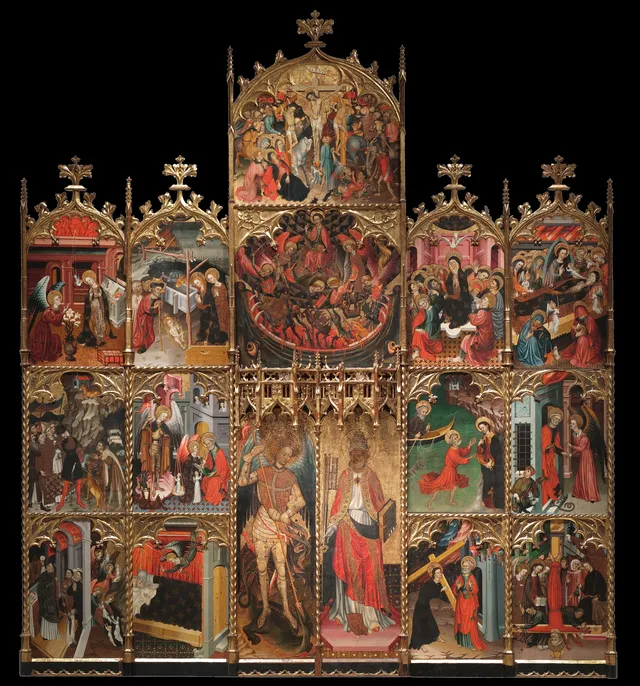
In painting, the style passed through successive phases. Ferrer Bassa's workshop, alert to Giotto and Tuscan models, opened a golden age around the mid-14th century, continued by the Serra brothers. Lluís Borrassà introduced the International Gothic, with its anecdotal detail and tender narrative scenes, while Bernat Martorell and later Lluís Dalmau absorbed Flemish naturalism, culminating in Jaume Huguet, the dominant Catalan painter of the later 15th century. Among the panel painters was Bernat Despuig (documented 1383–1451), who with Jaume Cirera produced the Altarpiece of Saint Michael and Saint Peter (1432–1433) in tempera and gold leaf for Sant Miquel de la Seu d'Urgell, now in the Museu Nacional d'Art de Catalunya.
Catalan Gothic left a lasting imprint on the architecture of Valencia, Mallorca and the wider western Mediterranean, and its great altarpieces remain central to the Iberian Gothic canon. Standing between French High Gothic and the incoming Italian and Flemish currents that heralded the Renaissance, it remains one of the most distinctive regional schools of the late medieval period.
Key artists
Works
Frequently asked questions
What is Catalan Gothic?
Catalan Gothic is an art movement. A distinctive variant of the Gothic style that flourished in Catalonia and the Crown of Aragon from the 13th through 15th centuries.
Who are the key Catalan Gothic artists?
Key Catalan Gothic artists in the collection include Bernat Despuig.
Where can I see Catalan Gothic works?
Catalan Gothic works in the collection are held by Museu Nacional d'Art de Catalunya.