Movement
German Gothic
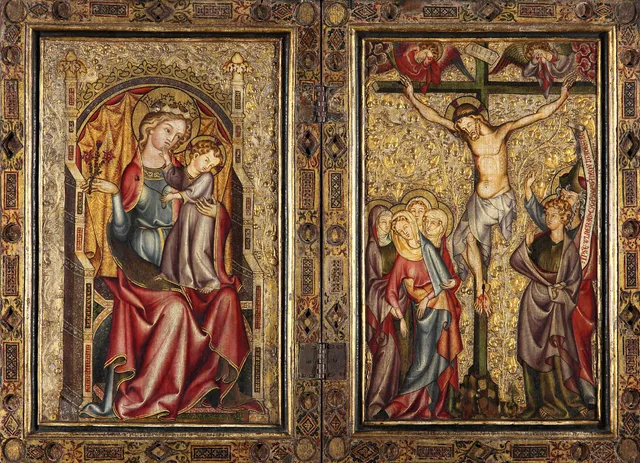
German Gothic is an art movement of the 1300–1500 period. The gallery holds 1 work in this movement. Browse German Gothic paintings, portraits, pictures and artworks from the world's public-domain museum collections.
German Gothic painting flourished in the German-speaking lands from the late fourteenth into the fifteenth century, a regional flowering of the International Gothic that swept Europe's courts around 1400. Its Central European variant, the Weicher Stil or "soft style," took root around 1390 in Westphalia and the Rhineland, carried by artists working for wealthy merchant cities — Cologne above all, then a commercial and artistic hub of northern Europe. The work was overwhelmingly devotional: painted altarpieces and smaller panels made to focus prayer in churches, council chapels, and private homes, where they staged the lives of Christ, the Virgin, and the saints with vivid immediacy.
The style is recognizable at a glance. Figures stand against backgrounds of solid gold leaf — the gold ground — finely tooled with punched ornament and incised tracery, often crowned by painted baldachins that frame the holy figures like statues. There is little or no spatial depth; meaning is carried instead by sharp, flowing contour line, a luminous palette of jewel-like colors, and an unguarded emotional intensity. Gold and costly blue pigments such as azurite and lapis lazuli made these panels expensive objects, their materials a substantial part of the commission's cost.
The tradition's leading figures span its arc. Conrad von Soest (c. 1370–after 1422) introduced the courtly soft style to northern Germany; his Marienaltar in Dortmund, of around 1420, is a touchstone of refined color and gilding. The Master of Saint Veronica brought the same idiom to Cologne early in the century, laying the ground for its greatest master, Stefan Lochner (c. 1410–1451), whose Last Judgement (c. 1435), Altarpiece of the Patron Saints of Cologne (c. 1440–1442, now in Cologne Cathedral), and Madonna of the Rose Bower fuse flowing line and brilliant gold with an emerging Northern realism. Our Cologne Diptych belongs to this intimate gold-ground devotional culture.
The Cologne school reached its high point at mid-century, then gave way as Netherlandish naturalism and the printmaking of Martin Schongauer (c. 1445–1491) and Albrecht Dürer (1471–1528) introduced Italianate perspective and classical proportion — the reforms that opened the German Renaissance.
Works
Frequently asked questions
What is German Gothic?
German Gothic is an art movement. Late-medieval painting in the German lands, with sharp line, intense emotion, and gold-ground altarpieces.
When did German Gothic take place?
German Gothic dates from 1300–1500.
Where can I see German Gothic works?
German Gothic works in the collection are held by Gemäldegalerie Berlin.