
Movement
Chinese Individualist School
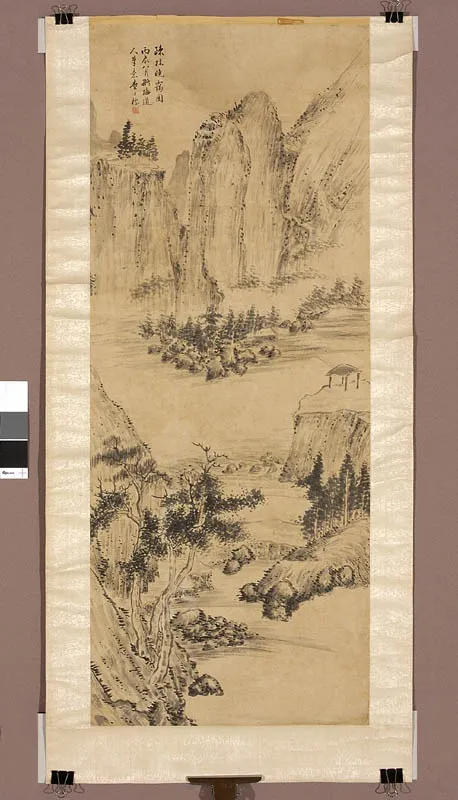
Chinese Individualist School is an art movement dating from 1640. The gallery holds 2 works in this movement, including works by Zha Shibiao, Zheng Min and Wen Zhengming. Browse Chinese Individualist School paintings, portraits, pictures and artworks from the world's public-domain museum collections.
The Chinese Individualist school — also called the Eccentrics — emerged from the trauma of the Ming–Qing transition, when the Manchu conquest of 1644 toppled the native Ming dynasty. A generation of southern painters, many of them yimin or "leftover subjects" who refused to serve the new regime, made painting a vehicle for grief, defiance, and intensely private feeling. Several were scions of the fallen imperial house: Bada Shanren (Zhu Da, 1626–1705), a descendant of the Ming prince Zhu Quan of Nanchang, and his kinsman Shitao (Daoji, c. 1642–1707) both took refuge in Buddhist monasteries to disguise their identities. They rejected the dominant orthodoxy of Dong Qichang and the "Four Wangs," who prized the faithful copying of old masters, insisting instead that brush and ink answer to lived experience.
Visually the school is defined by free, abbreviated, calligraphic brushwork and deliberate distortion. Bada cultivated a sparse, enigmatic manner — glaring fish and sullen birds set in vast voids — that juxtaposes solid and empty, heavy and light to suggest a troubled inner world. Shitao, the most original landscapist of the seventeenth century, painted from direct observation and set out his philosophy in the Huayulu ("Comments on Painting"), centred on yihua, the "single brushstroke" from which an entire composition unfolds.
The canonical core is the "Four Monks": Bada Shanren, Shitao, Hongren (1610–1664), and Kuncan (1612–c. 1673). Hongren anchored the related Anhui (Xin'an) school, whose painters revived the dry, austere linear manner of the Yuan master Ni Zan and drew on the landscape of the nearby Yellow Mountains. Among them were Zha Shibiao (1615–1698) and Dai Benxiao (1621–1693); the collection holds Zha's "Landscape in the Style of Ni Zan," exemplifying that cool, spare lineage, alongside the boisterous "Drunken Zhong Kui" by the later Yangzhou eccentric Hua Yan (1682–1756).
Standing as rival and counterpart to the Orthodox school, the Individualists carried their self-expressive impulse into the eighteenth century through the Eight Eccentrics of Yangzhou, and their freedom of brush would prove decisive for modern masters such as Qi Baishi and Zhang Daqian, who looked back to Bada and Shitao as founding spirits.
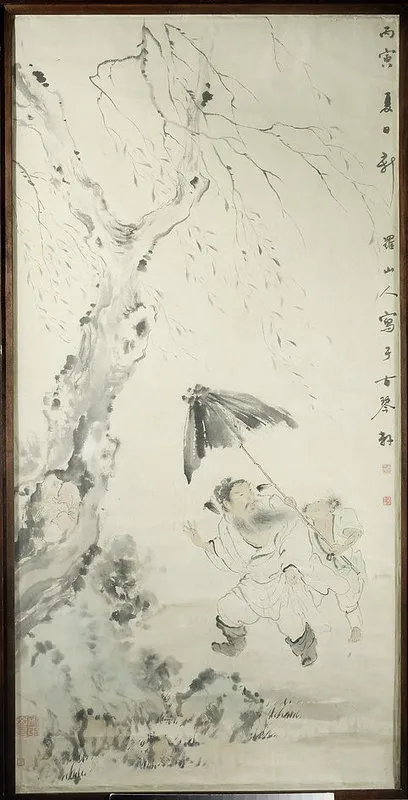
Key artists
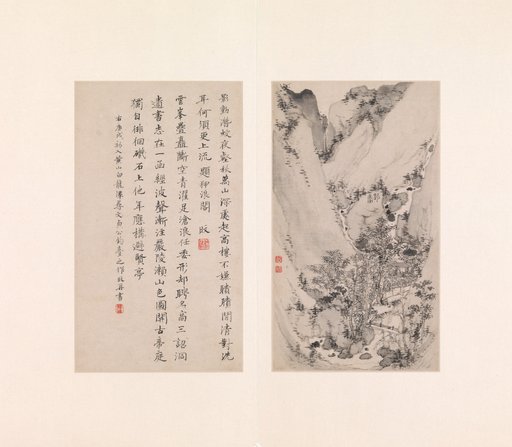

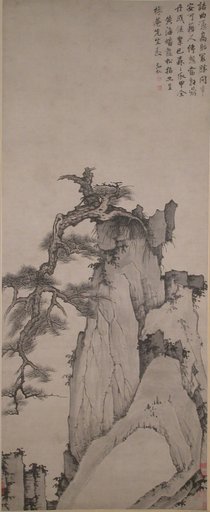
Works
Frequently asked questions
What is Chinese Individualist School?
Chinese Individualist School is an art movement. Eccentric early-Qing painters like Bada Shanren and Shitao who rejected orthodox imitation.
Who are the key Chinese Individualist School artists?
Key Chinese Individualist School artists in the collection include Zha Shibiao, Zheng Min and Wen Zhengming.
When did Chinese Individualist School take place?
Chinese Individualist School dates from around 1640.
Where can I see Chinese Individualist School works?
Chinese Individualist School works in the collection are held by National Museum in Warsaw.