Movement
Egyptian Revival
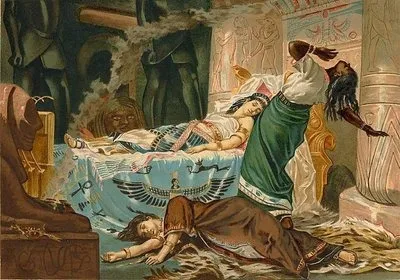
Egyptian Revival is an art movement dating from 1800. The gallery holds 1 work in this movement. Browse Egyptian Revival paintings, portraits, pictures and artworks from the world's public-domain museum collections.
Egyptian Revival is a current of decorative and fine art, architecture, and design that drew its vocabulary from the monuments of ancient Egypt. It crystallised in the wake of Napoleon Bonaparte's military expedition to Egypt in 1798—an event memorialised in Europe as much for its scholarship as its campaigns. Bonaparte travelled with some 160 scholars, artists, and engineers, among them Dominique-Vivant Denon, whose illustrated Voyage dans la Basse et la Haute Égypte (1802) and the monumental, state-sponsored Description de l'Égypte (published in installments from 1809 to 1826) flooded the Continent with accurate images of temples, tombs, and hieroglyphs. The resulting "Egyptomania" reshaped European and American material culture for decades.
Visually, the style is recognisable by a compact repertoire of motifs: obelisks, pyramids, sphinxes, scarabs, winged sun-disks, hieroglyphic cartouches, and stylised plant forms such as the lotus and papyrus. Designers favoured massive, planar geometry, battered (inward-sloping) walls, lotiform and palmiform columns, and the distinctive cavetto cornice borrowed from temple gateways. In furniture and metalwork these appeared as gilt-bronze sphinx mounts, pharaonic herm supports, and lion's-paw feet, translating antiquity into fashionable interiors.
The movement's leading tastemakers worked chiefly in design rather than painting. In Napoleonic France, the architects Charles Percier and Pierre-François-Léonard Fontaine codified the Empire style in their Recueil de décorations intérieures (1801–12). In Britain, the connoisseur Thomas Hope created a celebrated Egyptian room at his Duchess Street house and published its designs in Household Furniture and Interior Decoration (1807), a touchstone of the Regency taste.
The Egyptian theme also fed a strand of academic and Orientalist painting fascinated by the figure of Cleopatra. Juan Luna's monumental The Death of Cleopatra (1881)—held in this catalogue—exemplifies that tradition: the Filipino painter won a silver medal with it at the National Exposition of Fine Arts in Madrid, and it now hangs in the Museo del Prado, one of few works by a Filipino artist on permanent display there.
Egyptian Revival never stood wholly apart from Neoclassicism, with which it shared archaeological seriousness, and it later overlapped with nineteenth-century Orientalism. A potent second wave followed Howard Carter's discovery of Tutankhamun's tomb in November 1922, when angular Egyptian forms became part of the visual language of Art Deco, ensuring the style's enduring presence in jewellery, cinema, and architecture.
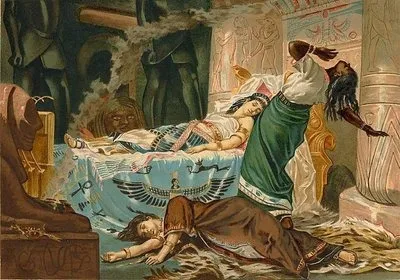
Works
Frequently asked questions
What is Egyptian Revival?
Egyptian Revival is an art movement. A wave of Egyptian-inspired decorative motifs in Western art and architecture following Napoleon's Egyptian campaign (1798–1801) and the decipherment of hieroglyphics.
When did Egyptian Revival take place?
Egyptian Revival dates from around 1800.
Where can I see Egyptian Revival works?
Egyptian Revival works in the collection are held by Museo del Prado.