Movement
Mir Iskusstva
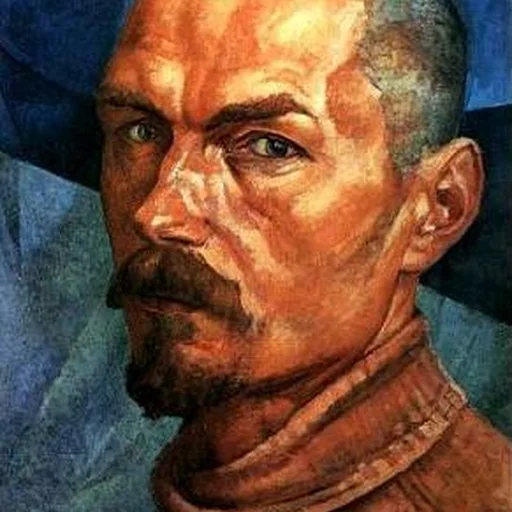
Mir Iskusstva is an art movement of the 1899–1904 period. The gallery holds 1 work in this movement, including works by Kuzma Petrov-Vodkin. Browse Mir Iskusstva paintings, portraits, pictures and artworks from the world's public-domain museum collections.
Mir Iskusstva ("World of Art") emerged in Saint Petersburg in November 1898, when a circle of friends and former schoolmates—Alexandre Benois, Léon Bakst, Konstantin Somov, Dmitry Filosofov, and Eugene Lansere, with the impresario Sergei Diaghilev as its driving organizer—coalesced around a shared distaste for the prevailing direction of Russian art. The following year they launched the lavishly produced journal of the same name (published 1899–1904), with Diaghilev as chief editor and chief polemicist, whose essays such as "Difficult Questions" laid out the group's creed. They defined themselves against the Peredvizhniki (the "Wanderers"), whose earnest social realism had dominated for a generation. Against didactic content, the miriskusniki proclaimed the autonomy of art and the primacy of beauty, individuality, and refined craftsmanship—an outlook closely allied to the European Art Nouveau and Symbolist currents of the fin de siècle.
Stylistically the group favored intimacy and decorative finesse over the grand oil canvas. Its members worked readily in watercolour and gouache, prized line and ornament, and excelled at book illustration, stage design, and interior decoration—seeking, as Benois put it, to carry art into every house. Their recurring subjects were carnivals, masquerades, dreams, and fairy tales, often steeped in a nostalgic revival of the elegance of 18th-century Versailles and Petersburg. Somov's rococo-tinged "Lady in Blue," Benois's "Versailles" series, and Bakst's vividly patterned designs are characteristic; Ivan Bilibin brought the same sensibility to Russian folk tales in his celebrated illustrated books.
The movement's deepest legacy lay in the theatre. From 1909 several miriskusniki designed for Diaghilev's Ballets Russes in Paris, where Bakst and Benois transformed scenography with their décor for productions including "Petrushka" (1911), spreading the group's aesthetic across Europe and influencing fashion and design well beyond painting. Closely entwined with the literary Symbolists of Russia's "Silver Age," Mir Iskusstva also helped prepare the ground for the Russian avant-garde that followed. The revived World of Art exhibitions of the 1910s drew a wider circle, among them Kuzma Petrov-Vodkin, whose "Bathing the Red Horse" (1912)—fusing icon-painting, early Italian fresco, and his own luminous palette—hung like a banner at the society's 1912 show and became a sensation of the era.
Key artists
Works
Frequently asked questions
What is Mir Iskusstva?
Mir Iskusstva is an art movement. The 'World of Art,' a turn-of-the-century Russian movement and journal founded around Diaghilev and Benois.
Who are the key Mir Iskusstva artists?
Key Mir Iskusstva artists in the collection include Kuzma Petrov-Vodkin.
When did Mir Iskusstva take place?
Mir Iskusstva dates from 1899–1904.
Where can I see Mir Iskusstva works?
Mir Iskusstva works in the collection are held by Tretyakov Gallery.