Artist
Movement
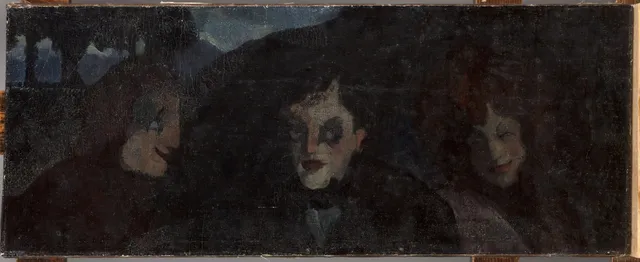
Decadence is an art movement of the 1870–1900 period. The gallery holds 1 work in this movement, including works by Félicien Rops. Browse Decadence paintings, portraits, pictures and artworks from the world's public-domain museum collections.
Decadence was a late-nineteenth-century artistic and literary movement, centered in Western Europe and first flourishing in France during the 1870s and 1880s before spreading across the Continent, to Britain, and to the United States. Its very name was originally an insult—a charge that the era's art mirrored the moral decay Montesquieu had blamed for Rome's fall—which writers such as Théophile Gautier and Charles Baudelaire defiantly adopted as a badge of honor. Baudelaire, who called himself decadent in the 1857 edition of *Les Fleurs du mal*, became the movement's presiding spirit. Paul Verlaine embraced the epithet "décadent," and from 1886 to 1889 Anatole Baju's review *Le Décadent* gave the tendency a name and a platform. Decadence grew partly out of Romanticism yet revolted against its worship of nature, and it set itself sharply against the Naturalism of contemporary Realists.
Aesthetically, the Decadents prized artifice over nature, sensation over morality, and the cult of "art for art's sake." Their work is marked by world-weariness, refined perversity, morbidity, and a fascination with taboo: sexuality, addiction, religious blasphemy, and self-destruction. The recurring iconography of the femme fatale, the androgyne, and the languid dandy runs throughout, rendered with ornate, hothouse intensity.
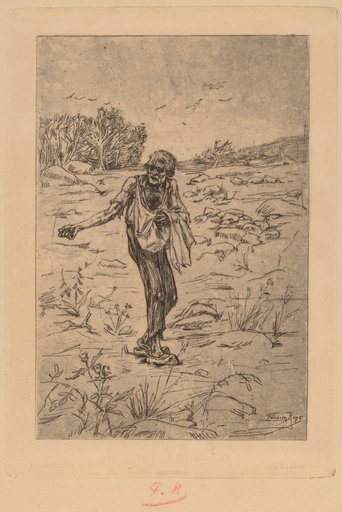
The movement's literary keystone was Joris-Karl Huysmans's 1884 novel *À rebours* (Against Nature), dubbed the "breviary of decadence," whose reclusive hero Des Esseintes worships the jewel-toned canvases of Gustave Moreau—above all *The Apparition* (c. 1874–76), depicting Salomé and the floating head of John the Baptist. In the visual arts the Belgian printmaker Félicien Rops (1833–1898), represented in this collection, is the defining figure: a master of etching, aquatint, and drypoint whose erotic, sacrilegious scenes fuse sex, death, and demonology. In Britain, Aubrey Beardsley (1872–1898) gave Decadence its most famous graphic style in his sinuous black-and-white illustrations for Oscar Wilde's *Salomé*.
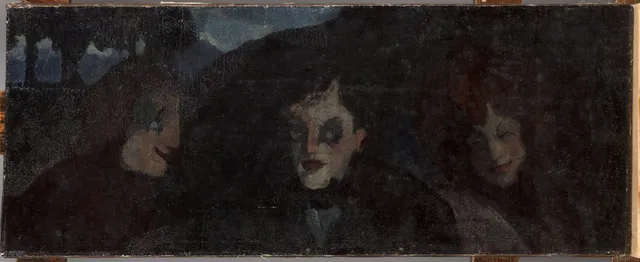
Decadence overlapped closely with Symbolism and Aestheticism—so closely that the labels are often confused—and its imagery shaped artists from Edvard Munch to Max Klinger. Its influence radiated outward across Europe, as seen in the work of the Polish painter and playwright Stanisław Ignacy Witkiewicz (Witkacy), whose painting *Decadence* this collection holds. Though largely spent by the First World War, the movement's embrace of artifice and transgression anticipated Art Nouveau, Surrealism, and modern aestheticism.
Artist
Decadence is an art movement. A late-19th-century European literary and artistic movement that prized artifice, the exotic, and the perverse over naturalism and moral earnestness.
Key Decadence artists in the collection include Félicien Rops.
Decadence dates from 1870–1900.
Decadence works in the collection are held by National Museum in Kraków.
Your cart is empty
Browse artworks →