
Movement
Neoplasticism
Neoplasticism is an art movement of the 1910–1940 period. The gallery holds 2 works in this movement, including works by Piet Mondrian. Browse Neoplasticism paintings, portraits, pictures and artworks from the world's public-domain museum collections.
Neoplasticism (from the Dutch *Nieuwe Beelding*, "the new plastic") was an avant-garde art theory formulated by the Dutch painter Piet Mondrian in 1917 and first carried into practice by the De Stijl movement. It emerged in the Netherlands during the First World War, a period of forced neutrality and cultural introspection, as artists sought a universal visual language purged of the individual emotion and naturalistic appearance they associated with a discredited old order. Mondrian set out its principles in the essay "Neo-Plasticism in Pictorial Art," published across twelve installments of the journal *De Stijl* in 1917–18. The thinking was partly shaped by the theosophical mathematician M. H. J. Schoenmaekers, whose treatise *Beginselen der beeldende wiskunde* (The Principles of Plastic Mathematics) framed reality as a play of opposing forces — the vertical against the horizontal, primary color against primary color.
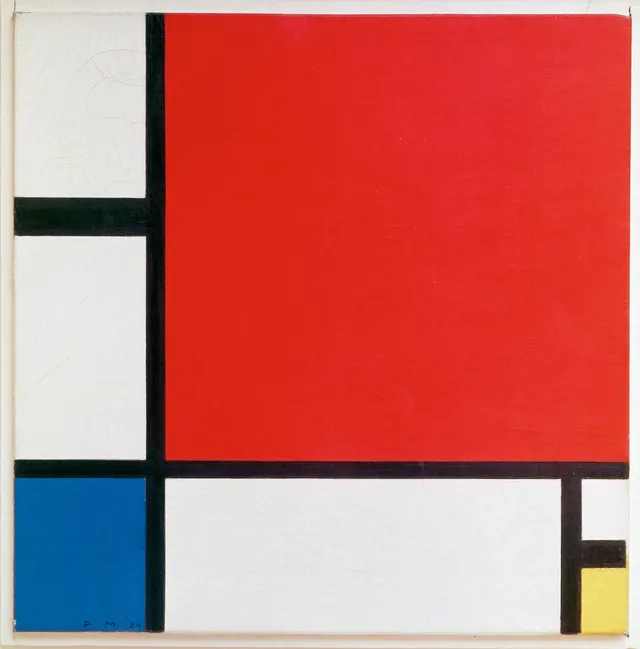
Visually, Neoplasticism is austere and instantly recognizable. It restricts the painter to horizontal and vertical lines, rectangular planes, the three primary colors (red, blue, yellow), and the three "non-colors" (black, white, gray). Perspective, modeling, curve, and diagonal are all banished. From this deliberately narrow vocabulary the artist seeks dynamic equilibrium: asymmetrical balance in which no single element dominates, an expression of what Mondrian considered universal harmony underlying the visible world.
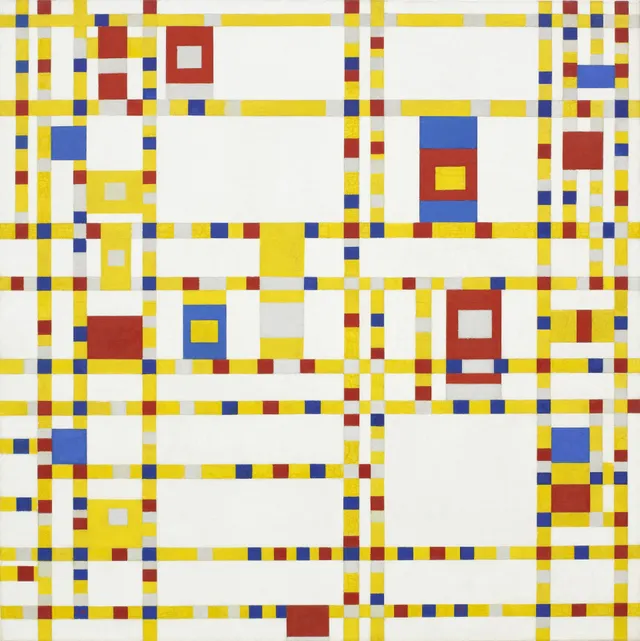
Mondrian remained the movement's defining figure, and works such as *Composition II in Red, Blue, and Yellow* (1930) distill the idiom to its essentials. After emigrating to New York in 1940, he loosened the rules in the syncopated, gridless pulse of *Broadway Boogie Woogie* (1942–43). The theory was also championed by Theo van Doesburg, co-founder of *De Stijl*, until his introduction of the diagonal in his 1925 doctrine of Elementarism caused a rupture with Mondrian, who left the group. In France its most committed adherent was Jean Gorin (1899–1981), whom Mondrian called the only French Neoplastic artist; Gorin extended the language into three-dimensional reliefs and admitted circles and diagonals.
Though Neoplasticism is often used interchangeably with De Stijl, it is more precisely the painterly doctrine at that movement's core. Its reductive grammar of grid and primary color radiated far beyond painting — into the architecture and furniture of Gerrit Rietveld, the Bauhaus, the International Style, and later graphic and product design — making it one of the most durable foundations of geometric abstraction and modernist visual culture.
Key artists
Works
Groups & collectives
Frequently asked questions
What is Neoplasticism?
Neoplasticism is an art movement. Piet Mondrian's theory and practice of pure abstract painting, developed within De Stijl from around 1917.
Who are the key Neoplasticism artists?
Key Neoplasticism artists in the collection include Piet Mondrian.
When did Neoplasticism take place?
Neoplasticism dates from 1910–1940.
Where can I see Neoplasticism works?
Neoplasticism works in the collection are held by Kunsthaus Zürich and Museum of Modern Art.