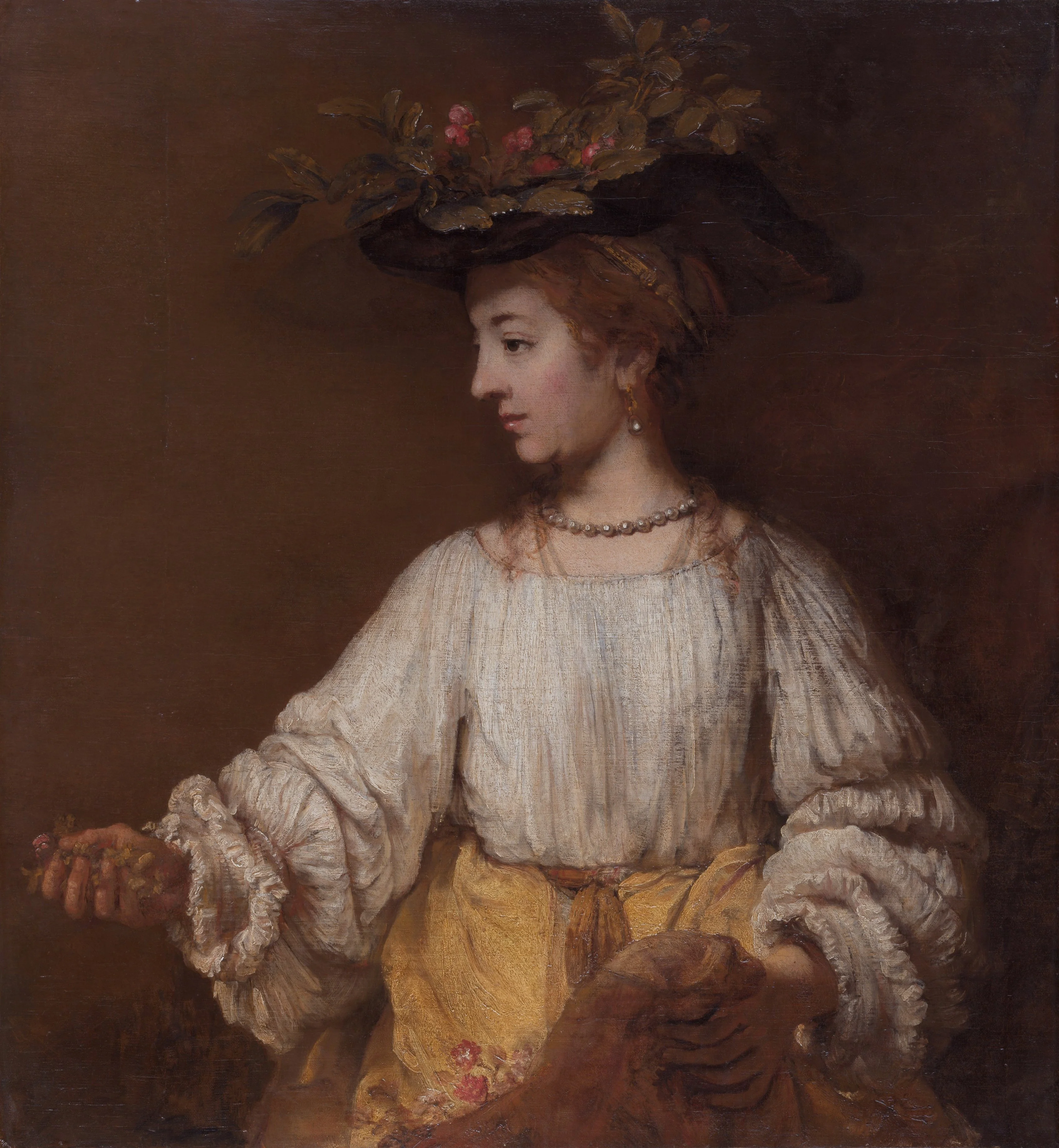
Ask a docent what Rembrandt was after and you will hear something about light. Look instead at the paintings of Rembrandt van Rijn in sequence, from the tight enamelled panels of his Leiden youth to the loaded canvases of his last decade, and a different shape comes up through the varnish. He spent roughly forty years worrying at a single question: how little of a face can you actually put down and still leave a living person on the panel? Light was only ever the instrument he used to ask it. The question is the constant. The answers change, and they change radically.
My claim is that those answers are not one style ripening toward a single perfection. They are rival solutions, tried, banked, abandoned, occasionally dug up again. The young Rembrandt answered with total description, every hair and pearl and gold thread accounted for. The prosperous Amsterdam portraitist answered with flattering exactness, the sitter delivered intact to a paying family. The bankrupt old man answered by subtraction: he picked up a coarser brush, left most of the detail out, and trusted a single dragged stroke of lead-tin yellow to do the work that a week of patient glazing used to do. I think the late answer is the one that holds, and the point of what follows is to say why the others do not.
The biographical coordinates are plain enough. Rembrandt Harmenszoon van Rijn was born in Leiden in 1606, a miller's son, and died in Amsterdam in 1669, according to the standard biographical record. His surviving output is usually put at around three hundred paintings and as many etchings. He worked first in his native Leiden and, from 1632, in Amsterdam, where he had briefly trained with the history painter Pieter Lastman; in 1639 he bought the grand house on the Sint-Anthonisbreestraat that now operates as the Rembrandt House Museum, as the Metropolitan Museum's Heilbrunn essay on his paintings records. Those are the bare facts. What he did inside them is the interesting thing.
The Leiden answer: describe everything
The first answer was to leave nothing out. In Leiden the young painter built faces the way a goldsmith builds a setting, surface by polished surface. An old woman's skin becomes a relief map of folds, each one caught by a needle of light; a metal gorget throws back the studio window in miniature. This is the register that his earliest serious pupil carried away wholesale. Gerrit Dou, who trained with Rembrandt as a teenager, made an entire career of it, founding the Leiden tradition of fijnschilders, the fine painters, whose works reward a magnifying glass. Dou's answer was to describe the world so completely that the eye could find no edge of paint anywhere. It is dazzling. It is also, in the end, a closed system: when everything is described, there is nothing left for the viewer to supply, and a face that surrenders all its information at once tends to stop holding the attention.
Rembrandt seems to have sensed this early. Even in the Leiden years he was running experiments his colleagues were not, using the etching needle to scribble his own face into a dozen passing emotions, scowling, laughing, gaping in mock surprise. These are not vanity pieces. They are a man testing how few marks it takes to make a mouth read as astonishment. The fine-painter answer and the etcher's shorthand were already at war in the same young hand.
Amsterdam, and the answer that paid
Amsterdam rewarded the describing hand handsomely. Once Rembrandt arrived in 1632 the portrait commissions came fast, and for a decade he gave the merchant class exactly what it wanted: likeness, dignity, the gleam of lace and the weight of a gold chain, rendered with enough finish to satisfy a sitter who was, after all, buying immortality by the square foot. His Portrait of a Lady with an Ostrich-Feather Fan belongs to this world of patronage, the sitter steady and self-possessed, her costume doing a good deal of the talking. This is the answer that paid the mortgage on the Sint-Anthonisbreestraat house.
But the most famous picture of these years already strains against the formula. In 1642 Rembrandt finished the enormous militia portrait now called The Night Watch, painted for the great hall of the Kloveniersdoelen, the civic guard's headquarters. As the Rijksmuseum puts it, he was the first to paint such a group actually doing something rather than lined up for inspection. The captain steps forward and speaks; a drummer rolls in from the right; a girl glows out of the gloom for reasons no one has fully explained. The commission asked for a row of paying faces. Rembrandt gave it a moment in motion instead, and in doing so he traded complete description for something riskier, the suggestion that these people existed before we walked in and will keep moving after we leave.
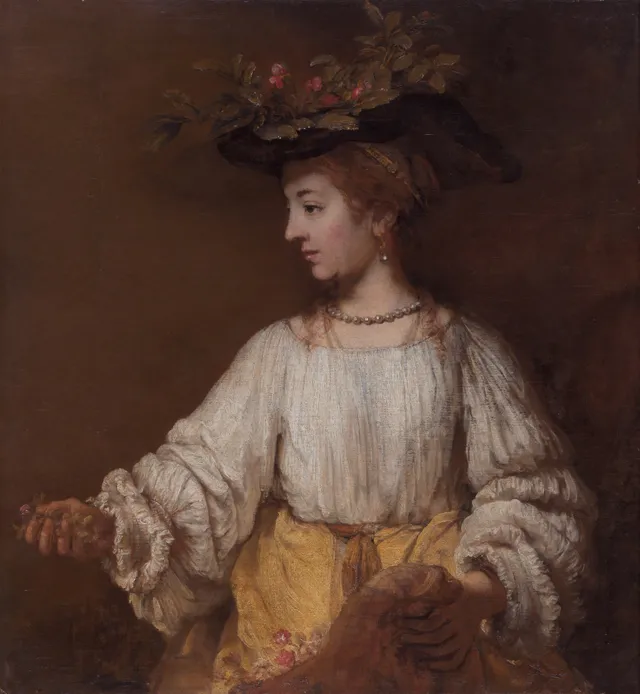
Looking hard at Flora
Stand close to Flora and you can watch the two answers fighting inside one canvas. A young woman turns three-quarters toward us, dressed as the goddess of spring in a costume that is half pastoral fantasy and half theatre wardrobe. Flowers crowd the band in her hair; she holds a flowered staff loosely, the way you hold a prop you have been handed rather than a thing you own. Now look at how the picture is actually made. The embroidery on her bodice is not counted out thread by thread in the Leiden manner. It is conjured. Rembrandt loads the brush and lets a few thick, broken touches stand in for a whole sleeve of needlework, so that from arm's length the fabric reads as dense and costly and up close it dissolves into frank ridges of pigment. The flowers are dabs. The light falls full and even on her face, and that face is the quietest thing in the painting, soft, a little withdrawn, declining to perform the goddess at all.
That is the discovery. The costume is where the bravura goes; the face is where the person stays, and the person is rendered with restraint precisely because Rembrandt has learned that a withheld expression reads as inner life while a fully described one reads as a mask. He spends the paint on the silk and saves the silence for the eyes. A lesser painter would have reversed the priorities and given us a brilliant face on a flat dress.
The late answer: take it away
Then the money failed. By the mid-1650s Rembrandt's affairs had collapsed, and his answer to the old question changed with his circumstances. The National Gallery of Art notes that he painted one of his great late self-portraits in 1659, the year after his possessions and the Sint-Anthonisbreestraat house had been auctioned because of his insolvency. A painter who has lost his collection of props and curiosities has, in a sense, lost his vocabulary of description. What he had left was the brush and the question. The late pictures answer it by removing almost everything that the Leiden panels insisted on.
Look at Aristotle with a Bust of Homer, painted for an Italian collector in this late manner. The philosopher stands in a darkness with no edges, dressed in a billowing white shirt under a dark sleeveless gown, a heavy gold chain looped twice across his chest. His right hand rests on the marble head of the blind poet. The fingers do not grip; they lie flat on the cold skull, almost as if listening through it. The light pools on the sleeve and the bust and then drowns, and the eyes look at nothing in the room. The whole drama lives in two facts set against each other: the worldly gold chain, a token of success and patronage, and the poor blind plaster head that outlasted every fortune. Rembrandt does not spell this out. He paints the sleeve in great loaded sweeps, lets the chain catch fire in a few thick gold strokes, and leaves the philosopher's thought entirely to us. Description has been replaced by implication.
The same withholding governs the Syndics of the Drapers' Guild, his last great group portrait. Five wardens of the cloth-makers' guild sit at a table laid with a rich carpet, an open ledger before them. One of them rises slightly, as if interrupted, and they all turn their heads toward us in the same instant. The picture stages the precise second in which a room of officials notices that someone has come in. Get close and the faces are built of broad, confident planes, the ruffs scumbled rather than drawn. There is no fine-painter polish anywhere. And yet these are among the most present human beings in Dutch art, exactly because Rembrandt trusts the suggestion of a glance over the inventory of a feature. The late answer is austere, and it is the one that survives contact with a living viewer.
The printmaker's answer
There is a third answer running in parallel to all the others, and it is made of bitten line rather than paint. Rembrandt was the most inventive printmaker of the seventeenth century. The Met's Heilbrunn essay on his prints credits him with around 350 etchings that extended what the medium could suggest about illumination and painterly effect. In a print he had no colour and no impasto. He had black lines and the white of the paper, and out of that pair he could conjure a whole room dropping into shadow with a window of light still alive at its centre.
The etchings also let him do something he rarely risked in a paid portrait: declare what he was. Smarthistory notes that in his 1636 etching Self-Portrait with Saskia he presented himself, for the first time, as an artist at work, holding a porte-crayon as he drew at the plate. The print is intimate, domestic, and quietly proud. It is also the clearest statement that for Rembrandt the question of how to render a person was bound up with the question of who was doing the rendering. The reorganisation of all this printed output into a usable chronology is itself a feat of scholarship; Arthur M. Hind's catalogue of the etchings, first issued in 1912, set the standard and is now freely readable on the Internet Archive.
What the archive actually holds
Here is a number worth sitting with. Artifact World Gallery holds 769 works under Rembrandt's name across 66 venues, ranging across roughly 1600 to 1669, the whole span of a life. Set that beside the standard estimate of about three hundred autograph paintings and you can read the gap. The difference is the afterlife of a name: the etchings and their multiple states, the workshop pictures, the copies and the works once given to the master and since reassigned, scattered now through dozens of institutions. A figure like 769, spread over 66 collections, is a measure not of how much one man painted but of how widely his answers travelled. No single museum, however great, can show you the shape of that diffusion. An archive that pools 66 of them can.
It matters because the standard story of Rembrandt is told through a handful of masterpieces in three or four famous rooms. The wider record shows the question being worked out across panels and plates of every ambition, from a roadside mill to a god disguised as a traveller, and it shows how thoroughly the answers seeped into the hands of everyone who studied with him.
Works discussed in this article
The question, passed down a workshop
A teacher's real legacy is which of his answers his pupils choose to keep. Rembrandt ran one of the busiest studios in Amsterdam, and the choices his students made tell you where the difficulty really lay. Ferdinand Bol absorbed the warm shadow and the loaded brush of the middle years and turned them into a smooth, marketable grandeur that the regents of Amsterdam were glad to hang. Nicolaes Maes took the master's tenderness toward ordinary people indoors, into kitchens and sickrooms, before he too drifted toward fashionable portrait formulas. Jan Victors kept the biblical subject matter and the dramatic staging while leaving the rough late handling well alone, and the Danish-born Bernhard Keil carried a version of the Rembrandt shadow all the way to Italy.
Notice the pattern. Almost every pupil kept the early and middle answers, the describable, sellable ones, and almost none kept the late answer of radical subtraction. That answer was too strange, too close to looking unfinished, too dependent on a confidence no apprentice could fake. It is instructive to set the whole Dutch enterprise beside a wholly separate tradition of expressive distortion, the elongated, flame-lit saints of El Greco, who arrived at emotional intensity by stretching the body rather than loosening the brush. Two roads to the same destination, the inner life made visible. Rembrandt's road, the one that drops detail rather than warps anatomy, turned out to be the one the next two centuries of painting would actually follow.
So: one question, several answers, and a clear winner. The Leiden answer described a person completely and produced a brilliant surface that gives itself up at once. The Amsterdam answer delivered the likeness the buyer paid for and kept the painter solvent for a while. The print answer proved that light could be built from nothing but line and bare paper. The late answer threw most of that away and discovered that a withheld detail, a glance only half-described, a sleeve made of three loaded strokes, leaves more room for a human being than any inventory of features ever did. Rembrandt arrived there poor, in a rented studio, with the props sold off. The poverty is part of the achievement. He found out what could be removed only after almost everything had been.
Stand in front of the Syndics turning their heads, or Aristotle's flat hand on the cold marble skull, and you are watching a man who has answered his own question for the last time and answered it by trusting you to finish the painting in your own head. That trust is the whole inheritance. Every painter who later left a face deliberately unresolved was working an idea Rembrandt proved first, in the dark, with the chain catching one last flare of gold.
Sources & further reading
- Rembrandt van Rijn (1606-1669): Paintings — The Met, Heilbrunn Timeline of Art History
- Rembrandt van Rijn (1606-1669): Prints — The Met, Heilbrunn Timeline of Art History
- The Night Watch (Militia Company of District II under Captain Frans Banninck Cocq) — Rijksmuseum
- Rembrandt van Rijn, Self-Portrait, 1659 — National Gallery of Art
- Rembrandt, Self-Portrait with Saskia (1636 etching) — Smarthistory
- Rembrandt — Wikipedia
- A Catalogue of Rembrandt's Etchings (1912) — Internet Archive, Arthur M. Hind