Artwork
The Mill
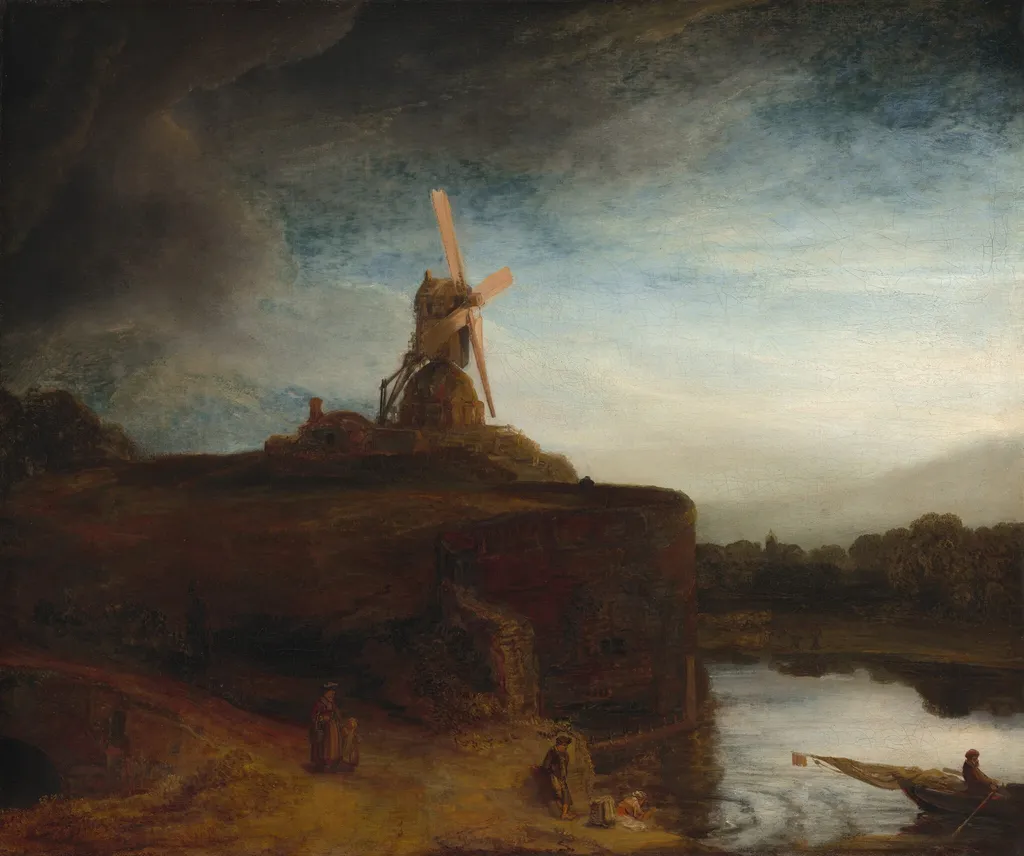
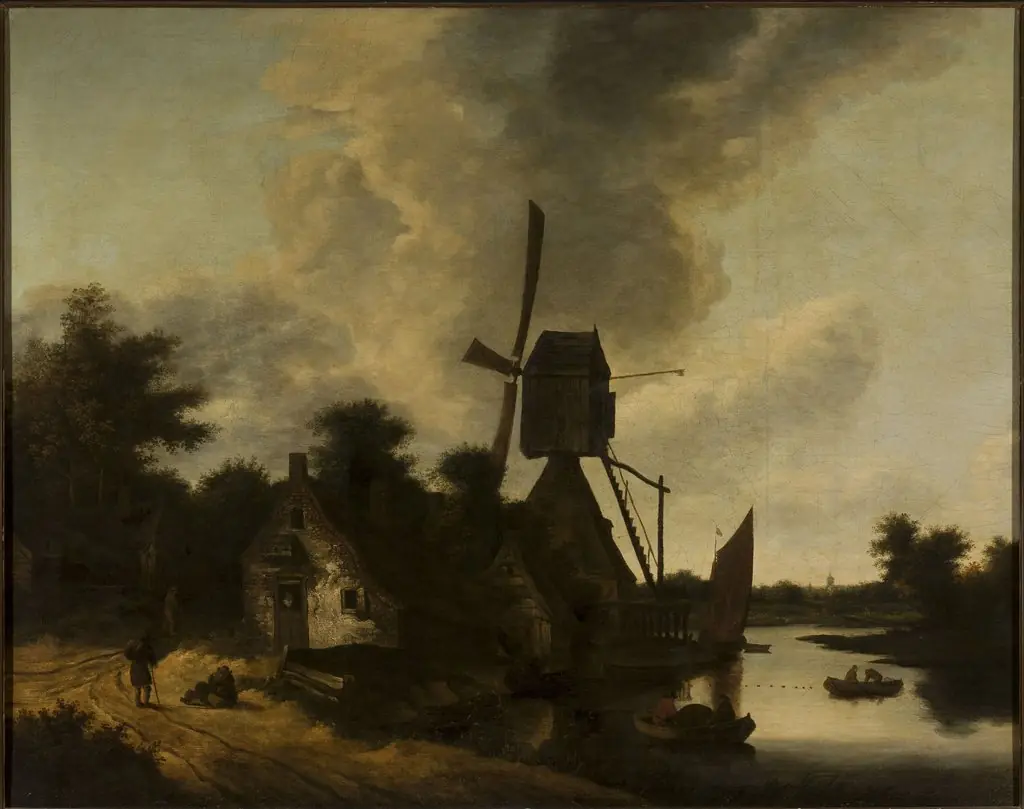
The Mill is an oil painting by the Baroque artist Rembrandt van Rijn. It dates from 1646 and is held in the collection of the National Gallery of Art.
About this work
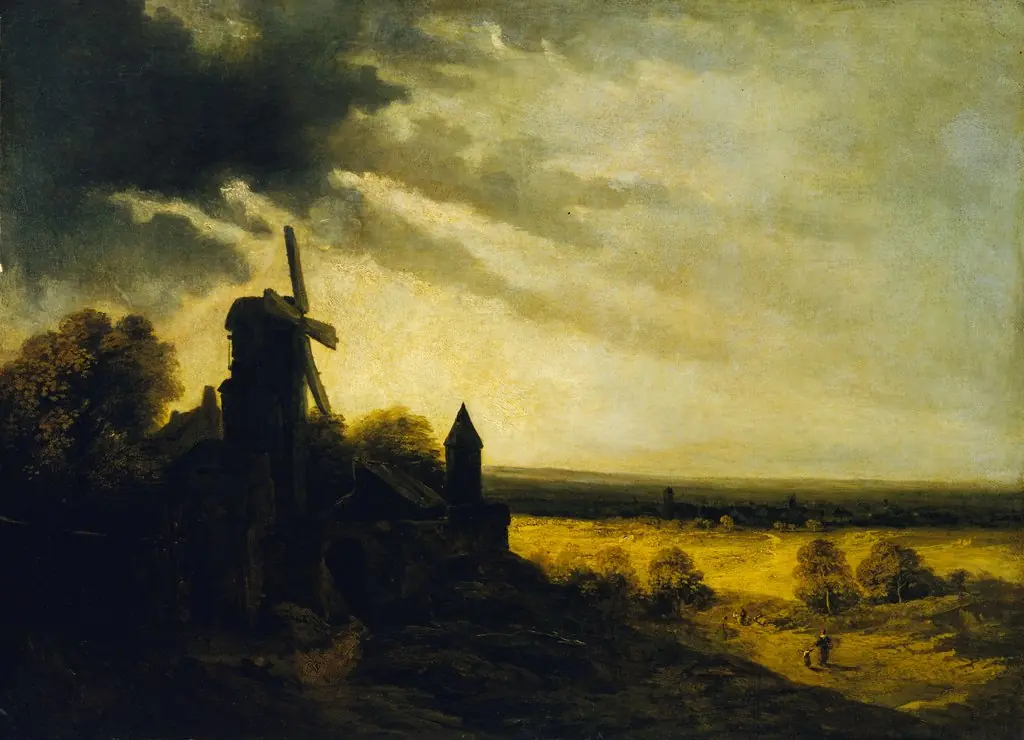
A windmill and a broad-leaved tree stand by a watercourse under a stormy, clouded sky. Rembrandt drives the scene with sharp contrasts of light and dark, the storm light catching the mill while the rest falls into shadow. Painted in 1646.
Subject & Meaning
The composition depicts a windmill perched on a hill above a watercourse, with figures such as a washerwoman in the foreground.
The composition depicts a windmill perched on a hill above a watercourse, with figures such as a washerwoman in the foreground. The scene is divided into two contrasting halves: a dark, stormy sky dominates one side while a calm, sunlit sky brightens the other, creating a dramatic landscape. Symbolically, the windmill serves as the focal point, representing the vital role of wind energy for Dutch agriculture and milling, essential to sustaining human life.
The mill’s elevated position and its vanes bathed in sunlight underscore its importance. Beyond this, the painting has been interpreted as autobiographical: Rembrandt’s father was a miller, and the turbulent sky may reflect the artist’s personal struggles after the deaths of his wife Saskia and son Titus, as well as his later bankruptcy, turning the mill into a metaphor for both livelihood and looming threat.
Technique & Style
Executed in oil on canvas, the painting measures 87.6 × 105.6 cm. Its formal organization centers on a dramatic chiaroscuro: the composition is split into contrasting halves, a dark, gray sky on the left and a luminous blue sky with warm light on the right. The windmill serves as the focal point, its vanes arranged in a deliberate tonal sequence: the raised vane is light against a dark sky, the opposite vane is dark against light, and the remaining two are respectively dark-against-dark and light-against-light. This scheme creates a rhythmic, almost abstract pattern that anchors the landscape.
The mill is set atop a hill, with its diagonals enhanced by the glowing sunset. The painting has undergone recent restoration, which has helped reaffirm its attribution to Rembrandt, though scholarly debate persists.
History & Provenance
The painting was executed by Rembrandt van Rijn between circa 1645 and 1650, though its exact dating remains debated among scholars. The earliest documented owner was Philippe II, duc d'Orléans (1674–1723); the work then passed by inheritance through successive dukes of Orléans until it was sold in 1792 to Thomas Moore Slade for an English syndicate. It entered the collection of William Smith, M.P., by 1793 and was acquired by Henry Petty-Fitzmaurice, 3rd Marquess of Lansdowne, by 1824.
The painting remained at Bowood House until 1911, when it was sold via Arthur J. Sulley & Co. to Peter A.B. Widener for £100,000. It was gifted to the National Gallery of Art, Washington, in 1942. Its attribution to Rembrandt was long doubted but has been restored, though not universally accepted. No commission is recorded for the work.
The Mill is in the collection of the National Gallery of Art (NGA) in Washington, D.C., to which it was gifted in 1942 by Joseph E. Widener. It was formerly part of the Orleans Collection and later owned by the Marquess of Lansdowne before being sold to P.A.B. Widener in 1911. The painting has been exhibited at several London venues: the British Institution in 1815 (no. 37) and 1864 (no. 112), and the Royal Academy Winter Exhibitions in 1878 (no. 172), 1888 (no. 74), and 1899 (no. 40).
Additionally, a copy was shown at the Grafton Gallery in 1911 (no. 67). The work was also part of a private sale exhibition in 1793 at Pall Mall, London.
Context
Critical reception of The Mill has long been shaped by attribution debates. For much of the 20th century the painting's status as a Rembrandt was doubted; recent restoration has strengthened the attribution, though it remains not universally accepted. Cornelis Hofstede de Groot documented the work in 1915, describing its tonal structure in which each windmill vane occupies a distinct light-dark arrangement.
Scholarship has also placed the painting within Rembrandt's personal context: iconological readings connect the windmill to his father's trade as a miller in Leiden, while the stormy atmosphere is interpreted as reflecting the artist's emotional and financial turmoil after the deaths of his wife Saskia and son Titus. As a work of the Dutch Golden Age, The Mill exemplifies Rembrandt's landscape practice and his ability to infuse a rural scene with dramatic, personal resonance.
Legacy
The Mill has been an enduring subject of scholarly and public interest, evidenced by its repeated exhibition in London at the British Institution (1815, 1864) and the Royal Academy (1878, 1888, 1899). Its visual impact is further attested by numerous etchings, including those by Mathieu, Dequevauviller, Turner, and Arendzen, as well as a painted copy exhibited at the Grafton Gallery in 1911. The painting’s attribution to Rembrandt was long contested, but recent restoration work has partially rehabilitated the claim, though it remains debated.
This ongoing attribution dispute, coupled with its prominent provenance and reproduction history, has cemented the work’s place in discussions of Dutch Golden Age landscape painting and contributed to its lasting legacy.
Overview
The Mill, an oil on canvas painting, is attributed to the Dutch Baroque artist Rembrandt Harmenszoon van Rijn. Housed in the National Gallery of Art, Washington DC, this work depicts a prominent windmill beside a watercourse under a dramatic sky. While long subject to scholarly debate regarding its authorship, its attribution to Rembrandt has been reaffirmed in recent years, though not without ongoing discussion among art historians.
Own this work as a print
Artist & collection

Artist
Rembrandt Harmenszoon van Rijn, known mononymously as Rembrandt, was a Dutch Golden Age painter, printmaker, and draughtsman.





 Studied in the Dutch Golden Age course