Artwork
Aristotle with a Bust of Homer
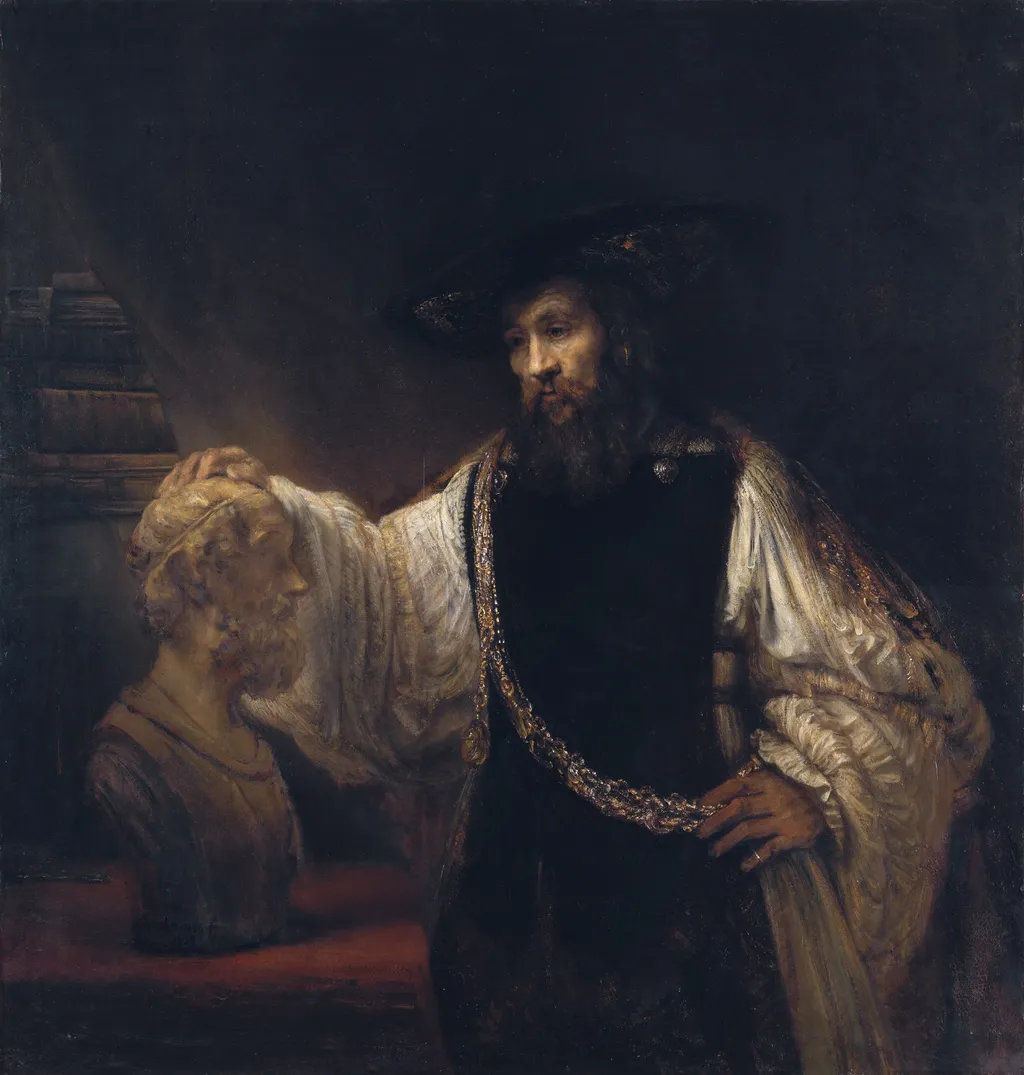
Aristotle with a Bust of Homer is an oil painting by the Baroque artist Rembrandt van Rijn. It dates from 1653 and is held in the collection of the Metropolitan Museum of Art.
About this work
In 1653 Rembrandt finished this canvas for the Sicilian nobleman Don Antonio Ruffo, showing Aristotle resting his hand on a bust of Homer.
In 1653 Rembrandt finished this canvas for the Sicilian nobleman Don Antonio Ruffo, showing Aristotle resting his hand on a bust of Homer. The philosopher wears a gold chain and a medallion of his former pupil, Alexander the Great. Warm light gathers on his contemplative face and the weathered stone while shadow swallows the rest.
The Metropolitan Museum of Art bought it in 1961 for $2.3 million, then a record for any artwork.
Subject & Meaning
The work depicts the philosopher Aristotle, identifiable by his long hair, beard, and rich attire, in a contemplative pose. He rests one hand on a sculpted bust of the poet Homer, while his other hand touches a gold chain from which hangs a portrait of his pupil Alexander the Great. This iconography contrasts philosophy, poetry, and power.
The painting's meaning has been interpreted as methodical science deferring to art, the wealthy philosopher envying the humble bard, or a commentary on portraiture's power. The shadowed eyes convey mystery and deep thought, inviting viewer contemplation. The golden chain symbolizes honor and worldly achievement, set against the enduring value of Homer's poetry.
Technique & Style
Aristotle with a Bust of Homer is an oil-on-canvas painting by Rembrandt, signed and dated 1653, measuring 143.5 x 136.5 cm. Belonging to the Dutch Golden Age Baroque, the work exhibits Rembrandt's varied brushstrokes and restrained palette. Deep shadows partially obscure Aristotle's eyes, imparting a contemplative mood, while light highlights the gold chain and sculpted bust. Stacked books in the background are rendered with careful realism. The modulated handling of paint and subtle tonal contrasts effectively convey psychological depth and texture.
History & Provenance
The painting was created in 1653 as a commission from the Sicilian nobleman Don Antonio Ruffo, who paid 500 florins; it arrived in Messina in 1654. Ruffo intended it as the first of a trio celebrating ancient Greeks, later adding works by Rembrandt of Homer and Alexander. The Ruffo family retained the painting until 1760.
After passing through English collections, it was owned by Sir Abraham Hume (from 1815) and later by Rodolphe Kann in Paris. In 1928 it entered the collection of American Alfred Erickson. The Metropolitan Museum of Art purchased it on November 15, 1961 for $2.3 million, then a record price. In 2013 the museum retitled it Aristotle with a Bust of Homer.
Aristotle with a Bust of Homer is held at the Metropolitan Museum of Art in New York City, which purchased the work in 1961 for $2.3 million (then a record price). The museum retains the painting as part of its permanent collection. Its exhibition history includes a loan to the British Institution in London in 1815 while in the collection of Sir Abraham Hume. An accession number is not mentioned in available sources.
Context
The painting's interpretive history is rich and varied; art historians have proposed multiple identifications for the subject, with Julius Held's 1969 argument for Aristotle, based on attributes such as the bust of Homer and the chain of Alexander, gaining broad acceptance, though Simon Schama later suggested Apelles. Scholarly readings have explored the contrast between worldly success and artistic genius, the power of contemplation, and the materiality of paint itself (Rousseau, 1962; Held, 1969; Carroll, 1984; Beranek, 2016; Suthor, 2018). Commissioned by Don Antonio Ruffo as part of a trio of ancient Greek luminaries, the work reflects Rembrandt's engagement with prestigious intellectual and artistic hierarchies.
Its record-breaking $2.3 million acquisition by the Metropolitan Museum of Art in 1961 marked a milestone in art-market history and inspired critical responses such as Otis Kaye's 'Heart of the Matter'. The painting remains a central work in Rembrandt's oeuvre and a touchstone for Baroque history painting.
Legacy
The painting's reputation was dramatically elevated by its acquisition by the Metropolitan Museum of Art in 1961 for $2.3 million, then the highest price ever paid for a picture, and its appearance on the cover of Time Magazine that year. This milestone prompted American artist Otis Kaye to critique the commodification of art in his painting Heart of the Matter. The work's enigmatic quality has sustained scholarly debate about its subject and meaning, with interpretations ranging from Aristotle to Apelles.
In 2013, the museum retitled the painting to Aristotle with a Bust of Homer, reflecting ongoing curatorial refinement. The painting remains a highlight of the Met's collection and a touchstone for discussions of Rembrandt's intellectual depth.
Overview
Rembrandt's 1653 oil-on-canvas, "Aristotle with a Bust of Homer," portrays the renowned Greek philosopher in a moment of quiet contemplation. Commissioned by a Sicilian nobleman, the work is characterized by its dramatic lighting and enigmatic atmosphere. The painting depicts Aristotle, adorned with a gold chain, as he rests his hand upon a sculpted likeness of the epic poet Homer. Its profound mood has invited various scholarly interpretations over time.

Own this work as a print
Artist & collection

Artist
Rembrandt Harmenszoon van Rijn, known mononymously as Rembrandt, was a Dutch Golden Age painter, printmaker, and draughtsman.