The painted actor is the one sitter who arrives already finished. A merchant, a duchess, a saint in an altarpiece: each comes to the easel as a private self the painter has to construct into an image. The actor comes the other way round. He is already an image, built for an audience, holding a pose that was designed to be seen from the back of a hall. To paint him is to paint a performance of a self rather than the self, and that doubling is not a footnote to the genre. It is the engine of it. My argument here is simple and, I think, under-stated in most surveys: across three traditions that never spoke to each other (Edo Japan, Georgian London, ancien-régime Paris), the actor forced painters into the same formal break, and the break shows up in exactly three places.
Those three places are composition, light, and the handling of paint. Faced with a body that is already arranged for effect, the picture stops pretending to record a room and starts framing a pose. Faced with a face lit by footlights and limelight rather than a window, the picture borrows a theatrical, raking light that has no natural source. And faced with a sitter whose whole trade is artifice, the brush gives up the courtier's smooth finish and begins to show itself; the mark becomes part of the meaning. Where ordinary portraiture hides its means, the actor portrait flaunts them, because flaunting is what the subject does for a living. That is the thesis. The rest is looking.
A sitter who is already a picture
Start with the scale of the thing, because it tells you the subject was never marginal. Search our own holdings and the actor surfaces 426 times: 426 works across eleven venues, by 101 named hands, spanning roughly 1621 to 1950. That is three centuries of painters and printmakers deciding that a person in costume, mid-gesture, was worth fixing. The cluster is lopsided, as you would expect: a long Japanese spine of woodblock portraits, a thinner European line of stage celebrities done in oil. But the spread across eleven institutions and a hundred artists says the theme kept recurring to people who had no contact with one another. When a problem keeps producing the same formal solutions in places that cannot copy each other, the problem is real, and the solution is forced by the subject, not by fashion.
What the subject forces, first, is a confrontation with the mask. A portrait usually asks what a face conceals. An actor's face conceals on purpose, and conceals a known quantity, a role the audience already recognizes. So the painter cannot trade in the usual currency of psychological discovery. He has to paint legibility instead: the instantly readable attitude, the costume that names the part, the gesture frozen at its most communicative instant. This is why so many of these pictures look, to modern eyes, slightly stagey. They are stagey on purpose. The stiffness is the point.
Edo: the mask cut in wood
No tradition pushed the actor image further than Edo Japan, and none made the formal break more visible, because the medium itself was uncompromising. Yakusha-e, literally actor pictures, are woodblock prints, rarely paintings, of kabuki performers, a genre so central to its market that, by one reckoning, between a third and a half of all prints published in the Edo period showed kabuki actors.
Read that figure again. A third to a half of an entire society's print output, devoted to stage celebrities. The closest modern analogue would be if half the photographs ever taken were of film stars in character. According to Smarthistory, that volume made the actor print the commercial heart of ukiyo-e, the floating-world school. And the woodblock is a flattening machine. You cannot model a cheek in continuous tone with a carved key block; you commit to outline and flat fields of color, and you commit early, because the engraver, the printer, and the publisher all act on the designer's drawing before it reaches paper. Each sheet, as the Met's Heilbrunn essay sets out, demanded four collaborators: designer, engraver, printer, publisher.
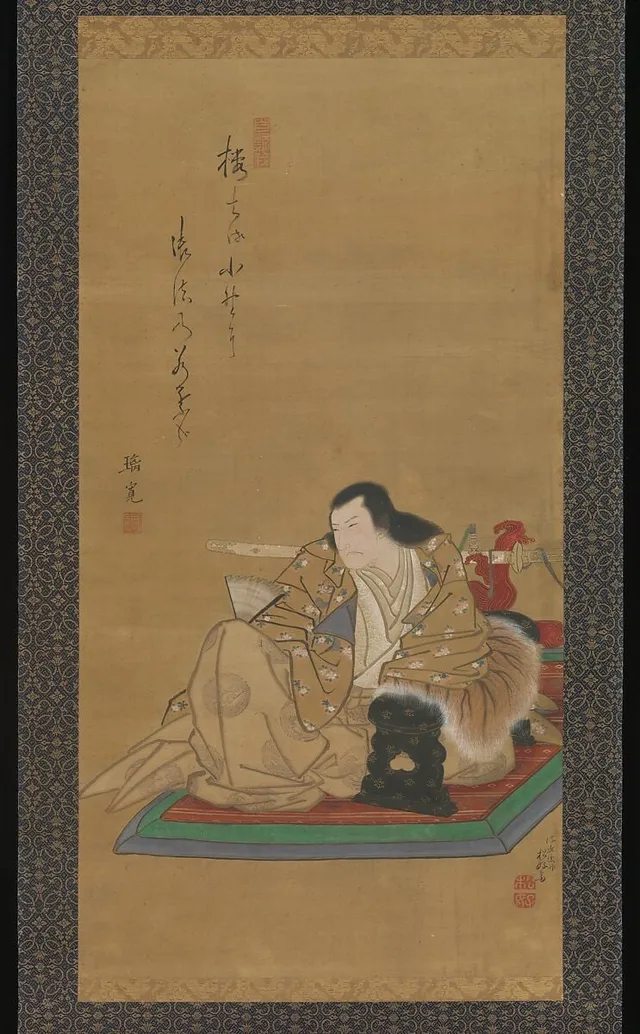
Look hard at the Osaka designer Shunkōsai Hokushū and his portrait of Arashi Kitsusaburō I as Prince Koretaka. The figure is built from contour and pattern. The robes are a near-abstract arrangement of crests and bands, each color a flat plane butted against the next, and the body underneath is barely asserted: the garment is the character. The face floats above this textile machinery as a pale oval, the brows set, the mouth fixed in the codified mie, the held climactic pose of kabuki. There is no window, no cast shadow, no atmosphere. The picture refuses depth the way the stage refuses it, presenting the actor frontally, planar, pressed toward us like a crest on a banner. This is the formal break in its purest state: a portrait that has thrown out modeling, recession, and natural light, and kept only the legible mask and the heraldry of the role.
The flattening was not a limitation the designers tolerated. It was a resource they sharpened. The genre's most extreme practitioner, Tōshūsai Sharaku, appeared in 1794 and produced almost thirty bust portraits in the ōkubi-e, the big-head format, before vanishing; an entire reputation built in a working career that lasted, by the standard account, about ten months. Sharaku cropped the body away and enlarged the head until the actor's expressive tics filled the sheet: the crossed eyes, the clenched jaw, the splayed hand. He kept the flatness and used it to amplify the grotesque truth of a man performing. The mask, magnified, became more honest than any modeled likeness.
This matters for the larger claim because the Japanese case isolates the variable. Strip away oil's capacity for atmosphere and you see what the actor subject wants when it is left alone: frontality, pattern, the role over the man. European painters had richer means at hand, and so their break looks different. But it is the same break, reached under different constraints, and the convergence is the evidence.
London: the black ground
Cross to late-Victorian London and the actor is no longer a woodcut crest but a full-length figure in oil, and yet the same instinct toward flattening reasserts itself, this time as an aesthetic program. James McNeill Whistler painted the great actor-manager Henry Irving in character and gave the canvas a title that announces its priorities before you reach the man: Arrangement in Black, No. 3: Sir Henry Irving as Philip II of Spain. The sitter is named second, after the color. Whistler is telling you, in the title itself, that the picture is an arrangement first and a portrait second.
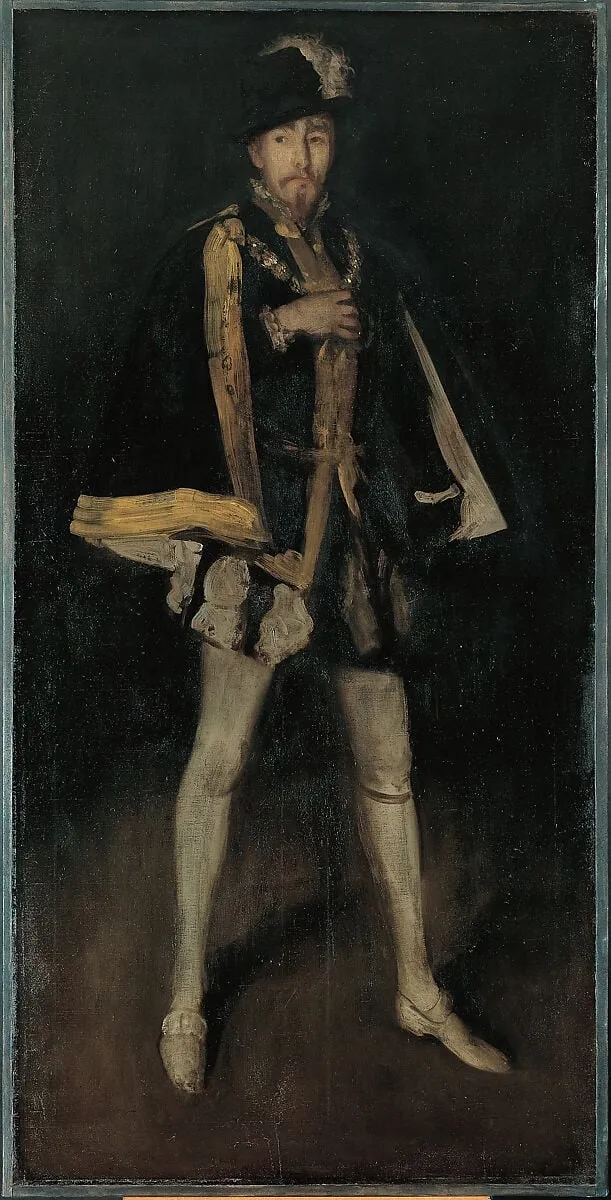
Stand in front of it. Irving is a tall, narrow column of near-black set against a ground that is also near-black, so that the figure does not so much stand in a space as condense out of one. There is no floor you can locate, no wall, no furniture. The face and one pale hand are the only places the light is allowed to settle, and even they are kept low and matte, the paint thin and dragged so that the weave reads through it. The whole canvas is a study in how little tonal difference a painter needs to hold a figure together. Whistler has done to oil what the woodblock did to the actor by necessity: he has suppressed depth, suppressed incident, and left the performer as a flat, frontal, legible silhouette lit by a light that belongs to the stage rather than to any room. The Spanish king's costume and Irving's celebrated stillness are one and the same shape. The actor's profession of self-presentation has been turned into the picture's whole method.
The handling carries the argument the title started. Whistler's paint is famously thin, laid in washes and wiped back, the opposite of the loaded society portrait. He wanted the surface to feel breathed on rather than built. For an actor sitter this is exactly right: a heavy, sculptural finish would assert a solid body, and the body is not the subject. The presence is. By keeping the paint as a veil, Whistler keeps Irving as an apparition, which is what a great actor is across the gulf of the footlights: there and not there, a man and an effect at once.
Paris and New York: the costume as evidence
Not every painter wanted the actor dissolved. The opposite strategy, pinning the performer to his costume as documentary fact, produced its own formal pressures, and our holdings carry two clean examples a century and an ocean apart. The earlier is the French miniaturist Jean-Baptiste Massé and his portrait of Pierre Louis Dubus, called Préville, of the Comédie-Française. Préville was the great comic servant of the eighteenth-century Paris stage, and the picture wants you to know the man and the trade at once. Here the formal problem is reversed from Whistler's. Massé must keep the face individual, this is a celebrity, recognizably himself, while the costume signals the line of roles. The composition splits its attention, and the light is even and flattering, the courtly light of a sitter who has commissioned his own dignity. The break shows up subtly: in the slight theatrical cock of the head, the readiness of the expression, a face caught not in repose but in the instant before a line.
The later example is American and more openly heroic. Henry Inman painted the English tragedian William Charles Macready in role as William Tell, and the picture leans hard into the pose. Macready is given the upward gaze, the planted stance, the charged stillness of a curtain tableau. Inman lights him from a low, dramatic angle that throws the brow into relief and rims the figure against a darker setting, footlight logic translated into oil. This is the actor portrait as monument, and it makes a useful contrast with the Japanese sheets: where Hokushū flattened the body into pattern, Inman swells it into sculpture, but both have abandoned the neutral, naturalistic light of straight portraiture for a light that performs. The means diverge. The instinct is the same.
Set these two beside the Whistler and you can watch the period argument unfold. The eighteenth century, in Massé, still trusts the even light and the legible costume; the nineteenth, in Inman, dramatizes the light; the aesthetic moment, in Whistler, abstracts the whole thing into tone. Three answers to one question, how do you paint a person who is always already performing, laid out across roughly a hundred and fifty years.
Off the proscenium
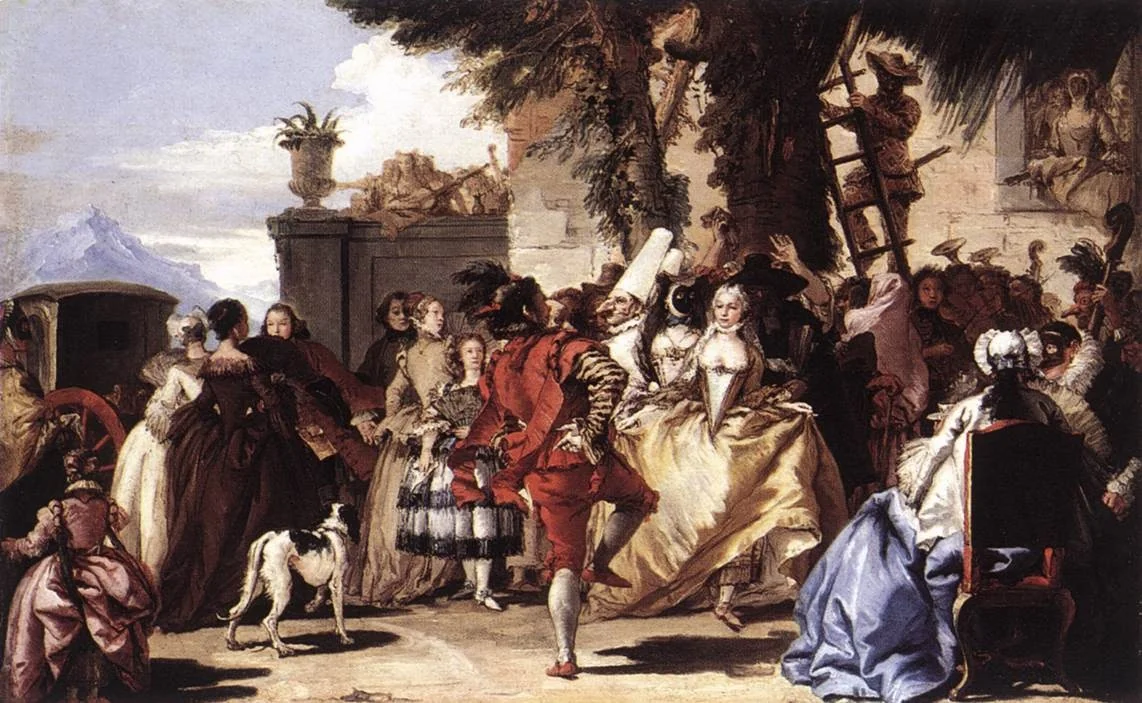
There is a fourth case the subject keeps producing, and our archive holds two strong instances of it: the picture not of a star in a role but of players as a social type, performers caught between performances. The hero of this essay belongs here. Giovanni Domenico Tiepolo and his A Dance in the Country stages a performance in the open air rather than on a boarded stage, and the looseness of the paint registers the shift. Where the studio actor portrait fixes a pose, Tiepolo lets the figures turn and overlap; the dancer's skirt is laid in with broad, confident sweeps, the faces are sketched rather than fixed, and the light is broad daylight rather than the raking beam of the stage. The performer here is part of a crowd, and the brush relaxes accordingly, trading the codified mask for movement.
The same social register, lower and earlier, runs through the Traveling Players of the Monogrammist JG, an anonymous Northern hand who signed only with initials. Itinerant actors were a stock subject of the Low Countries, disreputable and half carnival, and the picture treats them as genre rather than portraiture. No single performer is enshrined. The interest is the troupe, the cart, the makeshift platform, the gawking audience. And yet even here the formal pressure of the actor subject leaves its mark: the players are the most strongly lit, most strongly gestured figures in the scene, picked out from the crowd by exactly the theatrical emphasis the grander portraits use on their single stars. The painter, without a celebrity to flatter, still cannot resist letting the performers perform.
These off-stage pictures matter to the argument because they show the break is not merely a courtesy paid to famous sitters. It is structural. Put a performer in a painting, named or anonymous, and the composition will tilt toward the pose, the light will sharpen on the body that is meant to be watched, and the brush will lean toward display. The subject bends the picture before the painter decides anything.
Why the convergence is the proof
Return to the numbers, because they frame the claim properly. Four hundred and twenty-six actor works, a hundred and one artists, eleven institutions, three centuries: within that spread, the same three formal moves recur in traditions with no shared lineage. An Osaka woodblock designer of the 1820s and a London aesthete of the 1870s could not have learned the flattened, frontal, performance-lit actor from each other. They learned it from the actor. That is the strongest kind of evidence an art historian gets: independent invention of the same solution, which means the solution is dictated by the problem and not by influence.
The problem, restated one last time, is the doubled self. Every other sitter offers the painter a private person to translate into a public image. The actor offers a public image already made, and dares the painter to do something with it other than copy. The good ones answer by making the picture perform too, composing it as a frame around a pose, lighting it from a source that exists nowhere but the stage, and handling the paint so the surface announces its own artifice. The bad ones simply record a man in a costume, and those pictures are dead on the wall, because they have missed that the subject was never the man. It was the mask, and the mask demands to be met halfway.
Whistler understood this better than anyone in oil, and the woodblock designers understood it before him by a century, working in a medium that gave them no choice. If you want to see where Western and Eastern picture-making quietly agreed without ever meeting, do not look at landscape or still life. Look at the actor. Two hemispheres reached for the same flat, frontal, lit-from-the-footlights image of a person performing a person, and the place to test the convergence is a sheet of Edo paper held up beside a panel of London black.
Works discussed in this article
Sources & further reading
- Kabuki actor prints — Smarthistory
- Woodblock Prints in the Ukiyo-e Style — The Met, Heilbrunn Timeline of Art History
- Sharaku — Wikipedia
- Yakusha-e — Wikipedia
- Kabuki Actor Ōtani Oniji III as Yakko Edobei (1794) — The Met
- Kabuki Actor with a Fan — National Gallery of Art
- The Masters of Ukioye (1896) — Ernest F. Fenollosa / Internet Archive