The forest as a subject in painting has never sat still. It began as a moral interior, a place a soul could get lost in, and it ended up as the most carefully measured open-air laboratory in nineteenth-century art. My argument is simple and I will carry it work by work: the forest did not stay the same scene that travelled from the Rhineland to Haarlem to Fontainebleau to the Andes. It changed in transit, and at one crucial stop the act of painting it changed the woods themselves. A subject usually receives history. This one, once, made it.
I can say where the route runs because the archive lets me count the stops. Artifact World Gallery holds 393 works under the forest subject, made by 232 artists and now scattered across 72 venues, the earliest dated near 1116 and the latest just past 2009. That is a thin, long thread of nearly nine centuries, and it bunches in revealing places: a knot of Northern panels around 1500, a denser Dutch cluster in the mid-1600s, then a hard concentration in the decades on either side of 1850. Those bunches are not random. Each marks a moment when painters decided the woods meant something new, and each handed the next generation a forest already altered by the last one's looking.
The forest as a place you could be damned in
Start at the early end of the thread, where the forest is barely a place at all. For the Northern late-medieval imagination it was a condition, the wilderness outside the walls where reason thinned and folly thickened. Look at Cutting the Stone by Hieronymus Bosch. A charlatan surgeon extracts the proverbial "stone of madness" from a seated dupe while a funnel-hatted friar and a book-balancing nun look on. Around this little theatre of quackery Bosch opens a low, level countryside dotted with a few thin trees and a distant gallows. The trees are not described as oaks or willows. They are signs, vertical marks that tell you this is the open world beyond the town, the place where a man can be cheated of his wits. The forest here is moral weather, not botany.
That habit of mind travelled south and was slowly worn down by contact with Italy. Jan van Scorel, who crossed the Alps and came back to Utrecht carrying Roman light in his luggage, belongs to the generation that began to treat the wooded background as a thing with real distance in it, atmosphere thickening between the near branch and the far hill. The change is undramatic and easy to miss. A tree stops being a symbol you read and becomes a body you measure your eye against. You can feel the artist start to care how the light actually behaves under leaves, where it pools and where it fails. Once that switch is thrown the forest can start to behave like a subject in its own right, and the Dutch are the ones who let it.
Holland: the woods become weather and property
The mid-1600s cluster in the archive is overwhelmingly Dutch, and it is where the forest first gets painted as if it had a temperature and an owner. The great agent of that shift is Jacob van Ruisdael, and you can watch him do it across the panels we hold. He paints stands of oak and beech as though each had a working life, pruned and pollarded and felled for particular hearths, and he sets the eye walking into the wood along a low path rather than skating past it. The trees stop standing for anything. They acquire a soil, a season, a labour history. Where Bosch gave you a sapling that meant folly, Ruisdael gives you a tree that means firewood, and the gap between those two meanings is most of the distance the subject had travelled in a century and a half.
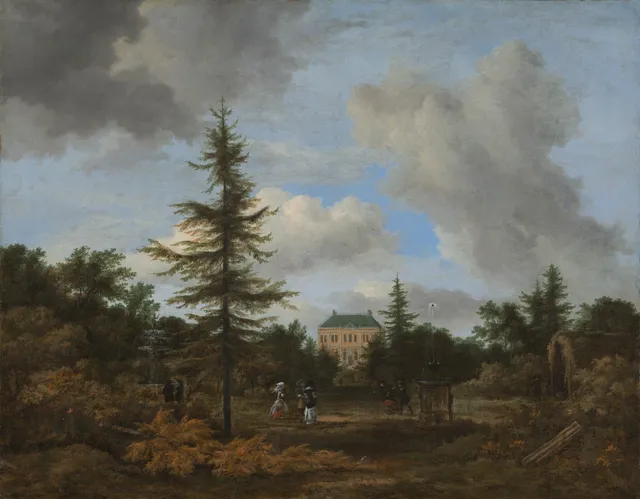
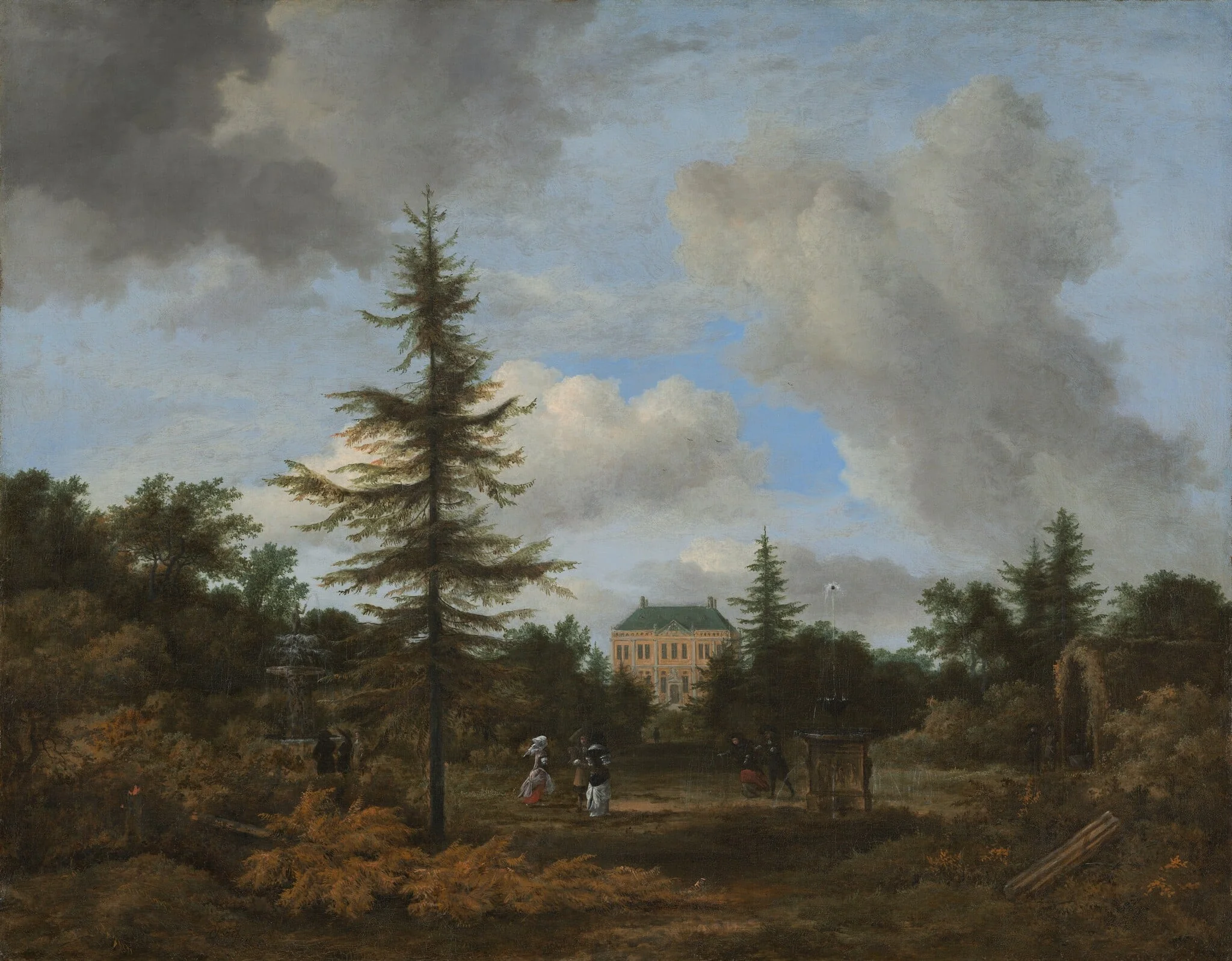
Look hard at Country House in a Park. The house is the nominal subject, the thing a patron paid to see, and Ruisdael all but buries it. A heavy stand of mature trees masses across the composition, their crowns shouldered together into one dark, breathing volume, and the building shows only in glimpses through the trunks. The path leads the eye in low, under the canopy, where the light goes brown and close. Then he does the thing that makes him Ruisdael: he gives the upper half of the panel to the sky, a tall weather of cumulus piling and dragging shadow across the park below. The architecture is grand. The trees are grander, and the cloud is grandest of all. A man commissioned a portrait of his estate and received, instead, a study of how little the estate matters under that much sky. The forest has become the place where human property is quietly outvoted.
The same Dutch instinct travelled north and froze. F.M.E. Fabritius de Tengnagel painted the Danish manor of Lykkesholm on Funen in winter, and his Prospekt af hovedgården Lykkesholm på Fyn. Vinter takes Ruisdael's wooded estate and strips it down to bare armatures, the trees reduced to grey calligraphy against snow. This is the Dutch forest in transit again, carried into a colder grammar where the woods record the season more than the soil. The bunching in the archive around these decades is really the record of a single idea passing hand to hand: that a wood is a true subject, worth the whole panel, with light and weather doing the work that saints and morals used to.
Fontainebleau, where looking rewrote the map
Now the route reaches its strangest stop, and the one that proves my thesis outright. In the 1830s a loose band of French painters began leaving Paris to work directly inside the Forest of Fontainebleau, a sprawl of woods, meadows, marshes and sandy clearings running to roughly 42,000 acres, with Théodore Rousseau regarded as the group's leader (The Metropolitan Museum of Art on the Barbizon school). They settled in the village of Barbizon at the forest's edge and painted what was in front of them: a single oak, a tangle of roots, a cluster of trunks against a far plain. The forest was no longer a moral interior or a patron's estate. It was a motif to be studied at the source, in changing light, day after day.
And then the looking did something pictures almost never do. It defended its own subject. In 1853 Rousseau petitioned the Duc de Morny to protest the commercial felling of the trees and the quarrying of the rocks in the Bas-Bréau section of the forest, and to ask that the area be protected (The J. Paul Getty Museum). The campaign worked. By an imperial decree of 13 April 1861 the forest's "artistic reserve" was enlarged to 1,094 hectares, the first time in France that protecting nature became a stated objective of forest management (Wikipedia on the Forest of Fontainebleau). Read that sequence slowly. Painters loved a wood, painted it until others loved it too, and the love became law a full decade before Yellowstone. The subject changed the place. The forest stopped being only something art depicted and became something art preserved.
That is also the moment the forest acquired its critics and its historians, which is how you know a subject has fully arrived. By 1890 John W. Mollett could publish a study treating the Fontainebleau painters as a settled school with a roster and a doctrine, the woods now framed as a movement's birthplace rather than a hunting ground for kings. The Barbizon habit of going to the motif spread fast, and it hardened the way younger painters thought a forest ought to be made. Gustave Courbet, whose nine works in our holdings make him the single most-represented hand on this subject in the collection, painted forest interiors and rock-shadowed glades with a palette knife that loaded the deep greens on like wet stone, insisting on the forest's physical weight rather than its mood.
The German line of the same decades pushed the woods the other way, back toward the sacred, but with the new outdoor seriousness baked in. Caspar David Friedrich conceived his oak-forest abbey as one of a pair with a sea picture, using the bare, broken oaks and a ruined choir to stage human mortality against the divine. The trees are studied from real winter oaks, and yet they are made to preach. Friedrich proves the forest could travel forward into Romantic theology without abandoning the patient looking the Dutch had taught. The subject was now flexible enough to carry weather, property, politics and God, sometimes in the same canvas.
Across the ocean: the forest as cathedral and inventory
The subject crossed the Atlantic and swelled. Frederic Edwin Church took the European discipline of close looking and aimed it at a forest no European had a vocabulary for. Heart of the Andes is a wall of South American jungle organized like a sermon and footnoted like a field guide. In the foreground Church paints individual leaves and a specific spray of flowers with a botanist's exactness, then lets the forest fall away into a river valley and a snow peak so far off it turns blue. The eye is meant to travel from a single identifiable plant to the curve of the planet without a seam. Nothing in the canvas asks to be read as a symbol, and everything asks to be identified. The forest here is both a temple and an inventory, the wilderness as a divine system you could catalogue. When Church showed the picture he hung it in a darkened room with gas jets and invited viewers to study it through opera glasses, as if the painted wood were a real place you visited. The Dutch had made the forest a subject. The Americans made it a destination.
The forest comes apart in the light
The last great change in transit is dissolution. Once painters were working inside the woods all day, they began to notice that the forest is mostly an event in light, and the Impressionists let it loosen accordingly. Camille Pissarro stands at the seam where Barbizon discipline turns into Impressionist touch. In Edge of the Woods Near L'Hermitage, Pontoise he paints exactly the Barbizon motif, the place where the trees meet the cleared field, but the foliage is now broken into a screen of separate green strokes, each one a decision about the sun rather than a leaf. The wood no longer has a moral and barely has an owner. It has a time of day.
Even when the forest slides to the margin it keeps doing this work. In Skiffs Gustave Caillebotte gives the river the lead and the trees the supporting role, a dense bank of summer green pressed along the top of the canvas and doubled, shaking, in the water below. The wood has become a reflection, a band of broken color that exists chiefly to be disturbed by oars. From Bosch's symbolic saplings to Caillebotte's quivering green margin runs a single subject that has been pulled completely inside out: the forest that once meant danger now means light on water. That is the whole journey in two pictures.
Works discussed in this article
What the archive remembers
Lay the 393 forest works out by date and the thread tells its own version of this story. The early panels treat the wood as a backdrop to human folly. The Dutch knot of the 1650s turns it into weather and labour. The hard concentration around 1850 is the Fontainebleau revolution, where the subject grew teeth and saved its own ground. Spread those works across 72 venues by 232 hands and you can also see how thoroughly the forest stopped belonging to any one nation. A Danish winter manor, a Bosch open country, an Andean valley and a Pontoise field edge are all, in our records, the same subject. They only look like one subject because each painter inherited a forest the last one had already changed, and added a layer of his own before passing it on.
There is a tidy proof of how far the journey ran in the single tree. Where Bosch needed a wood to carry a meaning, later painters found a whole sermon in one trunk. The National Gallery of Art, surveying how often trees and forests recur in its collection, singles out Jules Dupré's The Old Oak as one of the most regal portraits of a tree ever painted, a Barbizon descendant in which a single oak stands in for everything the forest used to say with many (National Gallery of Art on trees as a subject). The forest had been concentrated into one specimen, and the specimen could hold the weight. That is the end state of the transit: a subject so fully understood that an artist could paint the whole of it by painting one of its trees, and trust the viewer to feel the wood standing behind it.
So the forest you meet in a gallery is a palimpsest of every place it has been. Stand in front of a green margin shaking in a Caillebotte river and the danger of Bosch's open country is still in there, buried, overwritten by Ruisdael's weather and Rousseau's law and Church's botany. The next painter to take up the subject will inherit all of it at once, and will change it again. A wood, in art, is the one landscape that keeps growing after the paint is dry.
Sources & further reading
- The Barbizon School: French Painters of Nature — The Metropolitan Museum of Art
- Théodore Rousseau, Forest of Fontainebleau, and the 1853 petition to the Duc de Morny — The J. Paul Getty Museum
- Forest of Fontainebleau, the 1861 artistic reserve — Wikipedia
- Portraits of Trees: A Favorite Subject of Artists (Jules Dupré, The Old Oak) — National Gallery of Art
- Caspar David Friedrich, Abbey in the Oak Forest — Smarthistory
- The Painters of Barbizon: Millet, Rousseau, Diaz (1890) — Internet Archive (Mollett, 1890)