Artwork
Heart of the Andes
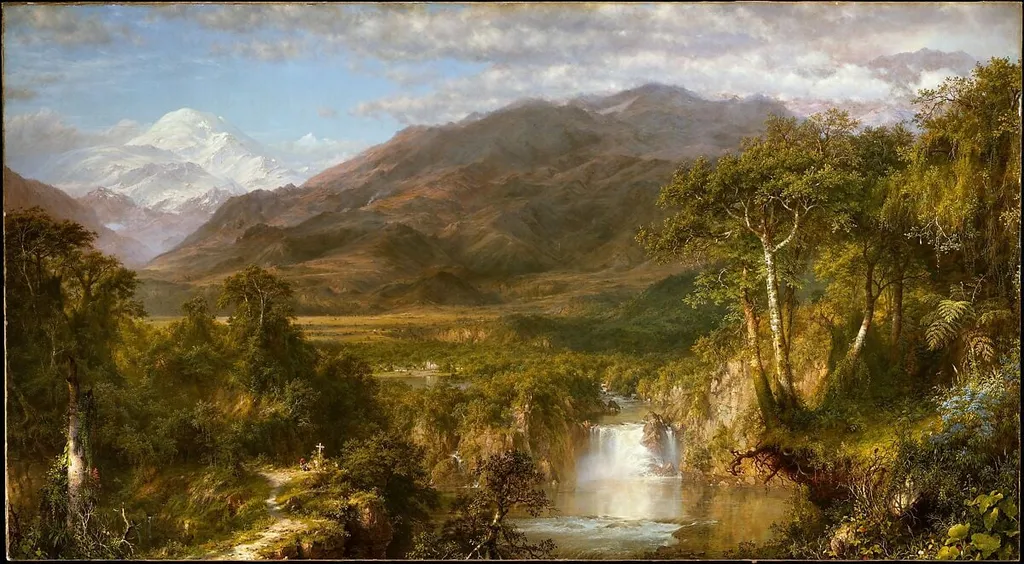
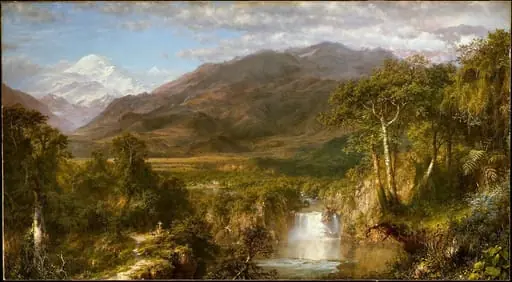
Heart of the Andes is an oil painting by the Hudson River School artist Frederic Edwin Church. It dates from 1859 and is held in the collection of the Metropolitan Museum of Art.
About this work
On April 27, 1859, thousands of New Yorkers queued at Broadway's Lyrique Hall to see Frederic Edwin Church's ten-foot canvas, lit by hidden gas jets in a darkened room. Church built the scene from sketches made on two Ecuador expeditions, compressing tropical plain to icy peak into a single vista. Visitors paid twenty-five cents and studied its botanical detail through opera glasses.
Subject & Meaning
Human presence is indicated by a path, a hamlet with a Spanish-colonial church, and two figures before a cross in the foreground.
The Heart of the Andes depicts an idealized composite landscape of the South American Andes, synthesizing topographies from Church's travels, including Mount Chimborazo, a waterfall, a tropical lake, and a lush jungle. Human presence is indicated by a path, a hamlet with a Spanish-colonial church, and two figures before a cross in the foreground. The cross symbolizes the peaceful coexistence of religion with the untamed landscape.
Church's signature, carved into a foreground tree and highlighted by light, has been interpreted as a statement of man's relationship with nature, though the tree's unhealthy condition contrasts with the vibrant jungle. The painting reflects Alexander von Humboldt's call to portray the 'physiognomy' of nature and John Ruskin's ideal of the spiritual unity of art, morality, and the natural world.
Technique & Style
Executed in oil on canvas, the painting measures approximately 168 × 303 cm. Church employed meticulous, precise brushwork to render an extraordinary level of detail, from individual leaves and butterflies to distant mountain peaks. The composition synthesizes multiple Andean topographies into an idealized landscape, following picturesque principles by juxtaposing smooth, rounded hills and still water against jagged, irregular mountain forms. A calm palette of green and ochre tones predominates.
The artist's signature is carved into the bark of a foreground tree, with the play of light on the incised letters emphasizing human presence within the scene. This work reflects Church's scientific carefulness, consistent with Humboldtian ideals of close natural observation.
History & Provenance
Frederic Edwin Church painted Heart of the Andes in 1859, signing and dating it on the tree trunk at lower left. The work was created in his New York studio, synthesizing sketches from his 1853 and 1857 South American expeditions, which were partly financed by Cyrus West Field. Church first exhibited the painting in 1859 in New York, then sold it to William T. Blodgett for $10,000, a record price for a living American artist at the time.
After Blodgett's death, the painting was sold at auction in 1876 to David Dows. Following Dows's death, his widow Margaret E. Dows inherited it, and she bequeathed it to the Metropolitan Museum of Art in 1909, where it has remained ever since.
Since 1909, The Heart of the Andes has been held in the collection of the Metropolitan Museum of Art in New York. Its first public exhibition ran from April 29 to May 23, 1859, at the Tenth Street Studio Building. The single-painting show drew over 12,000 paying visitors and later traveled to other eastern U.S. cities and London.
In 1864, it was featured in a fundraising exhibition for the United States Sanitary Commission. The painting was displayed in a large window-like frame with controlled lighting, and opera glasses were provided for viewing details.
Context
When unveiled in 1859, The Heart of the Andes caused a public sensation. Over 12,000 visitors paid to see it, and Church was hailed as America's leading landscape painter. The painting sold for $10,000, a record for a living American artist, and attracted admiration from contemporaries including Mark Twain.
As a student of Hudson River School founder Thomas Cole, Church broke from his teacher's allegorical mode by pursuing scientific precision and expanding American landscape painting to South America, the Arctic, and the Caribbean. The work remains one of the most celebrated 19th-century American paintings, cementing Church's reputation for synthesizing art, science, and spectacle.
Legacy
Since entering the Metropolitan Museum of Art in 1909, The Heart of the Andes has been recognized as one of the most celebrated American paintings of the 19th century. Its initial sale to William Tilden Blodgett in 1859 set a record price for a work by a living American artist. The painting's fame was further disseminated through authorized reproductive engravings and a smaller watercolor copy, now at the National Gallery of Art.
It continues to be regarded as a landmark of the Hudson River School and a key example of Church's synthesis of scientific observation and sublime landscape.
Overview
Frederic Edwin Church's monumental oil painting, Heart of the Andes, portrays an imagined South American landscape. Created in 1859, this large canvas, measuring over five feet high and nearly ten feet wide, became a cultural phenomenon upon its debut in New York City. The work solidified Church's reputation as the foremost landscape artist in the United States, drawing immense public attention to his detailed depiction of the Andean region.
Artist & collection

Artist
Frederic Edwin Church was an American landscape painter born in Hartford, Connecticut.



 Studied in the Color & Light course