The rebels never left the room
French Romanticism is usually told as a jailbreak. A younger generation of painters, the story goes, walked out of the cold marble corridors of the Academy and let feeling back into French art. That version flatters the rebels and gets the fight wrong. The Romantics never left the room. They stayed inside the institution that trained them, hung their canvases at the same official Salon, painted at the same heroic scale, and used that proximity to pick a sustained argument with the art directly upstream of them: Neoclassicism, the school of the line and the antique exemplum. The thesis of this essay is simple. French Romanticism was not a clean break. It was a quarrel with its predecessor, conducted on the predecessor's own ground, over a single disputed question: what is a serious painting actually for?
Both sides already agreed on a great deal, which is what made the disagreement so sharp. Both held that the highest painting was history painting: large, public, morally weighted, peopled with bodies under pressure. Neither doubted that drawing mattered or that the past was worth painting. The fight was over emphasis and loyalty. The Academy bet everything on contour, on the example drawn from Greece and Rome, on the lesson a viewer should carry home. The Romantics answered that a painting earns its seriousness through color, through the felt charge of a present event, through the nervous system rather than the syllabus. Tate's working definition of the movement names the same shift from the other end, pointing to a new interest in human psychology, the expression of personal feeling, and the natural world (Tate, Romanticism). Read that against the Academy and it reads as a list of grievances.
An argument inside the family
It helps to remember how close the two camps stood. The Romantics were not outsiders storming a gate. They were the Academy's own gifted children, raised on the discipline of Neoclassical draftsmanship and then turning that training against its own first principles. A studio could produce a partisan of line and a partisan of color from the same bench. The dispute was domestic, and like most domestic disputes it ran hottest precisely because the antagonists shared a vocabulary. When the line painters accused the colorists of sloppiness, and the colorists accused the line painters of producing handsome corpses, each knew exactly which nerve to press.
The venue mattered too. There was, in practice, one stage in France worth fighting on, the official Paris Salon, the juried exhibition through which reputations were made and unmade. A Romantic painter who wanted to land a blow could not do it from the margins. He had to do it on the Salon wall, beside the very canvases he meant to dethrone, in front of the same critics and the same crowd. The argument was public by design. That is why it reads, two centuries on, less like a manifesto and more like a series of provocations staged in the enemy's house.
Géricault loads the gun
The opening shot is usually dated to 1819, when Théodore Géricault hung an enormous canvas at the Salon. The Raft of the Medusa is roughly 490 by 716 centimetres, a wall of a painting, and it depicts the survivors of a real and recent disaster: the 1816 wreck of the French naval frigate Méduse, which ran aground off the coast of present-day Mauritania and left scores of people adrift on a makeshift raft (Wikipedia, The Raft of the Medusa). Look at what Géricault did with that scale. He took the exact format the Academy reserved for the death of heroes and the oaths of antique citizens, and he filled it not with a lesson out of Plutarch but with a contemporary scandal, sunburned and dying men reaching toward a smudge on the horizon. The Metropolitan Museum's survey of Romanticism treats the picture as the icon of the emerging style for just this reason (The Met, Romanticism).
Notice the precise nature of the provocation. Géricault did not abandon the grand machine of history painting. He hijacked it. The monumental size, the pyramidal mass of bodies, the studio rigor of the anatomy, all of that is Academic inheritance, deployed with total command. What he changed was the subject's status. The thing on the wall was news, not myth. A viewer in 1819 would have read the newspapers about the Méduse and then stood in front of a canvas that gave the event the dignity the Academy normally rationed out to gods and senators. That is the argument in its purest early form: keep the predecessor's seriousness, redirect it at the living present.
Géricault did not get to finish the fight. He died young, in 1824, and leadership of the movement passed to Eugène Delacroix, whom the Met's essay identifies as the painter who carried Romanticism forward on the strength of color and expressive brushwork (The Met, Romanticism). The Getty, which holds and documents Géricault as the French Romantic who painted the Raft, treats him as the hinge figure he was, the man who set the terms others would inherit.
Delacroix makes the case for color
If Géricault loaded the gun, Delacroix kept firing for thirty years. The National Gallery of Art calls him the leading exponent of Romanticism in French painting and frames the whole movement as one that placed emotion and intuition ahead of reason. The phrasing is exact, because the quarrel with Neoclassicism really did come down to a hierarchy. The Academy put reason, and therefore line, on top, drawing as the intellectual skeleton a painting hangs on. Delacroix inverted it. For him color was not decoration applied after the thinking was done. Color was the thinking.
His most quoted public statement of the position is a painting, not a sentence. He made The Liberty Leading the People in the autumn of 1830 to commemorate the July Revolution of that year, and showed it at the official Salon of 1831, the same institutional stage where the line painters held court. An allegory of Liberty, bare-breasted and carrying the tricolor, strides across a barricade of the dead. The Academy would have recognized the allegorical machinery instantly. What it would not have recognized was the smoke, the dirt, the way the figures are built out of charged, broken color rather than clean contour. Delacroix took an Academic device and ran it through a furnace.
The critic who understood this best was Charles Baudelaire, who spent his Salon writing of the 1840s and 1850s arguing that Delacroix was the great painter of the age precisely because he painted from temperament rather than from the rulebook. Baudelaire's collected art criticism is freely readable today, and it remains the sharpest contemporary articulation of why the colorists believed they were winning. He understood the Romantic wager as a claim about modern feeling, not a nostalgia for ruins.
What the monkeys were judging
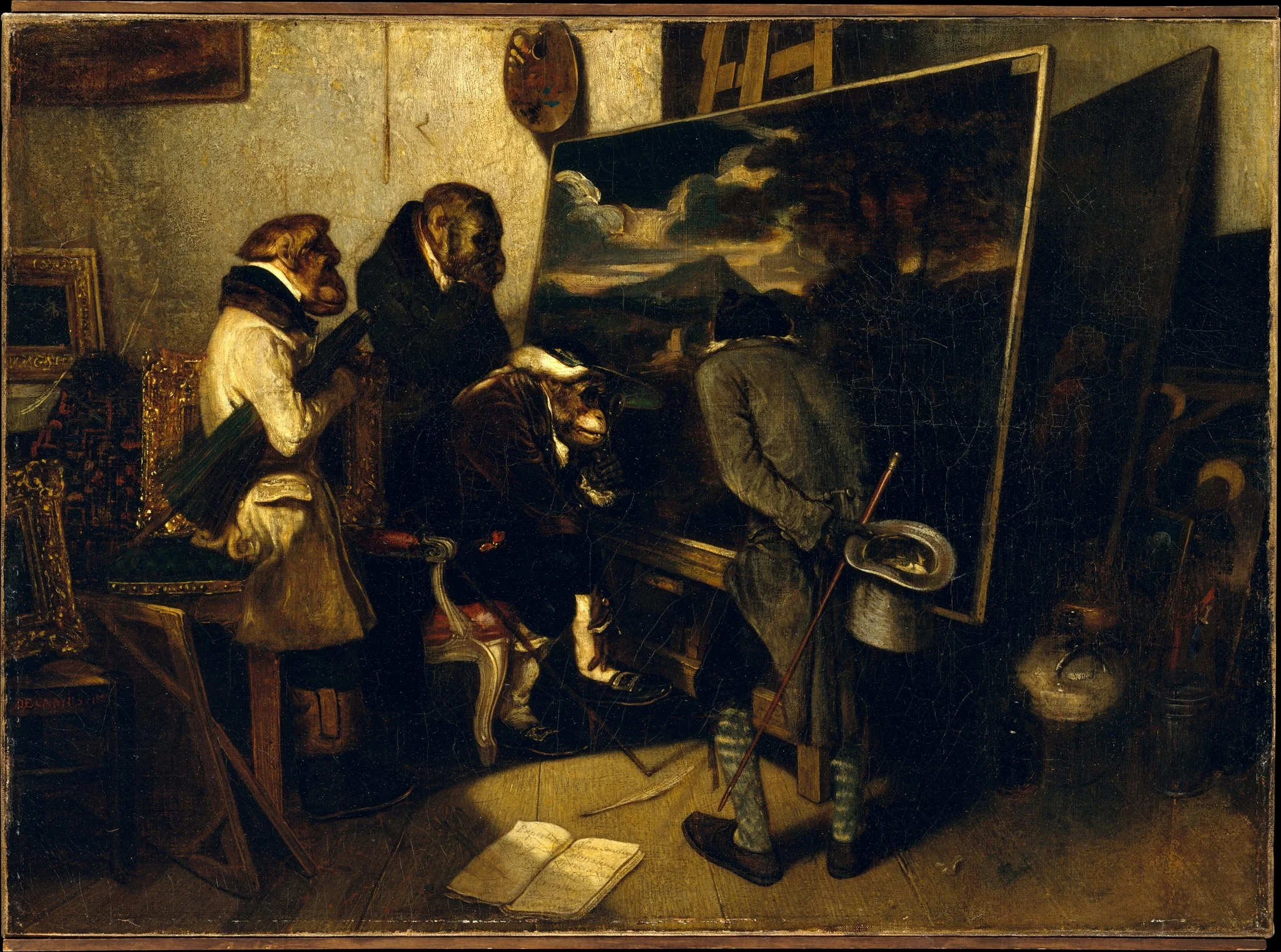
Not every Romantic painter charged the barricade. Some turned the argument into comedy, and the sharpest of those was Alexandre Gabriel Decamps. His The Experts is a satire aimed straight at the men who decided which paintings entered the Salon, and it makes its case by replacing the connoisseurs with monkeys.
Look at what is actually in the picture. A row of monkeys is gathered along a table, hunched in postures of professional concentration, peering at a framed canvas propped before them. One leans in close as if checking the handling of a passage of paint. Another holds back with the skeptical reserve of a man who has seen too many submissions. The light is low and brown, the warm bituminous tonality Decamps loved, and it gives the scene the hush of a real committee room. The joke lands because the painting is so straight-faced. Decamps does not caricature the monkeys into clowns. He paints them with the gravity of a genuine portrait, gives them the body language of authority, and lets the absurdity arrive on its own. The verdict being delivered with such solemnity is being delivered by animals.
That is the Romantic argument turned into a barb. The Academy held that taste was a rational discipline, teachable, defensible, vested in qualified judges. Decamps answers that the qualified judges are aping a competence they do not possess, applying inherited rules to a thing whose value escapes the rules. The work belongs to a tradition of Decamps painting that mocked official taste from inside the official system, and it is a reminder that the quarrel was fought with wit as often as with thunder.
The argument had many fronts
The fight was never only about barricades and shipwrecks. It opened on several fronts at once, and the breadth is easy to miss if you read the movement through its two famous names. Léon Cogniet's The Artist in His Room at the Villa Medici, Rome makes the case on the front of interiority. A painter at the Rome academy, the institution that minted Neoclassical careers, sits alone in a plain room. The picture is quiet, intimate, psychological, the opposite of a public moral exemplum. Cogniet takes the very headquarters of the antique ideal and paints, inside it, a single modern consciousness keeping itself company. The subject is a state of mind.
On another front the Romantics went looking for feeling outside the city, among the people the Academy never painted. Léopold Robert's Brigand and his wife in prayer gives a pair of Italian outlaws the dignity of devotion, finding in bandit life the kind of grave humanity the school reserved for senators. Robert was after sincerity of feeling in ordinary, even outlaw, lives. The choice of subject is itself an argument.
And the predecessor was not always French. The Romantic generation revered Francisco Goya, whose late portraits showed how far a face could be pushed toward raw psychology without losing its likeness. His Narcisa Barañana de Goicoechea fixes a sitter with the unsentimental scrutiny that French painters would spend decades trying to import. Goya was, in a sense, the argument's outside witness, proof from across the Pyrenees that paint could carry a temperament. Even religious history, the Academy's home turf, got the Romantic treatment. Giovanni Maldura's David at the Cave of Adullam keeps the biblical grand subject the school prized, then leans on shadow and mood rather than crisp didactic clarity. Maldura shows how thoroughly the new sensibility could colonize old material.
Works discussed in this article
The argument in the archive
The breadth of fronts is not just an impression. It shows up when you count. Artifact World Gallery's own holdings make the spread legible: 572 French Romantic works, gathered from 59 venues, the output of 207 named hands, clustered between roughly 1790 and 1890. Set that figure against the way the movement is usually taught, as essentially the achievement of two or three giants, and the corpus tells a different and more honest story. Two hundred and seven artists did not all paint barricades. They argued the same case across portraits, bandit genre scenes, biblical nocturnes, and satirical singeries, which is exactly what a hundred-year quarrel with a dominant school should look like in the historical record.
The hundred-year span is itself revealing. Tate dates the movement's currency to the early nineteenth century, and the headline battles do cluster there, around 1819 and 1830. But a body of work running to 1890 means the Romantic sensibility kept generating pictures long after the supposed decisive Salons, seeping into the practice of painters who never thought of themselves as combatants. An argument that produces work for a century was not settled by a single famous canvas. It was metabolized.
How the quarrel ended
Arguments in art rarely end with a winner. They end when the question changes. By mid-century the dispute between line and color, between antiquity and the present, had been absorbed so thoroughly that the next generation no longer needed to take a side. The younger painters who would become Realism took the Romantic insistence on the contemporary and the felt, stripped it of allegory and exotic costume, and pointed it at peasants, laborers, and provincial funerals. They kept the Romantic answer about subject and discarded the Romantic appetite for drama. In that sense the Romantics won the war they cared about most, the war over what a painting could legitimately be about, and lost the smaller war over how grandly it should announce itself.
Even the line painters were changed by the fight. The partisans of contour, the inheritors of Ingres, sharpened their own practice in opposition, and the long nineteenth-century French tradition of immaculate drawing owes part of its rigor to having something to argue against. A quarrel keeps both parties honest. That is the unglamorous truth the jailbreak narrative obscures. Romanticism did not destroy its predecessor and walk free. It pressed against Neoclassicism so hard, for so long, that the pressure shaped everything that came after, including the school it was pushing against.
So return to the monkeys for a last look. Decamps painted his council of experts with a straight face because the joke only works if you grant the experts their seriousness first. The same is true of the whole movement. French Romanticism mattered because it took the predecessor seriously enough to argue with it for a hundred years, on its own wall, at its own scale, in front of its own jury. The next painter who wants to overturn a tradition could do worse than study how these rebels did it. They did not leave the room. They took it over from the inside, and they kept the furniture.
One small coda from the corpus, for the painters who get left out of the giants-only version of the story. The single-work names sit beside the famous ones in the archive, a Paul-Jacques-Aimé Baudry here, a Maldura there, each a reminder that a movement is a population, not a podium. The argument was loud at the top and constant underneath, and the count of 207 hands is where you hear the undertone.
Sources & further reading
- Romanticism (art term) — Tate
- Romanticism (Heilbrunn Timeline essay) — The Metropolitan Museum of Art
- The Raft of the Medusa — Wikipedia
- Liberty Leading the People — Wikipedia
- Théodore Géricault, Raft of the Medusa — Smarthistory
- Romanticism — National Gallery of Art
- Théodore Géricault (artist record) — The J. Paul Getty Museum
- The Mirror of Art: Critical Studies (Baudelaire) — Internet Archive