Artwork
Narcisa Barañana de Goicoechea
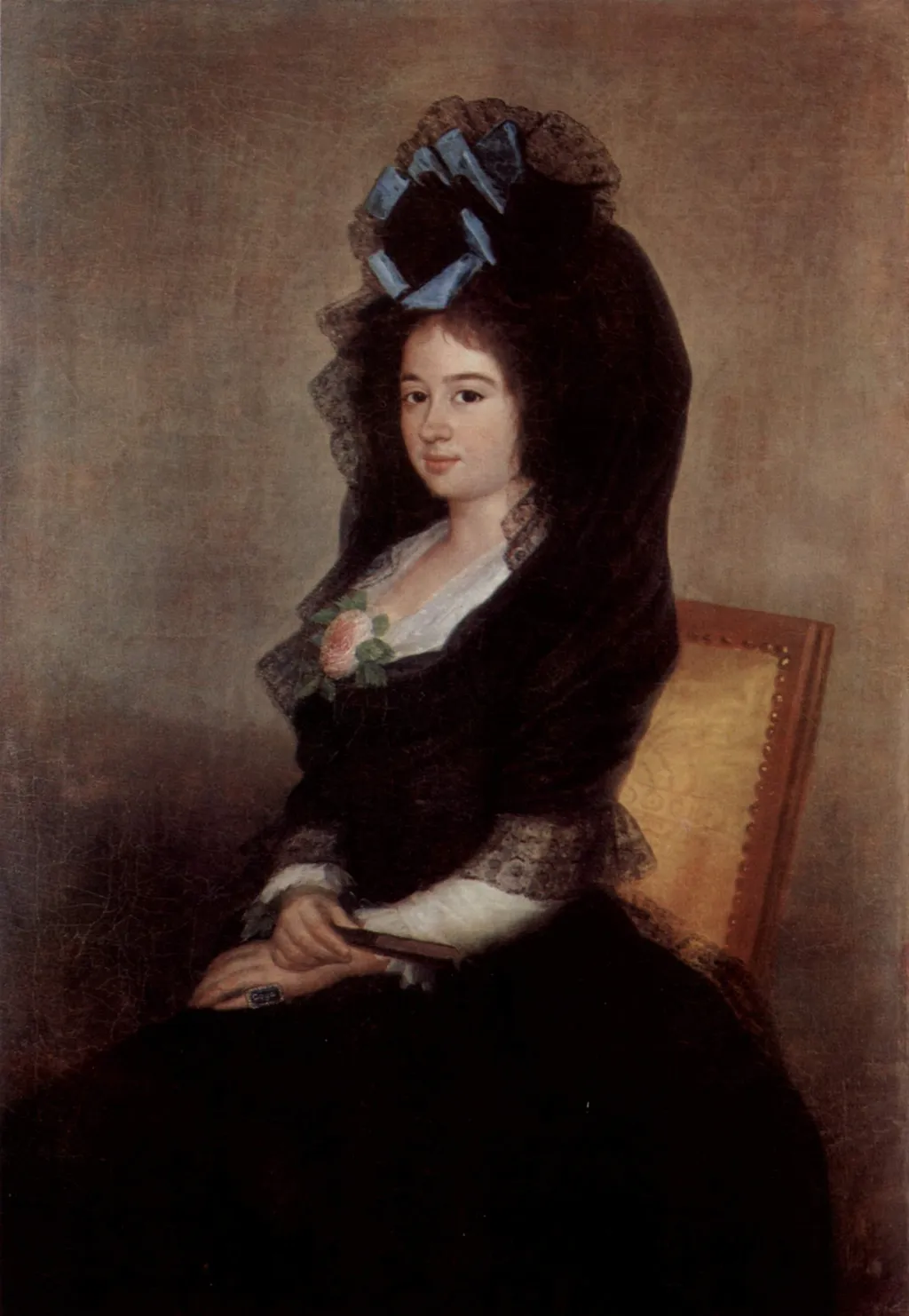
Narcisa Barañana de Goicoechea is an oil painting by the French Romanticist artist Francisco de Goya. It dates from 1815 and is held in the collection of the Metropolitan Museum of Art.
About this work
Subject & Meaning
A distinctive iconographic element is the artist's signature, painted directly onto the subject's large ring, a technique characteristic of his portraiture.
The work depicts Narcisa Barañana de Goicoechea seated elegantly in a yellow upholstered chair, wearing a black gown with lace trim and a rose at the décolletage. Her attire combines Spanish and French fashion elements, featuring a black mantilla adorned with a large blue bow. She holds a closed fan in her left hand and gazes directly at the viewer with a confident expression.
The painting highlights Goya's mastery in rendering textile textures, specifically silk and tulle. A distinctive iconographic element is the artist's signature, painted directly onto the subject's large ring, a technique characteristic of his portraiture. The subject's assured demeanor and the specific inclusion of family-related jewelry suggest a representation of status and personal identity within the Goicoechea family circle, to which Goya was connected through marriage.
Technique & Style
Created in 1815, this portrait is executed in oil paint on canvas. The artist demonstrates masterful handling of materials, specifically rendering the distinct textures of black silk and tulle mantilla with precision. The sitter is depicted seated in a yellow-upholstered armchair, wearing a black gown trimmed with lace at the collar and sleeves.
A single rose adorns the neckline, while a large blue bow decorates the headgear, blending Spanish and French fashion elements of the era. In her left hand, she holds a closed fan. The composition features a direct, assured gaze from the subject.
Notably, the artist's signature is integrated into the design, appearing on the large ring worn on the sitter's finger, a characteristic stylistic device. The work measures 112.4 cm in height and 78.1 cm in width.
History & Provenance
Attributed to Francisco Goya, the portrait of Narcisa Barañana de Goicoechea was painted in 1815. The work serves as a pendant to a portrait of her husband, Juan Bautista de Goicoechea. The painting's documented provenance begins with the collection of Felipe Modet, where it was displayed during a Goya exhibition in Madrid in 1900.
It subsequently entered the Durand-Ruel collection in Paris before being acquired by the Havemeyer family of New York in 1903. The Havemeyer family donated the piece to the Metropolitan Museum of Art in 1929, where it remains part of the permanent collection with accession number 29.100.18.
Context
The portrait of Narcisa Barañana de Goicoechea has been situated within Goya's late-period portraiture, a genre marked by psychological penetration and sartorial precision. Its attribution has been contested; scholars such as Rita de Angelis and Jose Gudiol list it among Goya's works, while earlier doubts were voiced by Aureliano de Beruete. The painting's provenance, from the Modet collection through Durand-Ruel to the Havemeyers and finally the Metropolitan Museum of Art, anchors it in the early twentieth-century canonization of Goya's oeuvre.
Its display at the 1900 Madrid Goya exhibition and subsequent inclusion in retrospective scholarship underscore the portrait's role in shaping perceptions of Goya's social and familial networks, particularly his ties to the Goicoechea family through his son Javier's marriage to Gumersinda.
Overview
This oil painting depicts Narcisa Barañana de Goicoechea, captured in a seated pose. The artist presents her with a dignified demeanor, dressed in opulent attire. The composition emphasizes her presence through a focused use of light and shadow, drawing the viewer's attention to her features and the delicate details of her presentation.
Own this work as a print
Artist & collection
Artist
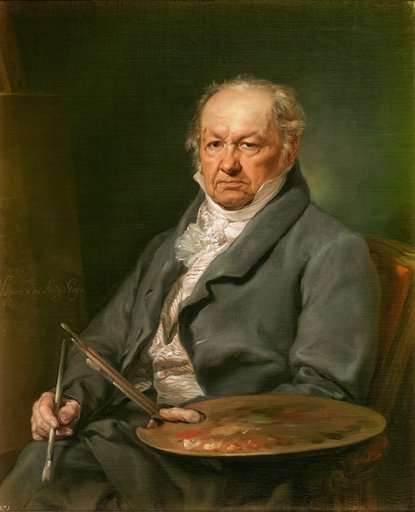
Francisco José de Goya y Lucientes was a Spanish romantic painter and printmaker.

- Dona Amalia Bonells de Costa
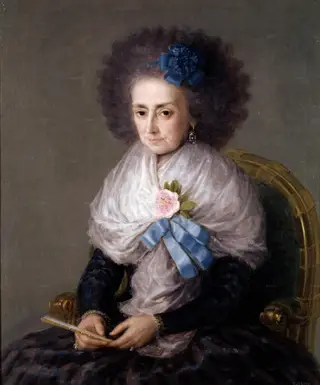 María Antonia Gonzaga, Dowager Marchioness of Villafranca
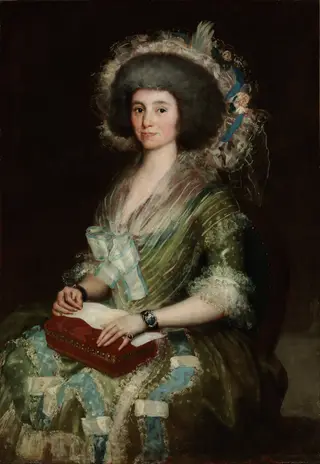 Portrait of Senora Ceán Bermudez
 Princess Luise Ulrike of Prussia (1720-1782)
 Tadea Arias de Enríquez
 Soția medicului Pataki Samuel II (Szatmari Papp Sára) (În RI: Pataki Sámuelné Szatmari Papp Sára)
 Portrait of the Actress Antonia Zarate
 The infanta María Amalia of Spain as a Child, Holding a Book
 Portrait of Doña Macedonia Escardo
 Queen María Luisa in a Mantilla
 The Marquesa de Pontejos
 Портрет Д.С. Яковлевой