Still life asks almost nothing of you at first glance. A table, a half-peeled lemon, a glass tipped onto its side, a watch with its blue ribbon trailing off the edge. The eye registers "things" and moves on. That casual glance is exactly the mistake the genre was built to punish. The painters who perfected the form in the seventeenth-century Netherlands assumed a viewer who would stop, lean in, and decode, because the objects on the table were chosen the way a writer chooses words. A lemon is sour. A watch runs down. A glass falls. None of it is accidental.
So here is the claim this essay will defend, and the method it will hand you: a still life is a sentence in objects, and once you learn its small vocabulary you can read almost any example of the type without a wall label. The skill is not connoisseurship and it is not memorization of a symbol-dictionary. It is a habit of looking, four or five questions you ask in order, that turn a pretty arrangement back into the argument its first owner paid to hang on his wall. Artifact World Gallery holds ten public-domain still lifes that together cover the whole terrain this method crosses, from a banquet table to a skull, from a tulip to a dollar bill, and I will read several of them with you closely enough that the questions become yours.
First, agree on what you are looking at
The Tate's definition is blunt and useful: the subject of a still life is anything that does not move or is dead (Tate, "Still life"). Cut flowers, fruit, fish, game, a wine glass. The Getty's explainer narrows it to mostly inanimate, commonplace objects, natural or human-made, the stuff of an ordinary house. The English name is a translation. It comes from the Dutch stilleven, a word that entered the language as the genre itself took shape in the Netherlands across the sixteenth and seventeenth centuries. That origin matters for reading, because it tells you these were not timeless decorations. They were products of a specific society at a specific moment, and they speak its concerns.
The Metropolitan Museum ties the genre's rise to the urbanization of Dutch and Flemish life, to a new merchant culture that put fresh weight on the home, on personal possessions, on commerce and on learning (Met, "Still-Life Painting in Northern Europe"). A people newly able to own things, and newly anxious about owning them, commissioned pictures of their things. That tension, pride in the goods and unease about the pride, is the engine under almost every great still life. Hold it in mind. It is the first thing the objects are arguing about.
One more fact of context worth carrying. The French Royal Academy, codifying the hierarchy of genres in the seventeenth century, ranked still life dead last, below history, portrait, and landscape. The reasoning was that a painter of lemons exercised only the hand, not the mind. The Dutch masters spent the century proving the opposite, loading the lowest genre with the most reading. When a critic dismissed these pictures as mere copying, the painters answered by making copying itself a riddle.
A close reading: Heda's interrupted meal
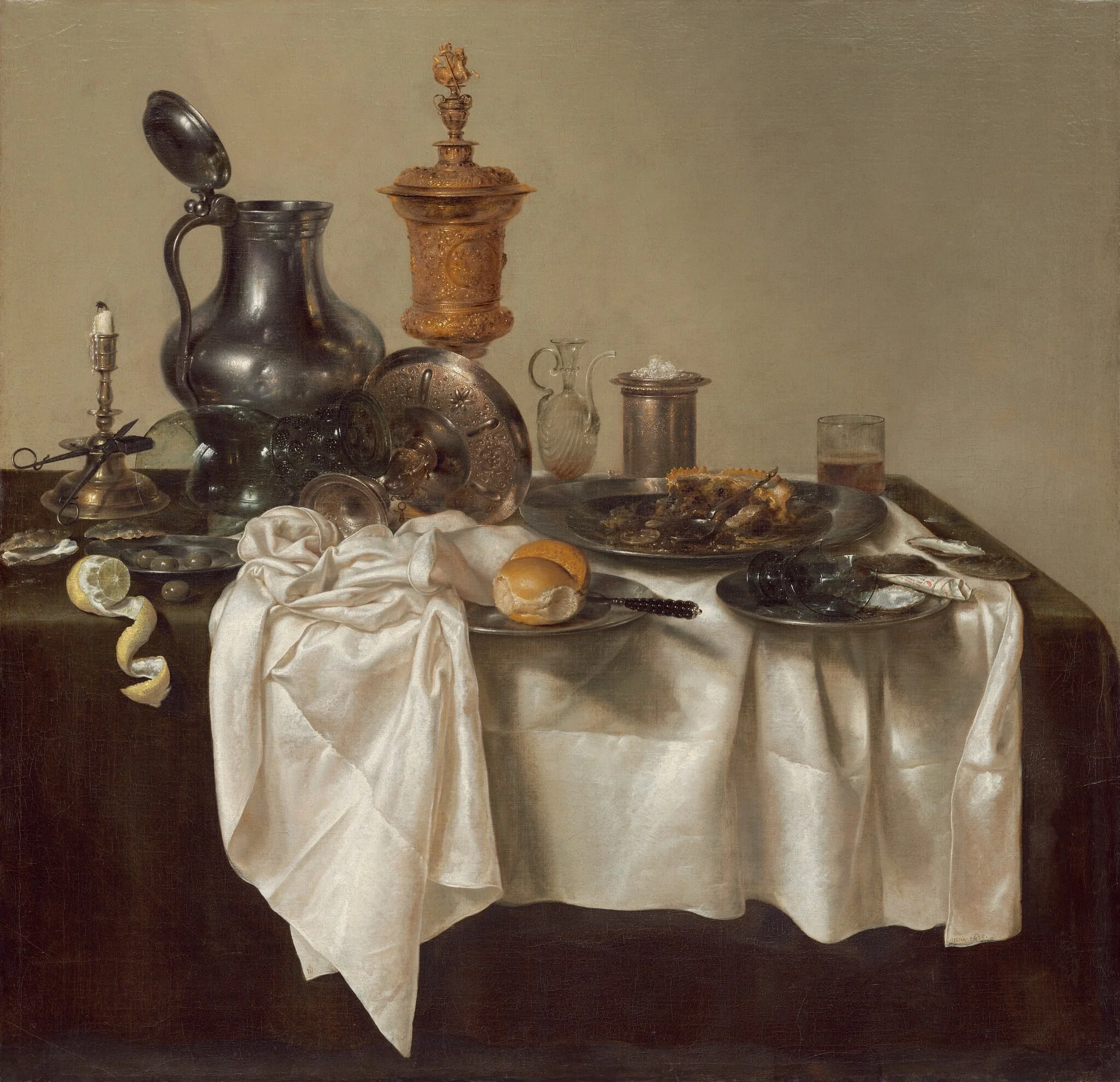
Stand in front of the Banquet Piece with Mince Pie by Willem Claesz Heda, and notice first what kind of meal this is. Nobody is here. The cloth is rumpled, half pulled back off the table's edge as if dragged by someone leaving in a hurry. A roemer of wine stands nearly full; a tall flute glass lies on its side, emptied, its bowl pointing at us. The mince pie has been cut into, its lid lifted and tipped. A silver tazza has toppled. This is not a feast. It is the wreckage of one, the ten minutes after the guests have gone.
Now follow Heda's light. It enters low from the left and is doing two jobs at once. It models the silver with a jeweller's patience, every dent and reflection in the gilt cup, the cool sheen down the side of the tilted flute, the warm gleam on the lemon's curling rind. Heda was a painter of metal and glass before he was a painter of food, and you can feel him preferring the surfaces that bend light. The pewter plate juts past the table edge into our space, a small trespass that says: this is real, this is here, you could touch it. He builds the whole picture from a narrow band of greys and browns, a tonal painting, almost monochrome, so that the one acid note of lemon yellow rings like a struck bell.
Then read the objects as a clock. The lemon is half-peeled, its skin spiralling down, beautiful and already turning bitter under the sweetness, a standard Dutch warning that pleasure curdles. The wine is poured but abandoned. The pie is opened but unfinished. The glass has fallen, and a tipped glass in this vocabulary is a stopped life, a breath let out. Somewhere near the front, Heda sets a pocket watch, its ribbon spilling over the edge. The watch is the key that unlocks the rest. It tells you the rumpled cloth and the toppled flute are not just elegant disorder. They are time, caught in the act of running out. Smarthistory reads a closely related Heda still life exactly this way, showing how its ordinary tabletop objects carry moral weight that only close looking releases (Smarthistory). The luxury is real and the painting loves it. The painting also tells you it is over.
That is the whole method in one picture. You asked what kind of scene it is, you followed the light to the things the painter cared about most, and you let the odd detail, the watch, reorganize everything around it into a single statement. Do that, and you have read the painting. Now let us make the questions explicit and try them on harder cases.
The grammar: what to look for, in order
- What state are the objects in? Fresh or wilting, whole or cut, lit or snuffed, upright or fallen. State is the verb of the sentence. A blown rose and a budding rose mean opposite things on the same stem.
- What is expensive, and is the picture proud or nervous about it? Silver, glass, lemons, and imported spice flag wealth. Watch for the worm, the fly, the crack that the painter uses to undercut the boast.
- What time is it? A watch, a guttering candle, an hourglass, a mayfly, fruit at the exact tipping point of ripeness. These set the clock running and make the picture about transience.
- What is out of place? A skull among the flowers, a coin among the food, a torn paper. The intruder is usually the thesis.
- What are you, the viewer, being asked to do? Some of these pictures want to fool your eye. The trick is itself the meaning.
Five questions. You will not always need all of them, and great paintings answer several at once. But run them in order and the table starts talking back.
The boast and the worm: reading the banquet
Take question two to the laid table. The Still Life with Peacock Pie by Pieter Claesz is a display of conspicuous consumption. A peacock pie, the bird's plumage reassembled over the crust so the diners could see what they were eating, was a centerpiece for people advertising that they could afford to turn dinner into theatre. This is the pronkstilleven, the "show" still life, and its first job is to impress. But the genre rarely lets a boast stand clean. The Dutch word for this kind of luxury came with a moral attached, and the painters knew their buyers wanted both the goods and the absolution. So the reading is double: admire the silver, then look for what spoils it.
You can run the same test on the Still Life with Ham by Gerret Willemsz Heda, the son trained in the father's tonal manner. The ham is the prize, fat rendered with real appetite, but notice the company it keeps: the bread broken rather than sliced, the glass set down mid-meal, the slight disorder that tells you the moment is already passing. The pleasures are laid out and quietly dated. Once you have asked "what is expensive" and "what time is it" of one banquet piece, every other one in the room becomes legible in seconds. The vocabulary is small and the painters reused it on purpose, the way a sonnet reuses its rhyme scheme.
The skull in plain sight: the vanitas
Some still lifes drop the disguise and put the thesis on the table as an object. This is the vanitas. The Tate defines it as a still life of symbolic things, skulls, snuffed candles, books, instruments, assembled to remind the viewer of death and of the emptiness of worldly goods (Tate, "Vanitas"). The name is a Latin word lifted from the opening of Ecclesiastes, vanity of vanities, all is vanity, and its painters clustered above all in Leiden, a university town where a learned audience caught the reference instantly. To read a vanitas you barely need question four, because the out-of-place object is sitting in the center, grinning.
The grammar is by now familiar. A skull is the plain statement of death. A candle just blown out, its smoke still rising, is the soul departing or the hour ending. An open book or a lute says learning and art will not save you either. A few coins or a purse name the wealth being renounced. The Rijksmuseum catalogues one such picture's skull simply as the symbol of Vanitas, paired with flowers in a vase to spell out the brevity of earthly life (Rijksmuseum). Pieter Claesz turned the type into a specialty, setting a skull beside a toppled glass and a watch, sometimes with a small bronze figure of a thorn-puller, the Spinario, to put a relic of antique art into the same memento. The picture says even the ancients, even their masterpieces, ended in bone.
The type has a known beginning. Jacques de Gheyn II painted one of the earliest independent vanitas still lifes in Dutch art, dated 1603, decades before the banquet painters hit their stride. And it did not die with the seventeenth century. A 2000 exhibition catalogue traces the vanitas straight into contemporary art, the skull and the snuffed flame still doing their work for artists who never saw Leiden. When you have learned to read one of these tables, you have been handed a key that fits four hundred years of pictures.
Flowers that could not have stood together
The flower piece looks like the safest, prettiest corner of the genre, and it hides the same argument. Begin with question one, the state of the objects, and a bouquet turns sober. Look at the Flowers in an Urn by Jan van Huysum, the supreme technician of the type. Every petal is a small marvel of paint. But spot the open blooms next to the tight buds, the single drooping head, the leaf already browning at the tip, the snail or the beaded drop of dew. The bouquet contains the whole life of a flower at once, bud to blossom to collapse, so that the arrangement reads as time folded into a single frame.
Here is the detail that should change how you look forever. These bouquets were impossible. The Still Life with Iris by Peter Binoit gathers blooms that flower in different months and could never have stood in one vase on one morning. The painter assembled them from studies made across a whole season, sometimes across years, building a flower that exists only in paint. So a tulip in such a picture is never only a tulip. In the years of Dutch tulip mania a single rare bulb cost more than a house, and a painted tulip let a buyer own forever the thing whose real version withered in a week and ruined speculators overnight. The flower piece is a banquet piece by other means. It shows you wealth and beauty and tells you, in the wilting leaf, exactly what they are worth.
Works discussed in this article
When the trick is the meaning
Question five belongs to a later chapter of the same story, and it crossed the Atlantic. In the United States at the end of the nineteenth century, John Haberle painted trompe l'oeil so exact that viewers reached out to touch the canvas to see whether the dollar bill pinned to it was real. His A Bachelor's Drawer spreads a single man's clutter flat against the picture plane: currency, photographs, ticket stubs, a comb, matches, scraps of newspaper. Nothing recedes. The whole scene is pressed to the surface so the illusion has nowhere to hide, which is precisely the bravado. Haberle is daring you to find the seam between paint and paper.
The dare is the content. His painting bluntly titled Imitation makes the joke explicit, a picture of fake money whose whole subject is the gap between a real thing and its convincing copy. The Treasury reportedly warned him off rendering banknotes so persuasively. Read this against the old French verdict that still life was mere copying, the lowest art because it only imitated. Haberle takes the insult and performs it so well that imitation becomes the punchline and the proof of skill. He answers question two, what is expensive, with literal money, and question five, what are you asked to do, with: be fooled, then notice you were fooled, then admire the hand that did it. The genre that began as an argument about Dutch merchants and their silver ends, three centuries on, as an argument about American cash and the eye's own gullibility. The grammar held the whole way.
The method, portable
Carry the five questions out of this essay and they will work on a picture you have never seen. State first: is the fruit ripe or rotting, the candle lit or smoking, the glass standing or down. Wealth second: name the costly things, then hunt for the fly or crack that needles the pride. Time third: find the clock, whether it is a watch, a bloom at its peak, or a guttering wick. Then the intruder: the skull, the coin, the torn paper that does not belong and therefore carries the point. Last, your own role: is the picture content to be looked at, or is it trying to deceive you, and is that deception the joke.
None of this requires a degree. It requires the patience the painters assumed you would bring and the academy assumed you would not. They were betting on the slow viewer, the one who stops at the lemon and stays for the watch. Do that, and the lowest of the genres turns out to hold the densest reading in the building. The table was never quiet. It was waiting for someone who knew the language to sit down. Pull up a chair at Heda's wreck of a banquet, find the watch, and start there.
Sources & further reading
- Still life — Tate
- Vanitas — Tate
- Symbolism and meaning in Dutch still life painting — Smarthistory
- Still-Life Painting in Northern Europe, 1600-1800 — The Metropolitan Museum of Art (Heilbrunn Timeline)
- Still Life with a skull and a ginger jar (Vanitas) — Rijksmuseum
- What Is a Still Life? — The J. Paul Getty Museum
- Still life — Wikipedia
- Vanitas — Wikipedia
- Jacob de Gheyn II — Wikipedia
- Vanitas: Meditations on Life and Death in Contemporary Art — Internet Archive