A style that knew it was being looked at
Walk past a wall of Mannerist painting and the bodies give the game away. Necks run long, fingers taper into spindles, a saint's torso spirals when a calmer painter would simply have let him stand. Heads sit a size too small for the frames they crown. The verdict handed down for most of four centuries was that this was the Renaissance going soft, virtuosity curdling into mere mannerism. I want to argue the reverse. Those distortions were not a loss of nerve. They were a pitch, a way for an overcrowded generation of painters to prove they could do what their teachers could not, sold to patrons who paid for exactly that proof and liked being seen to own it.
So the lens here stays blunt: who painted it, and who paid for it. Hold those two questions together and the elongations and the airless, tilted spaces stop reading as decadence and start reading as a labor market. Mannerism is the High Renaissance generation's answer to a problem its own masters created. Raphael and Michelangelo had seemingly finished the job. What remained for the cohort behind them was not to solve painting again but to perform it, with more difficulty, more invention, more skill made visible on the surface, for buyers cultured enough to tell the difference. A young painter could not out-Raphael Raphael. He could instead do something Raphael had not thought to do, and charge for the novelty. The strangeness was the selling point. That is the thesis, and it holds work by work.
The name began as an insult
The word descends from the Italian maniera, meaning style or manner. Giorgio Vasari used it as praise in his 1568 lives of the painters, where maniera named a confident personal handwriting, the quality that made a Pontormo unmistakably a Pontormo. The sneer came later. The Tate's own glossary dates the style to the followers of Raphael and Michelangelo, roughly 1520 to 1600, and points to its artificiality and its sensuous distortion of the human figure as the signature traits (Tate). The label as we now use it was sharpened in the nineteenth century by Jacob Burckhardt and pushed into common circulation by German scholars in the early twentieth. For most of that long stretch, to call a picture mannered was to file a complaint. Only in the last hundred years has the period been read on its own terms, and read seriously.
That recovery matters for the money side of the story, because the very qualities Victorian critics disliked are the ones sixteenth-century clients were paying to acquire. The Getty describes artists chasing the bella maniera, the beautiful style, setting out to shock and delight viewers with exaggerated poses, extreme perspective, and muscular figures that seemed about to spill past the edge of the panel (J. Paul Getty Museum). Shock and delight were not side effects. They were the deliverable, written into the price.
Who painted it
The makers were, in the main, the second and third generations of a fully professionalized Italian workshop economy. The scale of that world is legible even in our own holdings. Artifact World Gallery keeps 2,967 works tagged Mannerism, made by 468 separate artists and now scattered across 102 institutions, spanning roughly 1493 to 1717. That last figure is the tell. A movement carried by 468 hands is not the project of a few geniuses. It is a broad professional consensus about what ambitious painting was supposed to look like, sustained for the better part of two centuries because the people commissioning art kept rewarding it. Numbers like these describe an industry, not a revolt: apprentices, journeymen, and shop masters all working a recognizable house style because that style sold.
Venice gives a clean cross-section of the trade. Titian sits at the older edge, never a pure Mannerist but the gravitational mass everyone in the lagoon orbited. Jacopo Tintoretto seized the muscular figure and the plunging diagonal and made them fast, theatrical, nearly violent in their lighting. Paolo Veronese ran an enormous shop turning out silvered, silk-laden feasts for refectories and palace walls. Lorenzo Lotto is the moving outlier, a painter whose slightly off-balance compositions feel intensely private in a market that prized public showmanship. Even a steady, orderly studio hand like Bonifazio Veronese belongs to the same supply chain, feeding altarpieces to parishes that wanted the new look at a workable price. Five painters, five price points, one shared grammar.
A worked example: Lotto's Saint Catherine
Take Lotto's Saint Catherine. The saint fills the panel close and frontal, dressed and jeweled like a Venetian gentlewoman rather than a martyr. Her broken wheel, the instrument of her torture, is tipped almost casually into the lower corner, a luxury object more than a horror. Lotto crowds the figure forward so there is barely any air behind her, and he lavishes the same attention on the gold thread of her sleeve as on her face. That is the Mannerist instinct working quietly. The picture is less a story than a performance of refinement, a sitter and a painter both demonstrating taste. A devout buyer got a saint to pray to. A worldly one got proof that the workshop could render brocade, pearls, and a steady inward gaze with equal command.
Close looking: El Greco splits a cloak
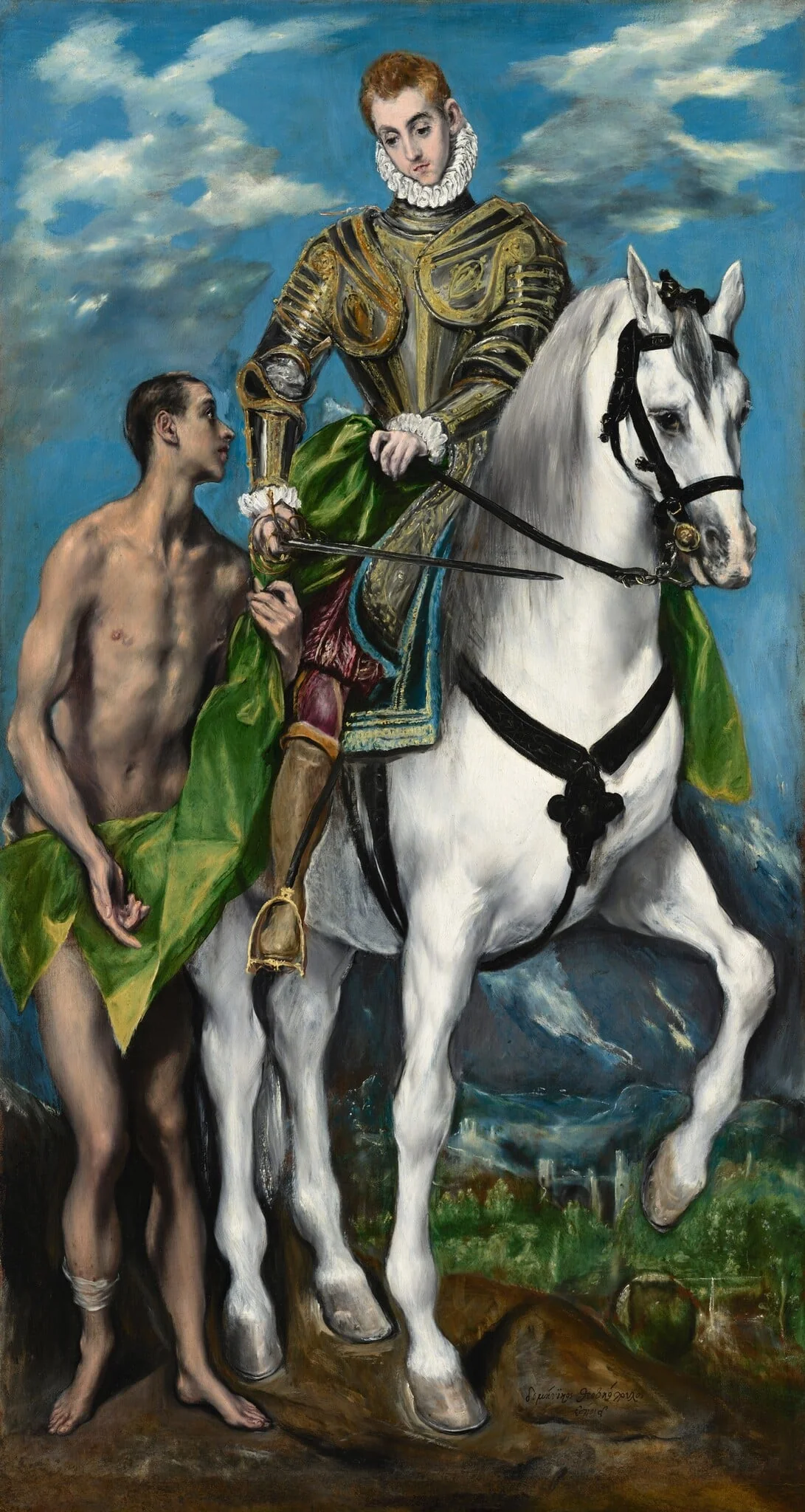
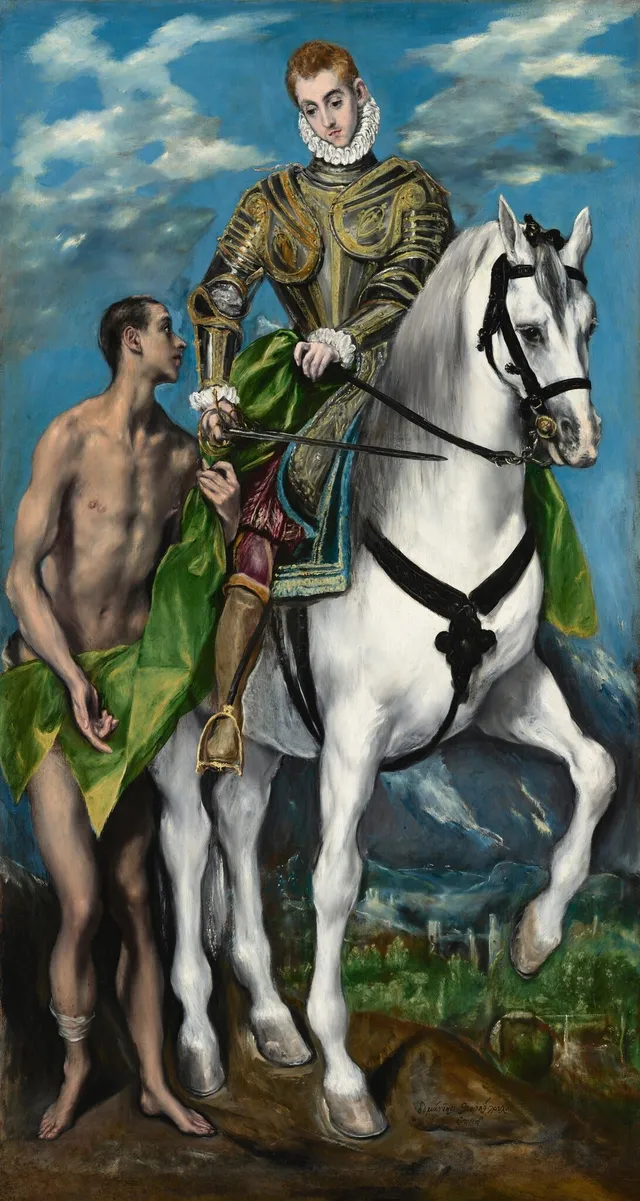
Now stand in front of Saint Martin and the Beggar. The canvas is tall and narrow, and El Greco fills almost the whole height with a single pale gray horse. The young soldier-saint, sheathed in steel armor that catches a cool silver light, leans from the saddle and draws his sword across his own green and gold cloak to share it. Below him a naked beggar lifts one arm, his body stretched as long and thin as the horse's legs, which are themselves too long for any real animal. There is almost no middle ground. The earth drops away to a thin ribbon of landscape, and above it a streaked, bruised sky presses the figures up toward us. El Greco has flattened the depth a Renaissance master would have built, then lit the whole scene as if from inside a storm. The point is not anatomical accuracy. The elongation is the meaning, a stretching of ordinary charity into something rarefied and otherworldly. He is not recording a road in Toledo. He is converting a small act into a vision, plane by silvery plane.
The same cold, electric atmosphere fills his View of Toledo, where the city heaves up the hillside under a sky that looks lit by something other than the sun. Put the two beside the gentler Holy Family with Saint Anne and you see the range of one workshop: civic spectacle, private devotion, and a saint on horseback, all carrying the same stretched, restless signature. El Greco trained in Crete and Venice, absorbed Rome, then built a career in Spain on precisely this strangeness, because Toledo's churches and devout collectors valued the spiritual charge his distortions delivered. The further he pushed the figure from the body, the closer he pushed it to feeling.
Who paid for it
Four kinds of buyer kept this style alive, and each wanted something slightly different from it. The first and largest was the Church, in the broad sense: cathedral chapters, parish vestries, monastic refectories, and the lay confraternities who funded altarpieces as acts of collective piety and local prestige. These were the bread-and-butter contracts, and they shaped the work. A confraternity paying for an altarpiece wanted a recognizable saint, a clear devotional focus, and visible expense, gold, fine pigment, many figures. Mannerism could supply all of that while also flattering the donors with its conspicuous difficulty, the look of money well spent on the best hands in town.
The timing tightened the relationship. The Metropolitan Museum's survey of Bronzino and his contemporaries places the Italian movement from about 1520 to 1600, running between the High Renaissance and the Baroque, with its hallmark distortion of the figure and flattening of pictorial space (Heilbrunn Timeline of Art History). That span brackets the Counter-Reformation, when the Church grew newly anxious about how images instructed and moved the faithful. Some Mannerist excess was reined in by that scrutiny. Some of it was redirected, the drama and the heightened emotion turned toward devotional intensity rather than display for its own sake. El Greco is the great case of distortion repurposed as religious feeling.
The second buyer was the princely court, and here the style found its most natural home. In Medici Florence, Mannerism became something close to an official manner, an art of polish, allegory, and learned in-jokes legible to a small, cultivated audience. Bronzino's glassy court portraits, with their cold skin and heraldic stillness, are the type at its most controlled, painting as a display of breeding. Vasari himself, whose word gave the movement its name, worked as a court painter and impresario for Duke Cosimo I, running large decorative programs and writing the careers of his peers into history at the same time. A court wanted art that signaled sophistication and dynastic confidence. Difficulty, refinement, and a faint air of exclusivity were features, not bugs. The harder a picture was to read, the more it flattered the few who could.
The third buyer carried the style north and made it portable: the foreign court collecting Italian taste at a distance. The clearest specimen is Bartholomeus Spranger, the Antwerp-trained painter who rose to serve Emperor Rudolf II in Prague and turned out elegant, erotic mythologies for a connoisseur's cabinet. His figures run to tall, slender bodies balanced on small heads, the look of an artist painting for one exacting eye rather than a congregation. The Heilbrunn essays trace how this northern strain of the style spread through courts and printmakers across the sixteenth century (Met, Northern Mannerism). This is patronage as collecting rather than devotion. Rudolf wanted virtuosity itself, the proof of a master's invention, hung among curiosities and instruments. The figures grow more impossible because the audience is paying for the impossibility.
The fourth buyer is the easiest to overlook: the private sitter from the rising merchant and professional class, who paid for portraits. Jan Gossaert's Portrait of a Man, possibly Jan Snoeck, points to that market in the North, where Italian forms met a Netherlandish appetite for sharp, individual likeness. A merchant did not commission allegory. He commissioned himself, rendered with enough imported elegance to announce that he kept current company. The Mannerist vocabulary of crisp contour and cool poise served him perfectly, dignity for hire, available to anyone who had earned the fee.
Difficulty as a price tag
Pull the four buyers together and a single logic appears. Each was, in the period's own term, paying for difficoltà, difficulty overcome. A foreshortened figure seen from below, a knot of bodies that still reads clearly, a hand that bends past comfort yet stays graceful: these were the painterly equivalents of a virtuoso's cadenza. They demonstrated that the artist had mastered the masters and gone further. A patron who bought such a picture bought membership in the audience smart enough to applaud it. The distortions everyone later mocked were, at the moment of sale, the most expensive thing in the frame. Read a Mannerist contract beside the picture it produced and the logic is plain. The client specified the saints and the schedule; the painter answered with a flourish nobody had asked for, because that flourish was his signature and his advertisement at once.
This also explains why the Italian and Northern stories run on slightly different clocks. The Heilbrunn essays note that Northern Mannerism appeared early in the sixteenth century and stands apart from the Italian phase, which began a little later and stretched into the seventeenth (Met, Northern Mannerism). The style traveled along the routes that money and prestige traveled: Italian masters lured to foreign courts, prints carrying compositions across borders, local painters learning the imported grammar to win local commissions. Patronage was the distribution network, and the distortion was the product that moved along it.
Works discussed in this article
What the style left behind
By the early seventeenth century the market shifted again. A new generation of buyers, and a Church newly insistent on clarity and direct emotional address, wanted painting that gripped a crowd rather than rewarding a clique. That demand produced the Baroque. The Baroque kept Mannerism's theatrical lighting and dramatic diagonals while discarding its deliberate obscurity, trading difficulty-for-connoisseurs for spectacle-for-everyone. It is tempting to read that as Mannerism failing. It is more accurate to read it as the audience changing, and the trade adapting, as it always had. The skills did not vanish. They were repointed at a wider room.
Go back to El Greco's stretched horse with all of this in mind. The exaggeration that once looked like a mistake reads now as a transaction visible on the surface: a painter showing a buyer that he could take a small charitable act and lift it into pure vision, and a buyer paying for exactly that lift. Mannerism was never a failure of the Renaissance ideal. It was the moment the trade in skill became its own subject, and the customers, for nearly two centuries, kept saying yes.
Sources & further reading
- Mannerist — Tate
- Michelangelo: Mind of the Master (bella maniera) — The J. Paul Getty Museum
- Mannerism: Bronzino (1503-1572) and His Contemporaries — The Metropolitan Museum of Art (Heilbrunn Timeline of Art History)
- Northern Mannerism in the Early Sixteenth Century — The Metropolitan Museum of Art (Heilbrunn Timeline of Art History)
- A beginner's guide to Mannerism — Smarthistory
- Mannerism — Wikipedia
- Lives of the Most Eminent Painters, Sculptors & Architects (Vasari) — Internet Archive