Artwork
Portrait of a Man, possibly Jan Snoeck
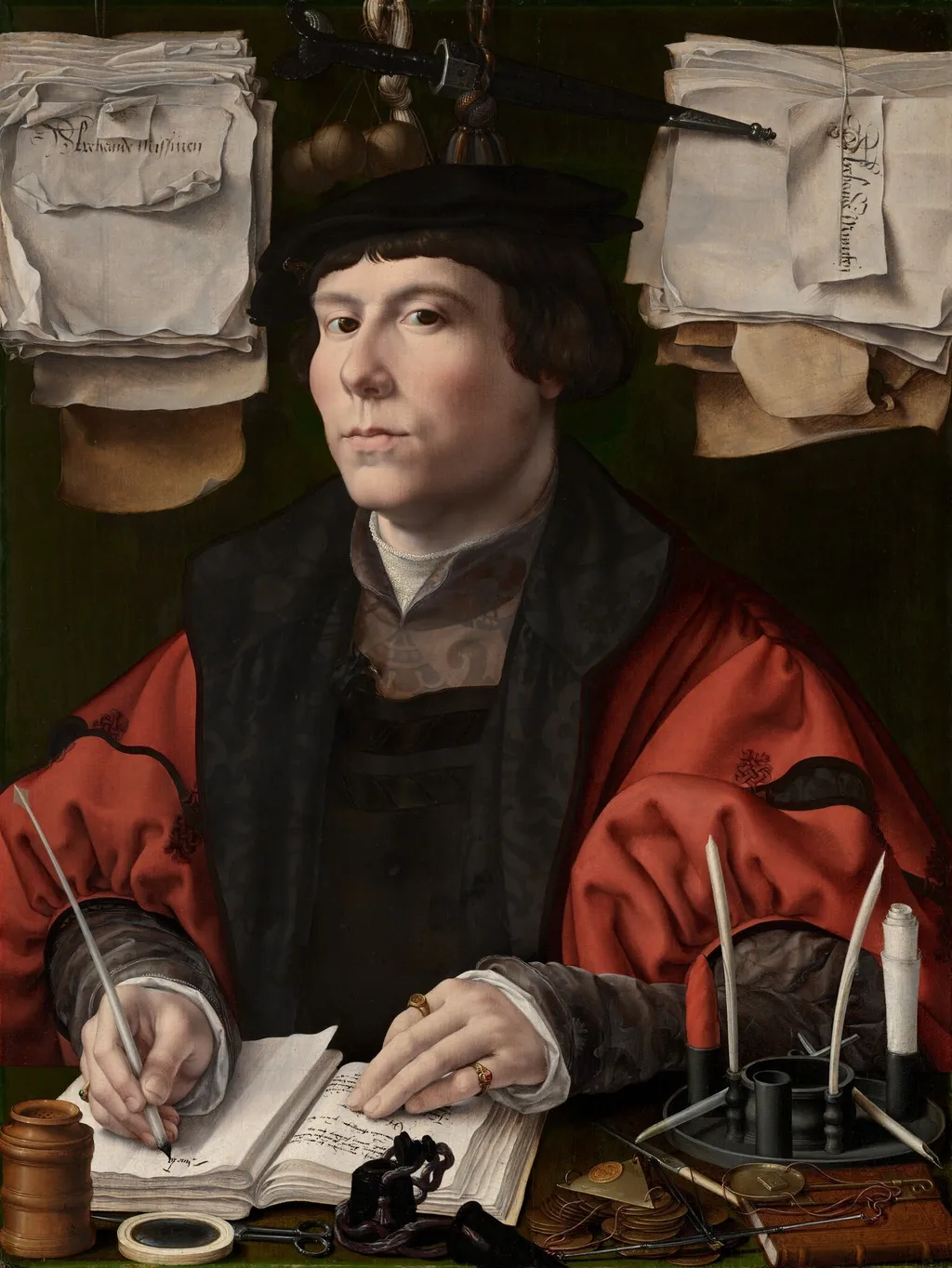
Portrait of a Man, possibly Jan Snoeck is an oil painting by the Mannerist artist Jan Gossaert. It dates from 1530 and is held in the collection of the National Gallery of Art.
- Inscription
- Inscribed:upper left on the paper: Alrehande Missiven (miscellaneous letters); upper right on the paper: Alrehande Minuten (miscellaneous drafts); on ring on sitter's index finger: IS; on pin on hat: IAS (intertwined)
About this work
Jan Gossaert painted him around 1530, surrounded by inkpots, coin scales, and papers marked "miscellaneous letters" and "miscellaneous drafts" in Dutch.
A young merchant sits cramped among his tools at a green desk, quill in hand, rings on his fingers, ledgers beneath them. Jan Gossaert painted him around 1530, surrounded by inkpots, coin scales, and papers marked "miscellaneous letters" and "miscellaneous drafts" in Dutch. The monograms "IS" and "IAS" have led scholars to tentatively name him Jan Jacobsz. Snoeck. The National Gallery of Art acquired it in 1967.
Subject & Meaning
The painting depicts a man identified as Jan Jacobsz Snoeck, a merchant or bookkeeper. He is shown in an office setting surrounded by the tools of his trade: a ledger, receipt, quill, and writing implements. These objects are not merely decorative but carry symbolic weight, associating the sitter with commerce, literacy, and administrative competence.
The inclusion of such professional attributes suggests a portrait meant to convey the subject's social standing and personal virtues, diligence, financial acumen, and trustworthiness, values prized in the mercantile culture of the sixteenth century. The work thus functions both as a faithful likeness and as a visual statement of identity and status.
Technique & Style
Jan Gossaert executed this portrait in oil on panel, a standard medium and support for Northern Renaissance painting. The work is described as “highly finished,” reflecting meticulous brushwork and attention to surface detail. The half-length composition presents the sitter, likely Jan Snoeck, with professional attributes such as a ledger, quill, receipt, and writing implements, situating him in an office environment.
These objects reinforce his identity as a merchant or clerk. The formal arrangement emphasizes both the figure and his occupational trappings, with careful rendering of textures. The panel measures 63.6 by 47.5 centimeters. Available sources do not document the painting's condition.
History & Provenance
The portrait was painted by Jan Gossaert in 1530. Its recorded provenance begins with the London dealer John Smith, who sold it on 4 August 1836 to the 3rd Marquess of Lansdowne for £100. It remained in the Lansdowne family collection until January 1967, when it was sold by Lord Lansdowne to the London art dealership Thos.
Agnew & Sons. The National Gallery of Art, Washington, D.C., purchased the painting from Agnew's later that same month.
The painting belongs to the National Gallery of Art in Washington, D.C.. Its exhibition history includes the 1866 British Institution exhibition in London and the later exhibition "Remember Me". The inventory/accession number is not provided in the available sources.
Overview
Jan Gossaert created this oil on panel around 1530, shortly before his death. It portrays a young man, likely a merchant, situated in a compact interior space. He is surrounded by various implements of his profession, including writing tools, scales for weighing coins, and labeled documents.
The sitter's attire and personal insignia have led to a scholarly, though provisional, identification of the subject as Jan Jacobsz. Snoeck.
Context
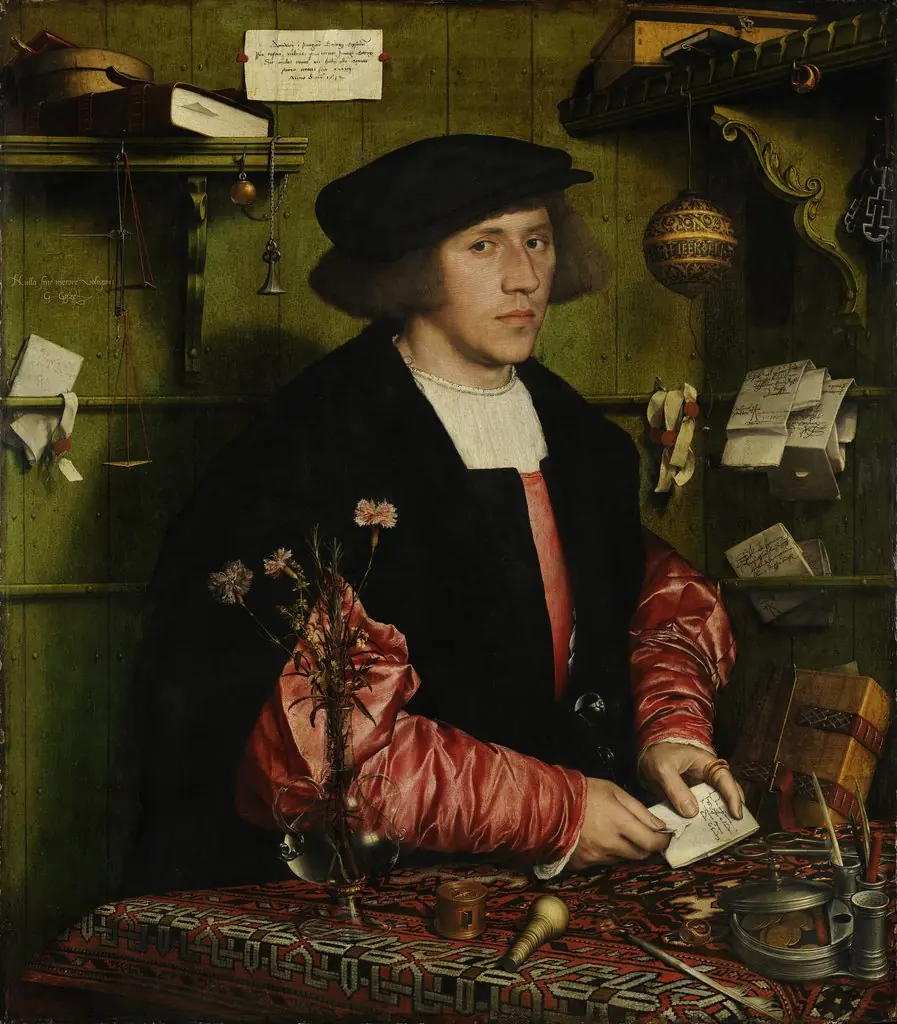
Art historians suggest that this portrait may have influenced Hans Holbein the Younger. It is believed Holbein encountered the work during his travels through the Netherlands in 1532. This exposure potentially informed his later depiction of the merchant Georg Gisze, now in Berlin, demonstrating a cross-pollination of artistic ideas among prominent Northern European painters of the era. The meticulous rendering of mercantile details aligns with a broader interest in realism during the period.
![Portrait of a Merchant [possibly Jan Snoeck]](https://artifactworldgallery.com/img/portrait-of-a-merchant-possibly-jan-snoeck--0a8a46dc3a051aff-w320.webp)
Own this work as a print
Artist & collection
Artist
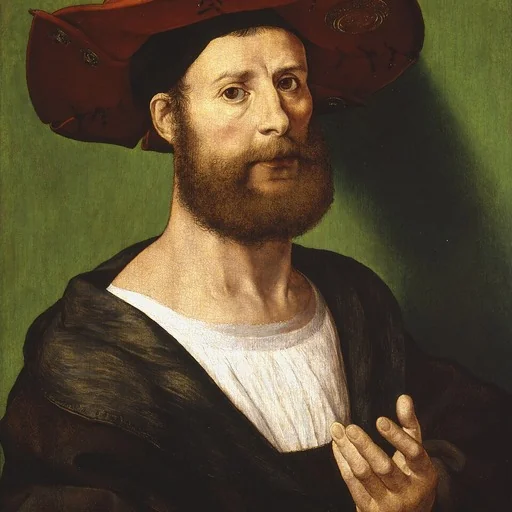
Jan Gossaert (c. 1478 – 1 October 1532) was a French-speaking painter from the Low Countries also known as Jan Mabuse (the name he adopted from his birthplace, Maubeuge) or Jennyn van Hennegouwe (Hainaut), as he called…

![Saint Jerome Penitent [right panel], by Jan Gossaert](https://artifactworldgallery.com/img/jan-gossaert--saint-jerome-penitent-right-panel--0d4ac14f44de87b1-w320.webp)
![Saint Jerome Penitent [left panel], by Jan Gossaert](https://artifactworldgallery.com/img/jan-gossaert--saint-jerome-penitent-left-panel--3d396afbb0f8e738-w320.webp)
 Portrait of a Man
 The Merchant Georg Gisze
 Portrait of (possibly) Pieter Gerritsz Bicker, pendant of (possibly) his wife Anna Codde
 Portrait of Sybrand Pompejusz. Occo
 Portrait of a Scholar
 Portrait of Joris Vezeleer
 Männliches Bildnis
 Portrait of Christoph Fugger
 Männliches Bildnis
 Man Playing the Clavichord
 Johann von Aich (1510–1549)
- Portrait of a Merchant [possibly Jan Snoeck]