The category we now call Nihonga is younger than most of the paintings filed inside it. That sounds like a paradox and it is the key to the whole subject. Nihonga is not a manner you can learn to spot the way you spot Cubism or Pointillism. It is a boundary line drawn late, on purpose, by men who felt their own painting tradition was about to be erased. The word was coined in the Meiji period to mark off Japanese-method painting from yōga, the imported practice of oil on canvas (Wikipedia). Strip away the politics and what remains is a claim about materials and seeing: that mineral pigment ground into glue and laid on silk or paper does something oil cannot, and that this difference was worth defending.
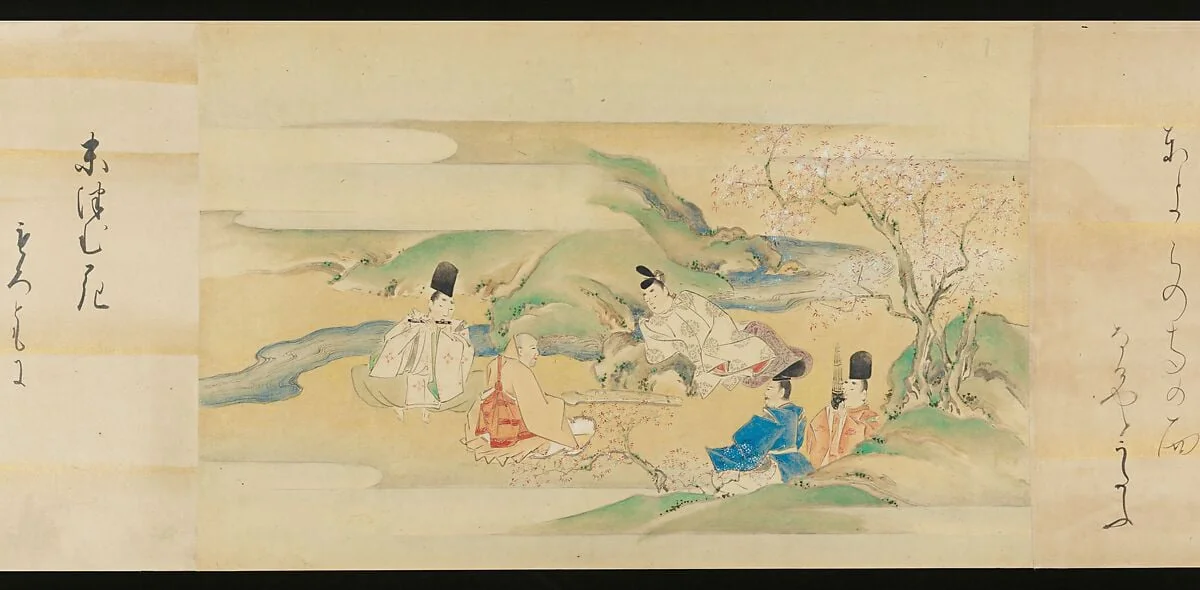
So here is the argument this essay will carry from one work to the next. Nihonga is best understood not as a look but as a retroactive lineage, a fence built in the 1880s and 1890s that reached backward to enclose four centuries of native painting and call it one inheritance. The cleanest way to test that claim is to stand in front of a single object made long before the word existed and ask what the Meiji theorists were actually pointing at when they said the words "Japanese painting." The object I will keep returning to is a handscroll of The Tale of Genji attributed to Kaihō Yūsetsu, a Kanō-trained painter of the seventeenth century. It predates the movement by roughly two hundred years, and that gap is exactly the point.
A word that arrived two centuries late
The vocabulary matters because it shapes what people expect. "Impressionism" and "Fauvism" name things artists did and then got labeled for. Nihonga runs the other way. The label came first, as a defensive act, and the paintings were sorted underneath it afterward. In the 1880s the Tokyo art world had a real problem. Western oil painting carried the prestige of modernity, of the new state schools and the new museums, and a generation of young Japanese painters were learning perspective and chiaroscuro from European models. The fear was concrete: that the older studio knowledge of pigment, brush, and ground would simply stop being taught.
Two men gave the counter-argument its shape. Okakura Kakuzō, also called Tenshin, supplied the rhetoric, and the American Ernest Fenollosa supplied the connoisseur's eye and the institutional pull. Okakura's English-language manifesto, The Ideals of the East, argued for a single Asian artistic inheritance with Japan as its living museum (Internet Archive). Fenollosa, who had toured temple collections that most Japanese curators of the day had never catalogued, set out his own survey of the East Asian canon in Epochs of Chinese and Japanese Art. The two of them were not describing a new movement. They were assembling an ancestry, and they needed real paintings to point to.
In 1898 Okakura made the project institutional. He founded the Nihon Bijutsuin, the Japan Art Institute, together with a group of painters that included Hashimoto Gahō, Yokoyama Taikan, Shimomura Kanzan, and Hishida Shunsō (Wikipedia). Those names are the first painters who were Nihonga artists in the strict sense, meaning they worked after the word and inside the program. Everyone the program claimed as a forerunner, from the Tosa school down through the Kanō academies and the Rinpa decorators, was enrolled posthumously. The category, in other words, was always part history and part recruitment drive.
Close-looking: the Genji scroll, revisited
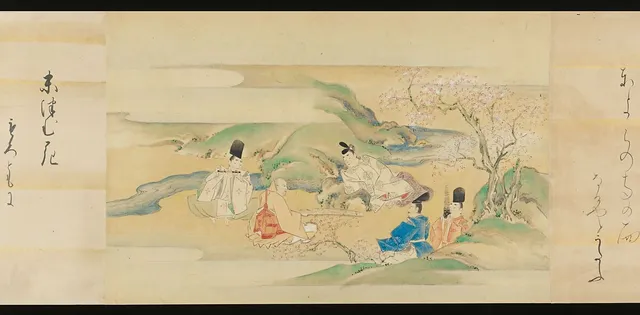
Now go to the painting itself. Yūsetsu's Tale of Genji is built on the conventions that the Meiji revivalists would later treat as the native birthright, and they are easy to read once you know where to look. The first thing is the roof that is not there. The interiors are shown by fukinuki yatai, the blown-off-roof device: the painter lifts the ceiling away and tilts the floor up toward us so we look down into the rooms at a steep diagonal. Verandas and screens run as parallel slants across the sheet, never converging. There is no vanishing point because the picture refuses one. Depth is signaled by overlap and by placement up the surface, not by the geometry an oil painter would reach for.
The second thing is the gold. Bands of cloud, the so-called suyari-gasumi, slide horizontally across the composition and crop the scenes for us. They are not weather. They are editing. A gold bank cuts off a garden so that the eye jumps to the figures inside a chamber, then another bank closes that chamber and opens the next. The cloud does the work that a film cut does. It also flattens. Where an oil painter would model air and recession, Yūsetsu lays down an opaque mineral plane that sits flush on the silk and asserts the surface as a surface.
Then the faces. The courtiers wear the hikime kagibana mask of classical yamato-e: a single ink stroke for each eye, a small hooked line for the nose, almost no individuation. This is not a failure of skill. It is a deliberate refusal of portraiture, so that emotion lives in posture, in the fall of a robe, in the angle of a head against a screen, rather than in a recognizable face. Look at how much feeling Yūsetsu gets from a sleeve. A figure half-hidden behind a standing curtain, the textile rendered in flat decorative blocks of mineral color, carries more narrative charge than any expression could. The whole grammar is anti-illusionist, and it is gorgeous, and it is exactly what Okakura wanted to save.
Revisit the scroll with the Meiji argument in mind and it stops being a quiet literary illustration. It becomes evidence. Every choice in it, the tilted floor, the cropping cloud, the masked face, the pigment that refuses to dissolve into atmosphere, is a position against the thing oil painting does best. Yūsetsu was not arguing with Europe; he had no reason to. But two centuries later his picture could be conscripted into the argument without changing a brushstroke, because the values were already there on the silk.
What 411 works tell us about a moving label
This is where our own holdings become useful, because they make the retroactive habit measurable. Artifact World Gallery keeps 411 works filed under Nihonga, made by 135 different hands and held across ten institutions, and the dates on them run from roughly 1500 to 1950. Set that 1500 against an external fact and the strangeness sharpens. The Getty's authority file lists Yokoyama Taikan, the painter most often called the face of the movement, as living from 1868 to 1958 (Getty ULAN). So the word Nihonga has a hard birth date in the late nineteenth century, yet the works we shelve under it begin three and a half centuries earlier. The 1500 end of the range is not an error. It is the fence reaching backward, the same recruitment of ancestors that Okakura performed in print, now visible as a spread of dates in a database.
A label that stretches from a Muromachi-era brush to a postwar Tokyo studio is not describing a technique that stayed fixed for four hundred years. It is describing a story that a later generation told about itself. The corpus, in that sense, is honest about its own construction: it admits that "Nihonga" is the name of a claim as much as a craft.
The ancestors the program enrolled
Spend time with the works the label pulled in and you see how varied the supposed lineage really was. Ogata Kōrin, the great Rinpa decorator, gives the most luxurious case. His Irises at Yatsuhashi takes a single episode from the Tales of Ise and removes almost everything: no travelers, no narrative, just irises in clumps of blue and green against a flat gold field, with the planks of the eight-part bridge cutting diagonals across them. It is decoration raised to the level of argument, and it shares with the Yūsetsu scroll the same refusal of European space. The gold is a wall, not a sky.
Pull on the lineage further and it frays in interesting ways. Soga Shōhaku painted his God of Good Fortune Jurōjin with a wild ink eccentricity that has nothing to do with Rinpa gold and everything to do with personal swagger. Kawanabe Kyōsai, whose Shakyamuni Subjugating Demons turns a Buddhist subject into a riot of grotesque energy, straddled the very break the movement was built around, since he lived into the Meiji years and watched the oil painters arrive. Tani Bunchō, a literati painter steeped in Chinese models, brings the continental strain that Okakura's pan-Asian rhetoric needed. And Ike Gyokuran, whose Peony and Bamboo carries the soft ink touch of the bunjinga circle, is a reminder that the tradition included women working at the highest level long before the Meiji academies opened.
These painters did not form a school. A Rinpa gold screen, an eccentric ink saint, and a literati spray of bamboo answer to different teachers, different patrons, different centuries. What unites them is not method but the later decision to read them as one bloodline. That decision is the movement. Smarthistory puts the irony plainly: Nihonga was defined in opposition to Western painting and yet, from the start, it absorbed Western ideas and techniques, taking shape at the very intersection it claimed to police (Smarthistory). Taikan's washes of atmospheric color, the famous mōrōtai or "hazy style," owe as much to a study of light as anything in the salons of Paris.
Works discussed in this article
The case rests in the pigment
If the lineage is a story, the materials are the one thing that is genuinely consistent across all four centuries, and they are where the argument finally becomes physical. Nihonga is defined technically by its substances: mineral pigments, sometimes ink, with other organic colors, bound and brushed onto silk or paper rather than oil onto canvas (Wikipedia). That is not a footnote. It governs how every one of these paintings looks.
Ground mineral color, iwa-enogu, behaves nothing like oil paint. It is opaque, slightly granular, and it sits on the surface as a discrete layer of color rather than blending wet into wet. You cannot smear a transition the way an oil painter can; you build with bounded fields. That single fact explains the flat gold of Kōrin's irises, the hard-edged cloud bands in the Genji scroll, the way a robe in Yūsetsu reads as a block of pattern rather than a modeled volume. The medium wants edges. It rewards design over illusion. When the Meiji theorists insisted that Japanese painting had its own integrity, the deepest version of that claim was not about subject matter or national feeling. It was about what happens when pigment refuses to behave like a window and behaves like a surface instead.
The debt runs to specific earlier masters as well. The National Gallery of Art notes that Nihonga remains a living Japanese style, still practiced today, and one deeply indebted to the vision of earlier painters such as the eighteenth-century naturalist Maruyama Ōkyo (National Gallery of Art). Ōkyo's careful observation of birds and flowers fed directly into the bird-and-flower subjects the Nihonga generation favored. The Metropolitan Museum's holding of Imazu Tatsuyuki's Peacocks and Cherry Blossoms, catalogued as a Taishō-period painting, shows that strain carried into the twentieth century with the pigment grammar intact (The Metropolitan Museum of Art).
Why the late label still earns its keep
It would be easy to treat all this as a debunking, as if calling Nihonga a constructed category empties it of meaning. The opposite is true. Almost every art-historical term is a later construction; the question is whether the construction tracks something real. Nihonga does, because the material fact underneath it is real. The painters Okakura enrolled were genuinely working in a shared physical practice, even when their styles and centuries had nothing else in common. The fence he built ran along an actual seam in the history of how paint meets a surface.
This is why the Yūsetsu scroll repays a second and a third visit. On the first look it is a charming classical illustration. On the second, with the Meiji argument in hand, it is a brief for everything mineral pigment can do that oil cannot. On the third it is something quieter and more durable, a demonstration that a tradition can be coherent without ever being conscious of itself as a movement. Yūsetsu had no word for what he was doing. He did not need one. The word came later, for people who suddenly did.
Look again at the gold cloud cropping a scene in that scroll, and then at the gold ground holding Kōrin's irises flat, and then at the hazy washes Taikan would paint a generation after the word was invented. The same instinct runs through all three: make the surface speak, refuse the illusion of a hole in the wall. That continuity, not any single style, is what Nihonga names. The fence was built late, but it was built along a line that had been there all along, waiting in the gold and the granular blue for someone to walk its length and call it a country.
Sources & further reading
- Nihonga — Wikipedia
- Nihon Bijutsuin (Japan Art Institute) — Wikipedia
- Yokoyama Taikan, Union List of Artist Names — Getty Research Institute (ULAN)
- Japan, Meiji to Reiwa — Smarthistory
- Colorful Realm: Japanese Bird-and-Flower Paintings by Itō Jakuchū — National Gallery of Art
- Imazu Tatsuyuki, Peacocks and Cherry Blossoms — The Metropolitan Museum of Art
- The Ideals of the East, with Special Reference to the Art of Japan (1920) — Internet Archive
- Epochs of Chinese & Japanese Art (1913) — Internet Archive