The Museo del Prado in Madrid is usually described as a treasure house, as if its main job were storage. That description misses what the building actually does to you. The Prado is an argument room. Walk the long central gallery and you are not visiting a warehouse of finished things; you are eavesdropping on painters quarreling with the painters who came before them, one generation answering the last, each convinced its predecessor had gotten something important wrong.
Here is the claim this essay defends. The Prado's greatness is not the sum of its masterpieces. It is the fact that the collection keeps rival generations hanging within sight of one another, so that a style stops being an abstraction and becomes a rebuttal you can point at. Because the Spanish crown bought deeply and, just as important, kept what it bought, Titian, Velázquez, and Goya ended up in the same handful of rooms. The museum lets you watch each of them take aim at the man before him. A movement, inside this collection, is never a label floating free above the pictures. It is one painter's reply to another, written in paint, and very often hung on a facing wall.
A building meant to hold bones
The argument was almost an accident of architecture. The neoclassical block on the Paseo del Prado was designed in 1785 by Juan de Villanueva, on the orders of Charles III, to house a Natural History Cabinet. It was conceived for fossils and minerals, not Flemish altarpieces. Only later, after the Napoleonic wars left the building damaged and the royal pictures scattered, was it repurposed, and it opened to the public for the first time in November 1819 under Ferdinand VII as the Royal Museum of Paintings and Sculptures (Museo del Prado). That origin matters to the argument I am making. The Prado did not assemble itself the way a modern museum does, by committee and acquisition policy. It inherited the private appetites of Habsburg and Bourbon kings who collected by passion and rivalry, and who hung what they loved next to what they had loved before.
So the building is a converted cabinet of natural history, and its contents are a converted royal hoard. Neither was planned as a survey of art. Yet the result reads like the most carefully argued survey in Europe, because the kings happened to favor exactly the painters who were obsessed with each other. The Spanish court wanted Venetian color, then it wanted painters who could do something Venetian color could not, then it wanted a painter who could expose the whole machinery of court portraiture. Each desire bought the rebuttal of the one before it.
Titian's color, and the men who could not let it go
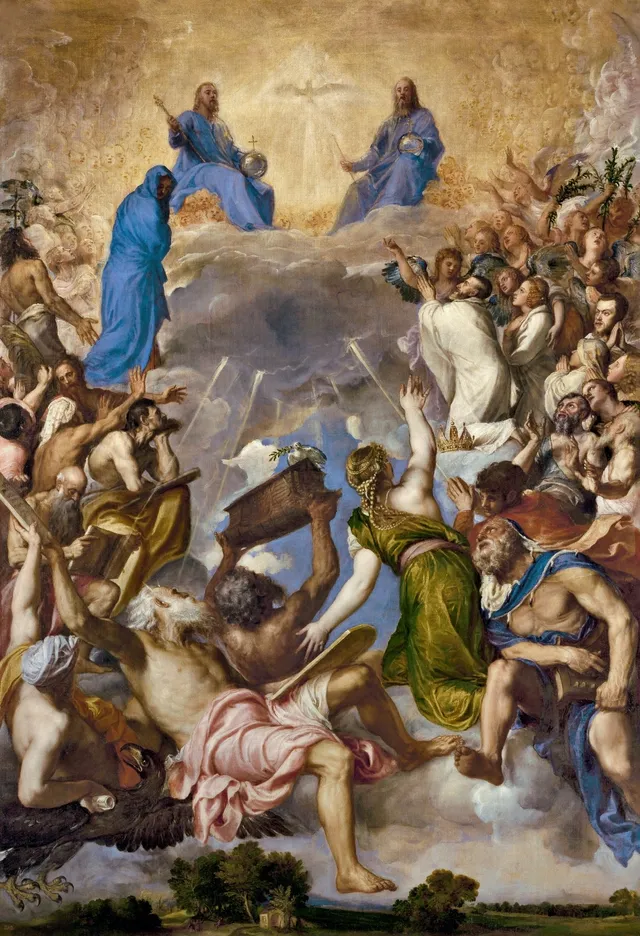
Start with the predecessor everyone in this building is arguing with. Titian painted for Charles V, and his work entered the Spanish collection at the source rather than through later dealers. La Gloria shows the emperor and his family among the blessed, lifted toward the Trinity in a churn of cloud and shifting drapery. The picture is built from color rather than from line. Edges dissolve, flesh is laid in with loaded, visible strokes, and the whole composition spirals upward instead of resolving into the steady geometry an Italian central-school painter would have imposed. Charles V kept this canvas close to him until his death. He understood that Titian had found a way to make paint behave like light and weather rather than like drawing.
This is the position later Spanish painting had to answer. Venetian handling, the late Titian especially, proposed that a picture could be loose, atmospheric, and frankly made of pigment, and still carry more conviction than a tightly finished surface. Rubens took up the proposition and carried it north; the Prado holds nearly a hundred works under his name, more than enough to show how he absorbed Titian and pushed the color into muscular motion. The argument was alive and well before any Spaniard touched it. What the Prado preserves, uniquely, is the next move.
Velázquez answers the Venetians
Diego Velázquez was court painter to Philip IV, and the great majority of his surviving masterworks now hang in the Prado (Heilbrunn Timeline). He had access to the royal Titians daily, and his reply to them is the most sophisticated in the collection. He accepted the Venetian premise that paint should look like paint, and then asked a harder question. What if the loose stroke were used not for celestial glory but for the cold, exact truth of a room and the people standing in it?
Look hard at Las Meninas, painted in 1656 (Smarthistory). The Infanta Margarita stands near the center, caught in the brightest pool of light, while a maid of honor bends toward her and a second curtsies. To the left, Velázquez has painted himself at a tall canvas whose front we never see; the picture he is making is turned away from us, its back a plain brown wall of stretcher and frame. At the rear of the room a small mirror glows, and inside it, dim and out of focus, are the king and queen. The royal couple are not in the room as figures. They are present only as a reflection, which means the space we occupy as viewers is the space they occupy as sitters. The far door stands open, a courtier paused on the lit stairs, and a heavy dog lies in the foreground ignoring everyone.
Now move close to the surface and the argument with Titian comes into focus. The Infanta's costume, seen from a few inches away, is not embroidery at all. It is a flurry of grey and rose dashes that refuse to resolve into thread. Step back and the silk reassembles itself perfectly. Velázquez has taken the Venetian loaded stroke and aimed it at optical fact rather than at heaven. He is saying, in effect, that Titian was right about how paint should be applied and wrong about what it was for. Color and broken handling do not belong to glory. They belong to the way a real eye actually receives a real room, where some things are sharp and most things are not.
Baroque is conventionally defined as the dominant seventeenth-century style, marked by dynamism and a realistic approach to depiction (Tate). Las Meninas takes that realism further than the definition expects. It is realistic about the act of looking itself, and it puts the painter, the princess, the dwarf, and the absent king into a single uncertain field. That refusal to flatter, to settle, to tell you where to stand, is Velázquez's quarrel with everything decorative the previous century had handed him.
Goya in the same room
A century and a half later, Francisco Goya stood in front of Las Meninas and answered it directly. He studied Velázquez early, etched copies of the royal portraits, and absorbed the older man's economy of touch. When he painted Charles IV of Spain and His Family, he quoted the structure of Las Meninas on purpose. The royal family is lined up across a dim gallery, and there at the left edge, half in shadow behind a large canvas, stands Goya himself, exactly where Velázquez had placed his own self-portrait. The homage is unmistakable, which is what makes the rebuttal so sharp.
Velázquez had used the loose stroke to find truth without cruelty. Goya keeps the stroke and removes the mercy. The faces of the Bourbon family are rendered with a glittering, jeweled exactness in the sashes and medals, and a startling bluntness in the flesh. The queen's expression is plain to the point of discomfort, the king's softness is not disguised, and the assembled relatives glint with decoration while their features sag. Goya does not caricature. He simply declines to improve them, and the contrast between the brilliance of the costumes and the ordinariness of the people is the whole point. Where Velázquez had asked what painting could honestly see, Goya asks what painting is allowed to say about the powerful who commission it. The same wall of the same museum holds the question and its darker reformulation.
Bosch, and the argument before the argument
Not every quarrel in the Prado runs along the Italian-Spanish color line. Philip II loved the work of Hieronymus Bosch, and the king's appetite gave Spain one of the deepest Bosch holdings anywhere. Cutting the Stone sets a small scene inside a circular field on a dark ground, framed by an inscription in elaborate Gothic script. A quack surgeon, wearing an inverted funnel as a hat, leans over a seated victim and extracts from his skull not a stone but a flower. A monk and a nun look on, the nun balancing a book on her head. The painting mocks credulity and false healing, and it does so through emblem and proverb rather than through observed light.
Held next to Velázquez, Bosch makes the later argument legible. The northern tradition Bosch belongs to treats a picture as a coded sermon, a surface dense with signs to be read. The seventeenth-century Spaniards would reject that mode without ever quite escaping its moral seriousness. Look at the way the Prado lets you pivot from Bosch's flower-as-folly to Velázquez's dwarf in Las Meninas, both of them present, neither of them decorative. The museum preserves the older idea of painting-as-message and the newer idea of painting-as-perception in the same suite of galleries, and you can feel the second growing impatient with the first.
The German wing of this northern conversation is thinner in the collection but pointed. The Prado's small holding under Hans Baldung Grien carries the same emblematic charge as the Bosch, the body used as a vehicle for warning rather than as a study in light. These pictures are the predecessor that Spanish naturalism spent a century answering.
A painting of a collection
There is one work in the Prado that pictures the very mechanism this essay is about. Archduke Leopold Wilhelm in his Gallery by David Teniers the Younger shows the archduke standing in a room whose walls are tiled, floor to ceiling, with paintings. Teniers served as Leopold Wilhelm's keeper of pictures and painted several of these gallery views, miniature catalogues in oil that record which canvases hung where. Venetian nudes sit beside Flemish portraits beside Italian saints, frame edge to frame edge, a whole century of rival schools forced into one field of vision.
That is what a princely collection did, and it is the precondition for everything I have described. Teniers shows us, inside a single frame, the act of hanging Titian next to a Northern master next to a Roman one, which is exactly the act that turned the Spanish royal hoard into an argument rather than a list. The picture is a portrait of taste as a way of putting paintings into conversation. The Prado, two centuries on, is the same gesture at architectural scale.
Esquivel's studio, and the Golden Age looking back
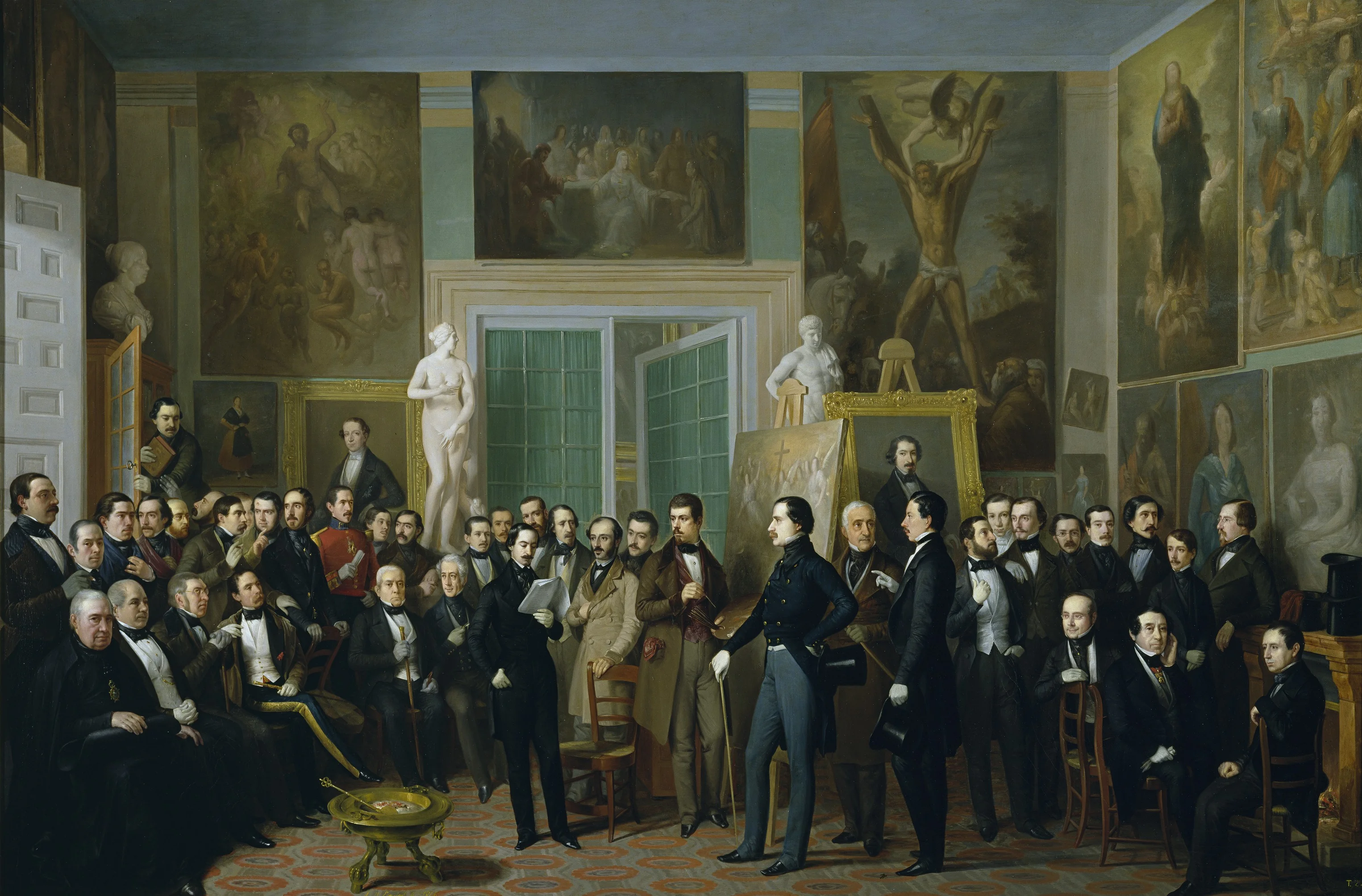
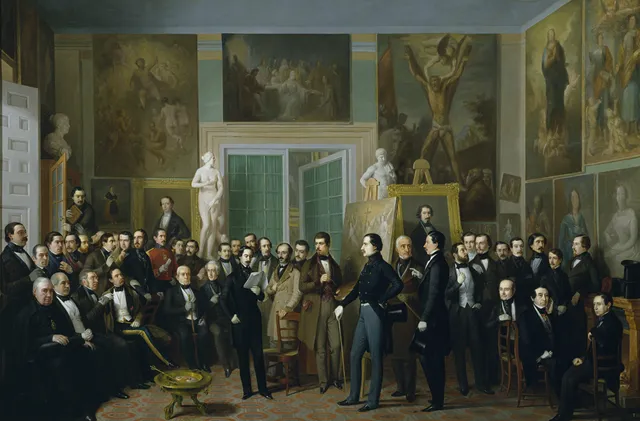
The argument did not stop in the seventeenth century, and the Prado holds the proof. By the time Antonio María Esquivel painted his great group portrait in the 1840s, the museum itself was a working presence in Madrid's artistic life, and the Spanish Romantics were busy reclaiming the Golden Age as a national inheritance. The Contemporary Poets. A Reading of Zorrilla in the Artist's Studio gathers the writers of literary Madrid into a single high-ceilinged room to hear José Zorrilla read.
Spend a moment inside the picture. More than twenty men, dressed in the dark frock coats of the 1840s, are arranged across the studio in attentive clusters, some seated, some leaning on chair backs, all turned toward the reading poet who stands and gestures with a sheet of paper. Light falls from a tall window at the left and rakes across the floorboards. On the rear wall hang framed portraits and a large canvas on an easel, marking the room as a painter's, and the composition fans the listeners outward from Zorrilla in a careful, legible arc. Every face is individuated, a roll call of a generation, and the brushwork is smooth and descriptive rather than loose.
The structure should feel familiar by now. Esquivel has built a group of distinct individuals inside a studio, with the artist's own world of canvases on the back wall and a single figure given the room's attention. He is reaching back across two centuries to the compositional logic of Las Meninas, the studio as the stage where a culture portrays itself. But his answer to Velázquez is gentler and more public. Where Velázquez had withheld and complicated, refusing to tell you who the picture was really about, Esquivel arranges everything for clarity and civic pride. His quarrel with the Golden Age is the quarrel of an heir, not a rival. He wants the prestige of Velázquez's stagecraft turned toward a new subject, the living republic of Spanish letters, painted as a community rather than a court.
What the holdings show
The shape of this argument is visible in the numbers, not only in the masterpieces. Artifact World Gallery holds 3,319 works tied to the Prado, made by roughly 850 different hands, and they span close to eight centuries, from about 1125 to 1929. That range is the real point. A museum assembled as a survey would cluster around its strengths and thin out at the edges. The Prado, built from royal appetite instead of policy, reaches from medieval devotion through the Venetians and the Flemish, through the Spanish Golden Age, and on into the nineteenth century of Esquivel and Goya, because each king kept buying the answer to what the last king had bought. Eight hundred and fifty artists is a crowd, and a crowd is what an argument needs.
Outsiders felt the pull. Nineteenth-century French painters built a whole appetite around Spanish art they knew chiefly through these holdings, the subject of the Getty's exhibition on the French taste for Spanish painting (Manet/Velázquez). Manet's debt to Velázquez is the clearest case of the argument jumping the Pyrenees: a Parisian modernist reaching back to a Madrid court painter to learn how to make black sing and how to let a brushstroke stay visible. The Prado was the source text, and Édouard Manet read it carefully.
The reach runs in both directions today. For its bicentenary in 2019, the Prado lent the Rijksmuseum fourteen masterpieces, six of them by Velázquez, for the exhibition Rembrandt-Velázquez (Rijksmuseum). The pairing was itself an argument staged between two collections, the Dutch realist set against the Spanish one, each lit by the other. Two hundred years after a converted natural-history cabinet opened its doors, the museum was still doing the only thing it has ever done well, which is to put painters in a room together and let them disagree.
Works discussed in this article
How to read the rooms
If you visit, stop treating the Prado as a sequence of trophies and start treating it as a transcript. Find a Titian first and look at how the paint is laid on, openly, as weather. Then find Las Meninas and look at the Infanta's sleeve from a foot away, where the silk turns back into grey and rose marks, and ask what Velázquez took from the Venetians and what he refused. Then walk to Goya's Charles IV, find the painter in the shadow at the left, and notice that he is standing where Velázquez stood, doing something colder. The route is the thesis. Each picture is a position, and the wall opposite holds the position it was written against.
The deepest lesson of the place is that originality in painting almost never arrives from nowhere. It arrives as a correction. Velázquez needed Titian to push against, Goya needed Velázquez, Esquivel needed the whole Golden Age, and Manet needed the lot of them, read in these rooms. The Prado is the rare museum that owns enough of the predecessors to make every correction visible. Go and stand at the hinge between two of them, the older confident picture and the younger impatient one, and you will hear the argument start.
Sources & further reading
- Diego Velázquez, Las Meninas — Smarthistory
- Velázquez (1599-1660) — The Metropolitan Museum of Art, Heilbrunn Timeline of Art History
- Museo del Prado — Wikipedia
- Baroque — Tate
- Manet/Velázquez: The French Taste for Spanish Painting — The J. Paul Getty Museum
- Rembrandt-Velázquez. Dutch & Spanish Masters — Rijksmuseum
- A Catalogue of the Paintings in the Museo del Prado at Madrid (W. Heinemann, 1896) — Internet Archive