The Museum of Fine Arts Boston was chartered in 1870 by people who did not yet own much worth showing. There was no Rembrandt on a wall, no mummy in a case, barely a building. What the founders had instead was a conviction, almost a dare: that a working industrial city could be improved by the sight of good objects, and that the objects would do the teaching if you simply put them within reach. Everything the museum has done since, across a century and a half and three buildings, is an attempt to answer the question buried inside that dare. The question is not about beauty. It is about purpose. What is a museum actually for, and whom does it serve when it serves anyone at all?
My argument is that the MFA never settled on one answer, and that this is its peculiar strength rather than a failure of nerve. The same institution that treats a Mary Cassatt tea party as an exercise in domestic intimacy treats a Nubian burial as a problem in archaeological ethics, and treats a room of Japanese scrolls as a near-sacred trust. Walk the galleries in sequence and you are not touring one museum. You are auditing several arguments about what a museum is for, each made in the language of a different collection, none willing to concede to the others. The encyclopedic museum is usually described as a place that holds everything. The MFA is more interesting than that. It is a place that asks one question and refuses to stop giving incompatible answers.
The first answer: a city that wanted to be taught
The museum opened to the public in 1876 in a Gothic Revival pile on Copley Square, designed by John Hubbard Sturgis and Charles Brigham, all red brick and terracotta and pointed arches according to the museum's own record of its origins. The choice of style was itself an answer. A Gothic shell announced that this would be a moral institution, a cathedral of self-improvement for clerks and schoolteachers and the daughters of merchants, not a private cabinet for the few. The early displays leaned heavily on plaster casts of antique sculpture, because the museum could not yet afford originals and because casts served the teaching mission perfectly well. You did not need the real Parthenon frieze to learn the shape of a horse's neck under Phidias. You needed a good copy and a quiet room.
That founding posture, the museum as instructor rather than treasury, never fully left. It is why the MFA's history was written down so early and so deliberately. Benjamin Ives Gilman, the institution's secretary, compiled a full account of its first fifty years and the museum published it in 1921, a primary source that still lets you read the founders explaining themselves in their own measured prose in the museum's own 1921 fiftieth-anniversary volume. Gilman, not incidentally, spent years thinking about how visitors' feet hurt and how their eyes tired, and he is often credited with the early theory of museum fatigue. The man who wrote the institution's history also worried about whether you could physically stand to look. That is the founding answer in miniature: the museum is for the visitor's education, and the visitor is a body, not an idea.
The American answer: intimacy at close range
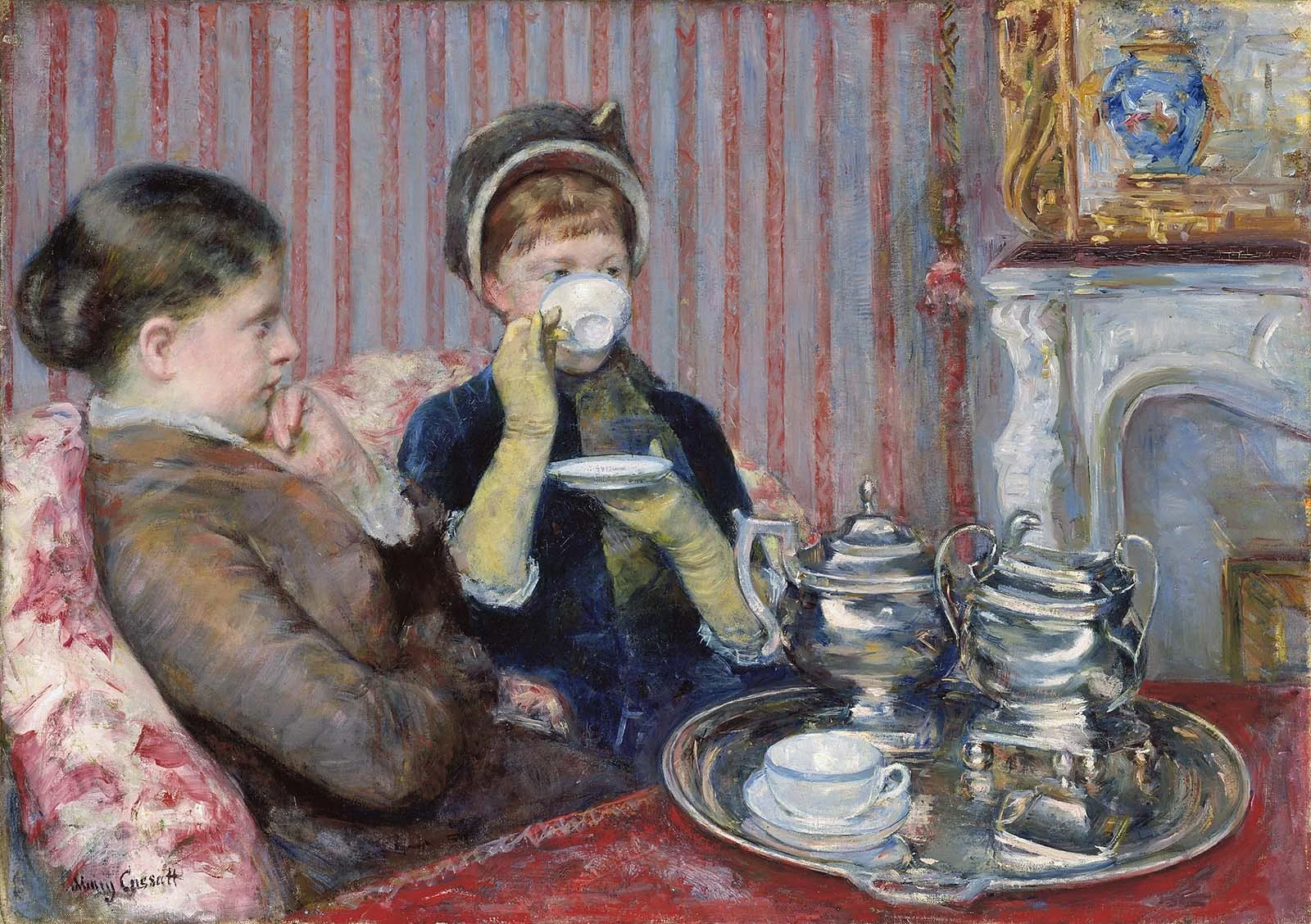
Stand in front of Five O'Clock Tea and the MFA gives you a completely different answer to its own question. Here the museum is not improving anyone. It is letting you eavesdrop. Mary Cassatt painted two women on a striped settee in a Boston-bred drawing room, and the first thing the picture does is shove a tea service at you. The tall silver pot and its companion vessels sit in the immediate foreground, oversized, gleaming, almost rude in how much canvas they take. Cassatt has tilted the tray up toward us so the silver reads as a bright vertical stack rather than a recession into depth. The two women are pushed back and to the right, and one of them has lifted her cup so that it cuts across the lower half of her face. We never get her full expression. We get a gloved hand, a hat, the cup, and the social fact of being unseen.
That raised cup is the whole picture. Cassatt learned the flattening and the daring crop from the Japanese prints she studied, the same visual logic the MFA was busy collecting on the other side of the world, and she turns it on a ritual she knew in her bones. The patterned wallpaper presses forward. Notice too how little Cassatt spends on the women's faces and how much on the chased pattern of the pot, the highlights bending around its belly, the cool weight of it catching the room. The painting's center of gravity is metal, not flesh. The depth Cézanne would later wrestle out of similar rooms is simply refused here. What you are left with is an argument that the most ordinary hour of an upper-middle-class woman's day, the pouring and the small talk and the careful holding of a cup, is worth the same formal seriousness a history painter would spend on a coronation. The museum that bought into Cassatt was answering its founding question with a quiet radicalism: art is for the unrecorded life, and a teapot can carry it.
The European answer: a city collecting its inheritance
Boston's collectors wanted Europe, and they wanted it whole. The MFA's holdings of French painting include one of the most physically present pictures Renoir ever made, Dance at Bougival. Auguste Renoir gives you a couple turning in a riverside dance garden, the woman in a white dress and red bonnet leaning her weight into the man's lead, his face half-buried under a yellow straw hat. Look at her feet. One is planted, one is lifting, and the hem of her dress lags behind the turn, so the whole figure reads as caught a half-beat into the spin. The brush stays loose in the foliage and tightens only where it matters, on the bonnet and the bright band at her collar; Renoir wants the eye to rest on her and let the garden blur. The ground is littered with a dropped match and a cigarette and a small bouquet, the debris of an afternoon already in progress. Renoir is painting motion and flirtation and the particular Sunday freedom of working Paris, and the MFA hung it as a statement that this new French painting belonged in the same building as the antique casts.
The European rooms answer the museum's question with appetite rather than instruction. They say a museum is for assembling the lineage a young country felt it lacked. Giovanni Paolo Panini makes the appetite literal. His Picture Gallery with Views of Modern Rome is a painting of a room crammed with paintings, a fantasy gallery where every famous Roman view hangs frame to frame, collectors gesturing at canvases stacked to the ceiling. Every frame inside the frame is legible, a miniature exhibition Panini could assemble from memory. It is a museum's daydream of itself, made a century before the MFA existed. Hang it in Boston and the joke turns sincere. Beside it the museum holds work like Gerard van Honthorst's allegory of the exiled Winter Queen, a Dutch Caravaggist's lit-from-within drama of dynastic loss, and quieter American Grand Tour pictures like George Loring Brown's view of Monte Pellegrino above Palermo, a Bostonian painting Italy for Bostonians who would never see it. The throughline is hunger for elsewhere.
Works discussed in this article
You can feel the same hunger cool into atmosphere in Old English House by Moonlight, where John Atkinson Grimshaw paints a gabled house under a wet moon with the precision of a man who loved the cold. The wet ground holds the light. The bare branches are drawn one by one. It is a picture about looking at a single place very hard at a single hour, and it sits naturally in a collection that grew, in part, from American eyes trained to want the European night.
The global answer: depth, and its costs
Here the museum's answers stop being compatible. The MFA holds the largest collection of Japanese art under one roof outside Japan, on the order of a hundred thousand objects, assembled in the late nineteenth century by Bostonians like Ernest Fenollosa, William Sturgis Bigelow and Edward Morse who were in Japan at the precise moment its temples and families were selling as the museum's history of the collection records. Fenollosa and his circle catalogued and carried home temple paintings, Buddhist sculpture and woodblock prints by the crate, and the museum built galleries to match what arrived. The result is a depth of holding that no other Western museum can match, and a provenance that the museum has spent the following century learning to talk about honestly. Depth was the answer. The cost of depth is the harder subject.
The Nubian galleries make the cost explicit and turn it into a virtue. The MFA's ancient Sudanese holdings, the finest outside Khartoum, came largely from the joint Harvard University and Boston MFA Expedition that excavated in Sudan in the early twentieth century. Those objects now travel as scholarship. The J. Paul Getty Museum mounted an exhibition of Nubian gold and jewelry drawn entirely from Boston, presenting an ancient African civilization on its own terms rather than as a footnote to Egypt as the Getty documented when the works went to Los Angeles. The objects traveled west to make that argument in a Los Angeles gallery, far from both Khartoum and Boston. This is the museum answering its question in the twenty-first century: a great collection is for repaying its debts through knowledge, sending its objects out to argue for the people who made them. The encyclopedic ambition that once read as acquisitive now has to justify itself as stewardship. The MFA, more than most, has been forced to do that work in public.
The building as an answer
In 1909 the museum abandoned Copley Square for a new neoclassical home at 465 Huntington Avenue, designed by Guy Lowell as recorded in the institution's history. The shift from Gothic to classical was not decoration. A Gothic museum says improve yourself. A classical museum says you are the heir of antiquity, walk in as if you belong. The new building swapped the cathedral for the temple, and with it swapped one answer to the founding question for another. The visitor was no longer only a pupil. The visitor was now an inheritor.
John Singer Sargent spent his last years painting murals for that building's rotunda, and the studies survive in other collections, including a preparatory canvas for the rotunda program now held by the Metropolitan Museum of Art in the Met's record of Sargent's mural studies. Sargent, the most fashionable portraitist of his age, chose to end his career not with another society face but with allegories of the arts and sciences painted directly onto the museum's ceiling. It was the last great commission of a career otherwise spent flattering the living. He understood the building as a single argument and wanted to write its closing line in classical figures overhead. The decoration of the rotunda is the museum theorizing about itself in plaster and paint, telling visitors below that they stand inside the lineage the galleries display.
What the archive actually holds
Artifact World Gallery holds 2,429 Museum of Fine Arts Boston works by 960 artists, spanning roughly 1110 to 1949, and that range is the clearest evidence of the museum's refusal to pick one answer. Eight centuries of making, almost a thousand hands, gathered under a single institutional name. That figure is a slice, not the whole museum, but the spread of it tells the story: devotional panels and society portraits, riverside dances and moonlit landscapes, all filed under one roof. No coherent thesis covers a medieval object and a 1949 canvas at once. What covers them is the encyclopedic wager itself, the belief that putting that much human work in one place is worth doing even when the objects argue with each other. The MFA's partnership with Smarthistory, which distributes the museum's teaching videos to a global audience, is the founding instructional mission carried into the present through Smarthistory's dedicated Boston content hub. The casts in 1876 taught the people who could walk to Copley Square. The videos now teach anyone with a screen. The instrument changed. The question did not.
It is tempting to want the MFA to resolve all this, to declare whether it is finally a school, a treasury, a temple or a steward holding objects in trust for the cultures that made them. It will not, and it should not. The Cassatt room and the Nubian gallery and the Sargent rotunda are not stages in a single development. They are simultaneous answers, kept deliberately in tension, each true in its own wing. A lesser museum would have chosen. Boston's founders set a question loose in 1870 and built an institution patient enough to keep answering it in different voices for a hundred and fifty years. The next answer is already being prepared in a storeroom, waiting for the wall that will make it argue with everything else.
For a working catalogue of the painters who pass through these debates, the museum's nineteenth-century holdings reward the curious: the academic precision of Jean Léon Gérôme sits a few rooms from the loose Impressionist light of the French gallery, and both belong to the same institutional sentence. You can follow that sentence outward through the wider currents of Impressionism or back through the long arc of nineteenth-century landscape, and the MFA will have an example waiting, hung as if to disagree with the one beside it.
Sources & further reading
- Museum of Fine Arts, Boston — Wikipedia
- Getty Museum Presents Nubia: Jewels of Ancient Sudan from the Museum of Fine Arts, Boston — The J. Paul Getty Museum
- Science: A Preparation for the Mural in the Museum of Fine Arts, Boston (study by John Singer Sargent) — The Metropolitan Museum of Art
- Museum of Fine Arts, Boston, 1870-1920 — Museum of Fine Arts, Boston (1921), via Internet Archive
- At the Museum of Fine Arts, Boston — Smarthistory
- Provenance: Museum of Fine Arts, Boston — National Gallery of Art