Artwork
Five O'Clock Tea
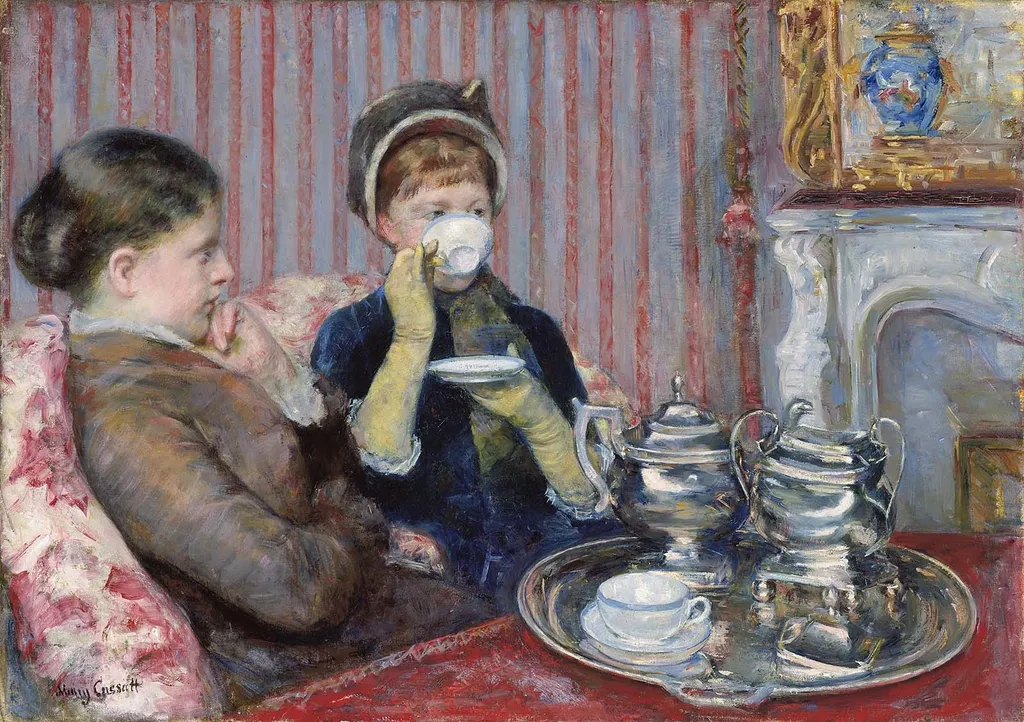
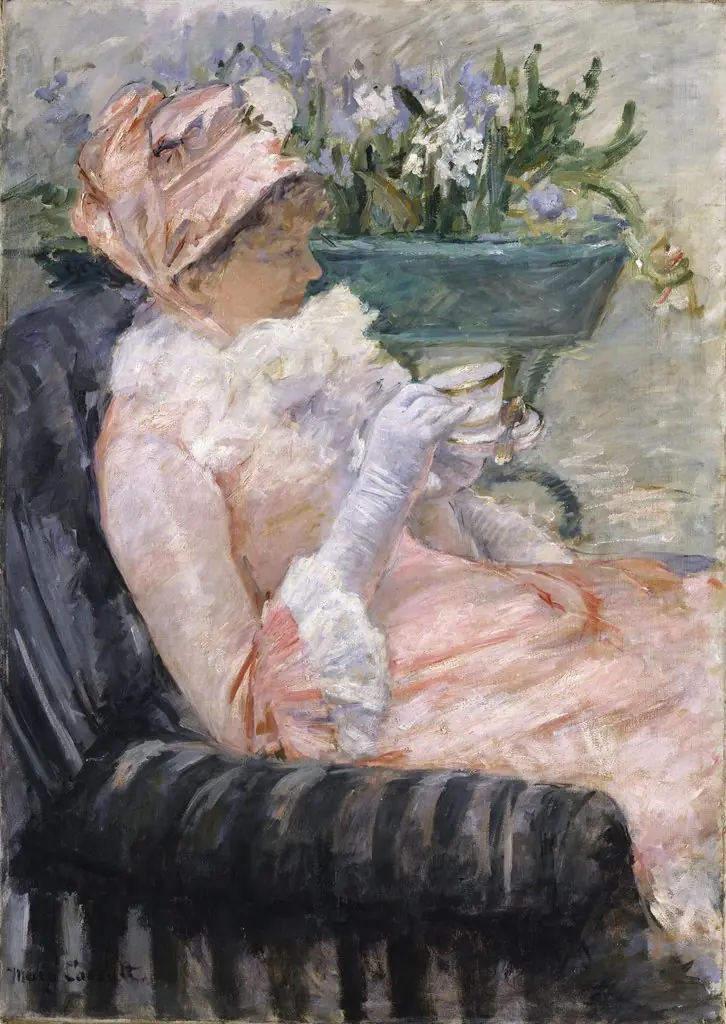
Five O'Clock Tea is an oil painting by the Impressionist artist Mary Cassatt. It dates from 1890 and is held in the collection of the Museum of Fine Arts Boston.
About this work
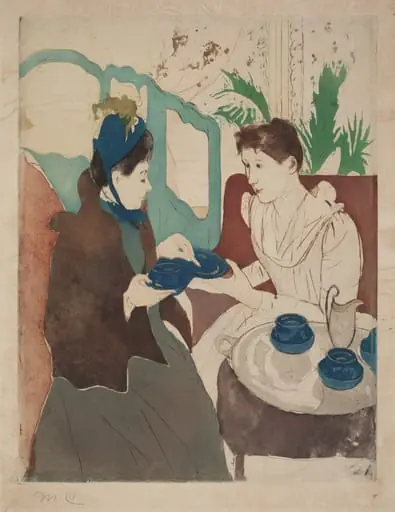
Lydia Cassatt sits at the left of a Parisian drawing room, her face turned away, while her companion lifts a teacup to her lips. The silver tea service, made for the family grandmother around 1813, gets more weight than the women themselves. Mary Cassatt painted the scene about 1880 with the flat geometry and asymmetry Edgar Degas had urged on her.
Subject & Meaning
The painting depicts two women having tea in an upper-middle-class Parisian drawing room, with the hostess identified as the artist's sister Lydia Cassatt.
The painting depicts two women having tea in an upper-middle-class Parisian drawing room, with the hostess identified as the artist's sister Lydia Cassatt. Art historians interpret the scene's meaning in divergent ways. Griselda Pollock argues that the compressed interior and lavish decor evoke the spatial and social constraints placed on women in the 19th century, while Norma Broude suggests the work may instead highlight women's agency and networks of sociability as empowering.
Sinéad Furlong-Clancy emphasizes the discomfort and awkwardness of the moment, captured by the obscured face of the guest, the overpowering silver tea set, and the heavily furnished setting, which together create a sense of disconnection. John Loughery likewise notes the composition's unsettling qualities, the prominent tea service, the hidden face, and the radical brushwork, but questions whether deeper symbolic meaning is intended.
Technique & Style
Executed in oil on canvas, Five O'Clock Tea (64.8 × 92.1 cm) exemplifies Cassatt's Impressionist technique. The composition is marked by a shallow pictorial space, with the silver tea service prominently occupying the lower right foreground in a still-life-like manner. The figures are set in the middle ground, the hostess in profile and the guest with her face partially obscured by a teacup.
Cassatt employs a varied brushwork and a color scheme dominated by mauve and red hues in the interior, contrasted with the subject's navy dress and yellow gloves. Light reflections on the tea set and the gilded mirror enliven the scene, while the compressed arrangement of furniture and decor creates a sense of intimate, semi-private sociability.
History & Provenance
Mary Cassatt painted Five O'Clock Tea (also known as The Tea) in 1880, depicting her sister Lydia Cassatt and another woman taking tea in a Parisian interior. The work was first exhibited at the fifth Impressionist exhibition. It was acquired directly from the artist by Henri Rouart, a French painter and collector.
Later, it entered the collection of Dikran Kelekian, an Armenian-American dealer. Kelekian sold the painting in 1942 to the Museum of Fine Arts, Boston, where it remains today. The painting was executed in oil on canvas in Paris. No commission is recorded; it was likely produced as an independent work.
Held at the Museum of Fine Arts, Boston (accession number not specified in available sources). The painting was exhibited at the fifth Impressionist exhibition in 1880. It entered the MFA collection in 1942, having previously been owned by Henri Rouart and Dikran Kelekian.
Context
Five O'Clock Tea debuted at the fifth Impressionist exhibition in 1881, marking Cassatt's first appearance with the group. The painting has become a touchstone for feminist art history: Griselda Pollock reads its compressed interior as encoding the social restrictions placed on women, while Norma Broude counters that it may depict empowerment through bourgeois sociability. John Loughery notes the composition intentionally creates discomfort, leaving interpretation open.
As a female Impressionist, Cassatt was largely confined to domestic spaces, and this work exemplifies her focus on rituals of upper-middle-class Parisian life. Today in the Museum of Fine Arts, Boston, it is prized for its challenge to traditional gender roles and its place in Impressionist canon.
Overview
Mary Cassatt's oil-on-canvas painting, Five O'Clock Tea, created around 1880, depicts two women engaged in a private social ritual within a Parisian drawing room. This work exemplifies Cassatt's characteristic focus on the domestic lives of women, rendered with an Impressionistic sensibility. It also prompts discussion among art historians regarding the social roles and potential agency of women in the late 19th century.
Artist & collection
Artist
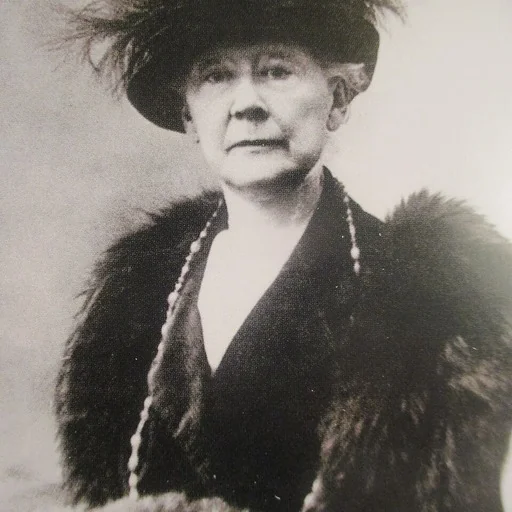
Mary Stevenson Cassatt (; May 22, 1844 – June 14, 1926) was an American painter and printmaker.