The lost dictionary
The pictures we file under Romanticism are usually sold to us as weather. Storm light over a gorge, a lonely crag, the heart visibly overflowing its banks. That is how the movement has been taught since the nineteenth century, and it is half right. But the people who first stood in front of these canvases did not only feel them. They read them. A lightning-split tree was a sign before it was a mood. A coral bead at a child's throat carried a meaning a mother could name without thinking. A cleared hillside made an argument about who owned the land and what providence intended it for. The emotion was real, and it was carried on a freight of legible symbols that the first audience decoded as fluently as we decode a traffic light. That literacy is what we have lost, and losing it has flattened the work into pretty turbulence.
My claim is blunt. Romantic painting was an iconographic language before it was an emotional one, and most of us no longer hold the key. The feeling everyone notices was the surface effect of a denser system of inherited signs, borrowed from religious emblem books, from the conventions of family portraiture, from the moral grammar of the cultivated estate. Recover the signs and the picture changes in front of you. The aim here is not to drain the storm of its drama but to show that the drama was an instrument of meaning, aimed at a viewer who came to the gallery expecting to interpret, not merely to swoon. This essay reads six works in the Artifact World Gallery archive the way their first owners would have, then asks why the label itself encourages us to forget how.
A word that arrived before the paintings
Romanticism is unusual among art movements in that it was named in a seminar room, not a studio. The term came out of German criticism, where August and Friedrich Schlegel began speaking of romantische Poesie, romantic poetry, in the 1790s, and the label spread internationally after Germaine de Staël carried it abroad in her book on Germany in 1813, as the history of the word records. The Metropolitan Museum dates its definition as an aesthetic to around 1800 in literary criticism, with the visual movement gathering force in France and Britain across the early decades of the century and flourishing until mid-century. The Tate fixes the height a little earlier, roughly 1780 to 1830, and frames the whole enterprise as a new emotionalism set against the prevailing ideals of classical restraint.
Here is the consequence that matters for iconography. Because the word was a critics' coinage looking for pictures, the painters who got swept under it did not invent a fresh visual vocabulary from nothing. They repurposed older ones. The emblematic tree, the ruin, the protective amulet, the georgic field of honest labor: these were established signs, and Romantic artists charged them with a new intensity rather than discarding them. The National Gallery of Art describes the movement as a turn that put emotion and intuition ahead of reason, a backlash against the rationality that had governed since the Renaissance. True enough as a temperature reading. What it omits is that the rebellion was conducted in inherited symbols, which is precisely why the first viewers found these supposedly wild pictures so readable.
Reading the Oxbow
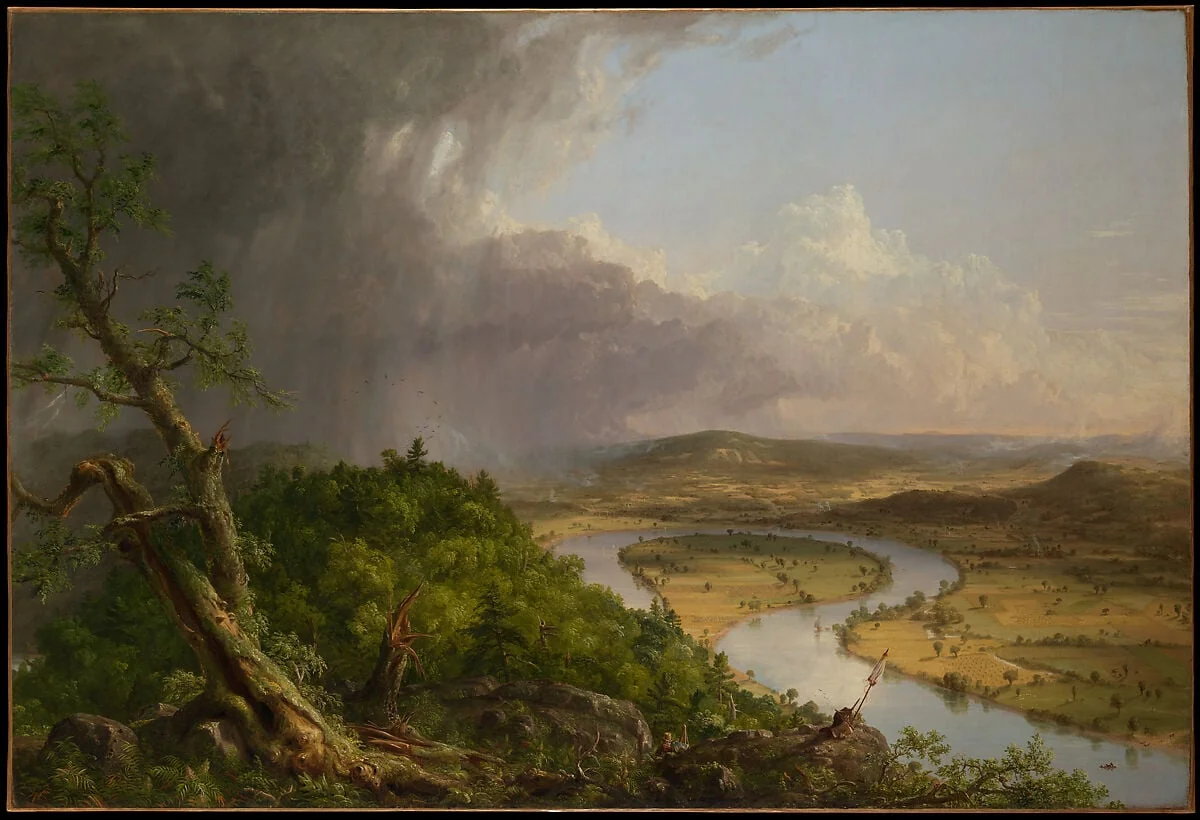
Look at Thomas Cole's View from Mount Holyoke after a Thunderstorm, the picture everyone calls the Oxbow. A single diagonal cuts the canvas in two. To the left and above, the mountain wilderness is still in the grip of the storm: a riot of dark, broken foliage, a blasted tree stump thrust toward us like a snapped bone, clouds dragging a slant of rain across the heights. To the right and below, the storm has already passed, and the Connecticut River loops back on itself in the bright, tamed valley, its silver oxbow ringed by stubbled fields, haystacks, and the thread of smoke from cleared ground. The two halves do not blend. Cole insists on the seam. He paints the wild and the cultivated as two propositions held in the same frame, and he asks which way the country should go. The composition forces the comparison. Your eye crosses the diagonal again and again, the way a reader's eye runs down a column of opposed arguments, and the picture refuses to settle the case for you.
Now the signs. Down in the foreground, almost lost against the green, sits a tiny figure: Cole himself, at his easel under a parasol, turning back over his shoulder to meet our eye. He has written himself into the landscape as its witness and its interpreter, a Romantic device that tells the viewer the scene is not neutral scenery but a thing being judged. Painters of the period used this inserted observer as a kind of signature on the meaning, a way of saying the land has been seen and weighed. On the far hillside, the clearings cut into the forest have been read for generations as Hebrew letters, a sign legible to a churchgoing American audience steeped in scripture, spelling the name of the Almighty across the land being opened to the axe. Whether or not every viewer caught the letters, the structure of the picture was unmistakable in 1836. The blasted tree is mortality and the violence of clearing. The luminous oxbow is the promise of a settled, providential republic. Cole, who distrusted the speed with which his adopted country was felling its forests, gives the wilderness the better paint and the cultivated valley the better light, and lets the contradiction stand. His original viewers did not need a wall label to feel the argument. Cole's other landscapes run the same case again and again, the wild and the improved weighed against each other like a moral ledger.
The grammar of objects
Move from the panorama to the parlor and the sign system tightens. Ralph Earl's Mrs. Noah Smith and Her Children looks at first like plain Federal-era record-keeping: a Vermont matron, her children arranged around her, the furniture stiff and bright. But every prop is doing work. The fashionable klismos chair and the columned interior announce a family that has arrived. The window or vista opening behind the group ties the sitters to the house and land Noah Smith owned, so that the portrait doubles as a deed. The grouping itself is a sign, the children ranged by age around the mother like a record of the family's increase. And the small red coral worn by a child belongs to one of the oldest threads in European picture-making, an amulet believed to guard infants against harm. In a period of brutal child mortality, that bead is not decoration. It is a prayer painted into the corner of the canvas, and a mother in 1798 read it instantly.
This is the part that modern eyes skate over. We see a charming naive group; the first viewers saw a coded statement of lineage, status, and the desperate hope that these particular children would live. Earl's portraiture keeps faith with the older emblematic habit even as the new Romantic warmth creeps into the handling of cloth and face. The lesson generalizes. In the Romantic decades the object in a portrait was rarely just an object. It was a sentence.
Landscape as a claim of ownership
Cross the Atlantic and the same logic governs the English scene. John Constable's Wivenhoe Park, Essex is one of the most loved landscapes of the period, and it is also, flatly, a property document. It was painted for the estate's owner, and it shows you exactly what he owned: the broad ornamental lake with its fishing net and small boat, the fat cattle standing in the shallows, the deer park stretching to a low horizon, the owner's daughter driving a little donkey cart along the near bank. The sky is enormous and alive, the Constable specialty, but the ground beneath it is improved, managed, and accounted for. Nothing in the picture is wild. Even the water is put to use, stocked and netted, and the cart on the bank turns the daughter into one more sign of the estate's good order.
To a viewer in 1816 this was the georgic ideal made visible, the cultivated estate as an image of moral order and rightful possession in an England then enclosing its common land at speed. The cattle are wealth, the net is plenty, the open park is a boast. Where Cole stages a debate between wilderness and clearing, Constable simply celebrates the clearing won, and his original audience read the lake and the well-fed beasts as a settled, virtuous prosperity. Constable's many studies of this same countryside return obsessively to worked land, locks, mills, and tended fields, because for him the loaded landscape was the point. The weather is the feeling; the field is the argument.
Works discussed in this article
When a barrel of cider was a political poster
Genre painting, the everyday scene, looks like the least symbolic corner of the period, and it is the most slippery. William Sidney Mount's Cider Making shows a Long Island farmyard at the press: horses turning the mill, men loading apples, a barrel filling, children and onlookers idling in warm autumn light. Read it as rural nostalgia and you miss what an American viewer in 1841 could not. The previous year's presidential campaign had run on the image of log cabins and hard cider, a whole election fought in the language of plain country virtue against moneyed sophistication. Cider, that season, was a partisan emblem. Mount, painting in the immediate wake of it, drops his viewer into a scene thick with that charge, and contemporaries argued over whether the picture endorsed the cause or gently mocked the electioneering it traded on.
That ambiguity is the sophistication. Mount built an American genre by loading homely subjects with civic meaning that his audience supplied from the newspaper, so that an apple press became a comment on democracy and class. The figures are posed with a stagey deliberateness, some looking out at us as if to ask which side we are on. His scenes of farm and tavern life keep doing this quiet political work under a surface of sunlit ease. Strip out the 1840 campaign and the picture goes mute. Restore it and the barrel starts talking.
The studio, the lineage, and the cool counter-argument
Two more works set the boundary of the period from inside. Matthew Pratt's The American School shows a group of young painters at work in Benjamin West's London studio, the master leaning in to correct a drawing. It is a picture about the transmission of artistic authority, and for a colonial American audience it carried an unmistakable boast: that the new world could produce and train serious artists, that the lineage of European art now ran through a Pennsylvanian's rooms. The easels and portfolios are the props of a claim to cultural legitimacy. Pratt is documenting the moment a national art declares itself ready, and his first viewers read the studio as a statement of arrival.
Against all this stands Jacques-Louis David's Madame David, the Neoclassical pole the Romantics defined themselves against. The portrait is sober, frontal, almost severe, the sitter rendered with an unsparing clarity that refuses theatrical feeling. Where Cole gives you a sky in revolt, David gives you control, the restraint that the Tate names as the very thing Romantic emotionalism rose to overthrow. Putting the two beside each other clarifies what changed. Neoclassicism trusted the legible body and the steady line; Romanticism kept the old emblems but let the weather and the brushwork carry the charge. Both painters trusted their viewers to read, but they trained that reading on different things, the one on the clear edges of a face, the other on the temper of a sky. The period critic Charles Baudelaire saw this clearly in his Salon of 1846, arguing that Romanticism lay not in any subject matter but in a manner of feeling, and going so far as to equate the word with modern art itself.
Why the label keeps fooling us
The reason the iconography slips away has partly to do with how the term is applied by cataloguers, and our own archive makes the problem visible. Artifact World Gallery holds 25,594 works tagged Romanticism, spread across 81 venues and made by 4,198 artists, with attributed dates running from roughly 1101 to 1915. Set that eight-century span against the Tate's tidy bracket of about 1780 to 1830 and the gap is the whole story. A canvas from 1101 and a canvas from 1915 cannot belong to the same movement in any meaningful sense, yet the tag yokes them together. A movement the textbooks confine to two generations gets stretched, by institutions cataloguing their holdings, across most of recorded European painting. That tells you Romanticism functions less as a period than as a temperature reading, a label pinned wherever curators sense heightened feeling. And a temperature reading is exactly the frame that makes us stop looking for signs.
Once you treat the work as mood, you no longer ask what the coral or the cleared hillside or the barrel of cider meant, because mood does not have a grammar. The corpus number is a warning. When 25,594 pictures sit under one emotional banner, the specific iconographic claim of any single one is the first casualty. The repair is to go back to the individual canvas and ask the older question the first owner asked without prompting: what is this object saying, and to whom.
So the next time a Romantic landscape stops you with its storm, slow down before you call it beautiful and let it be beautiful. Find the split tree, the witness in the corner, the cleared field, the bead at the child's throat. Those marks were left for a reader, and the reader was meant to be you. Relearning them is not hard. It is mostly a matter of granting that the first audience was clever, and that the painter expected to be parsed. The feeling was always the doorway. The meaning is the room behind it, and the room is still there, waiting to be entered by anyone willing to relearn the signs.
Sources & further reading
- Romanticism — The Met, Heilbrunn Timeline of Art History (Kathryn Calley Galitz)
- Romanticism (art term) — Tate
- Romanticism — Wikipedia
- The Mirror of Art (Salon of 1846) — Internet Archive (Charles Baudelaire)
- Théodore Géricault, Raft of the Medusa — Smarthistory
- Romanticism — National Gallery of Art
- romanticism (form-of-expression term, AAT 300056557) — Getty Art & Architecture Thesaurus