The Subject Nobody Names: Time
Walk past a Dutch still life painting and you might read it as an inventory: a lemon, a glass, a knife, a pie left open on the cloth. That reading misses the actual subject. The still life is the one genre that takes time itself as its argument. A history painting freezes a heroic instant and asks you to admire it. A portrait fixes a face against forgetting. The still life does something stranger and more honest. It assembles a handful of things that are visibly in the process of changing, and it holds them at the exact moment before the change completes. The flower is open but the petal has begun to curl. The glass is half empty. The fruit is ripe to the point just shy of rot. This is a meditation on duration, built out of objects that cannot speak and do not move.
My claim is simple and I will defend it work by work: the great still life painters did not record perishable things because they ran out of grander subjects. They chose perishable things because perishability was the point. The genre that academic theory ranked lowest turns out to carry the heaviest theme any picture can carry, which is that everything on the table, and everyone looking at it, is on the way out. The English word betrays the trick. We say still life, from the Dutch stilleven, as though the life in the picture had merely paused (the term itself comes from the Low Countries). It has not paused. It is running down in front of you, very slowly, forever.
It helps to know how far the establishment looked down on this. In the hierarchy of genres codified by the French Academy in the seventeenth century, still life sat dead last, fifth, beneath history painting, portraiture, scenes of everyday life, and landscape. The reasoning was that a painter of fruit invented nothing and elevated nothing; he merely copied dead matter. The verdict was wrong, and the painters knew it was wrong, and a good number of them spent their careers proving it on small panels that now stop traffic in museums.
Looking Hard at One Table
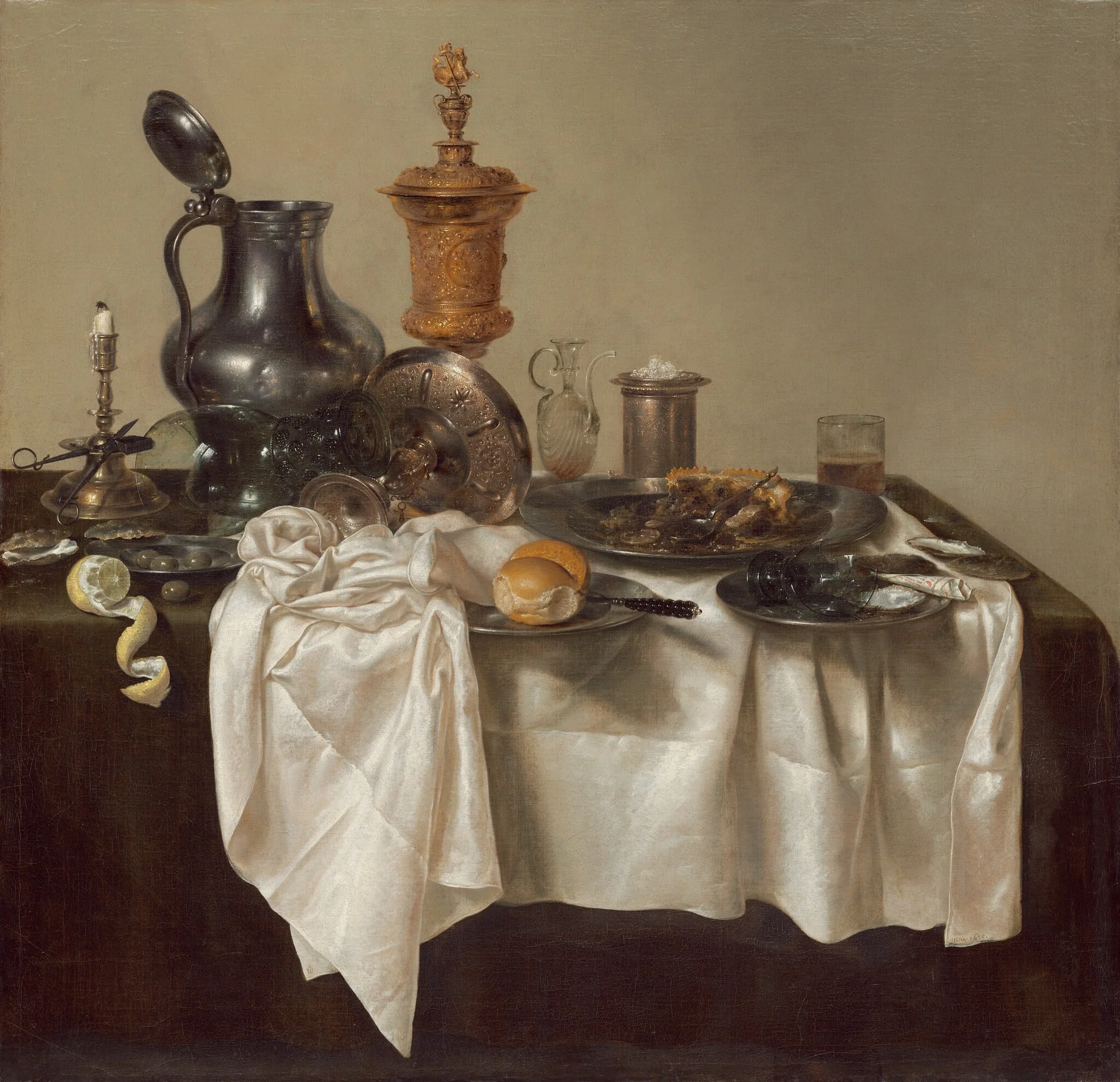
Take a single work and stay with it. Willem Claesz Heda's Banquet Piece with Mince Pie is a master class in how to paint time without a clock in the frame. Heda worked in Haarlem in the so-called monochrome manner, and the first thing you register is the restraint of the palette. Everything is silver, pewter, oyster-grey, the brown of a wine glass, the pale yellow of a cut lemon. No festive color shouts. The mood is the cool light of a room after the guests have gone.
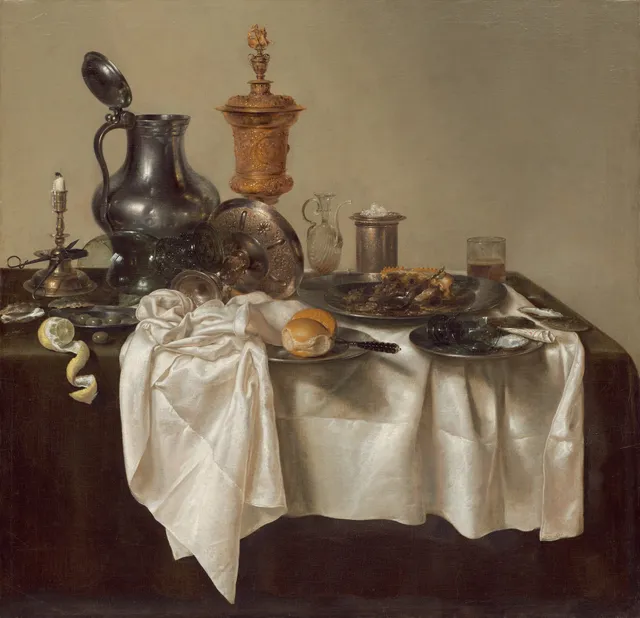
Now look at the arrangement, because the disorder is deliberate. A pewter plate juts out past the edge of the table and hangs in the air, weighted by a knife whose handle points straight at you. A tall silver tazza lies on its side, toppled, catching a long smear of window light along its bowl. The roemer of white wine stands half full. The mince pie has been cut, its crust broken open and pulled back so the dark filling shows. A lemon has been peeled in one continuous ribbon, and the rind spirals down over the lip of the table, bright against the gloom. A crumpled white napkin has been left where it fell.
None of this is accidental, and none of it is decoration. Every object is the aftermath of a human gesture. Someone tipped that cup. Someone peeled that lemon and dropped the rind. Someone ate part of that pie and set down the knife at an angle. The table is a record of action that has just stopped, the way a struck bell is still ringing in a room you have only now entered. Heda paints the pause after the meal, and a pause implies a before and an after. That is the whole grammar of time, compressed onto two feet of oak panel. The reflective surfaces do the rest of the work. In the curve of the overturned tazza and the belly of the glass, you can make out the cool gridded light of a window, which means the room keeps existing beyond the frame, and the light keeps falling, and the wine in the glass will keep evaporating after you walk away.
Compare the temperature of that picture with the warmer drama of his contemporary Pieter Claesz, another Haarlem painter who built the same vocabulary of half-eaten meals and tilted vessels. Claesz pushed harder toward the explicit reminder of death. The J. Paul Getty Museum holds a Vanitas Still Life by Claesz from the mid-1630s, in which a skull, a tipped glass, and a guttering lamp leave nothing to interpretation. Where Claesz states the theme outright, Heda lets the lemon rind carry it. Both are saying the same thing. Heda just trusts you to hear it. His Still Life with Peacock Pie, here under Claesz's hand, turns even a showpiece bird into a study of what a feast looks like once the appetite is spent.
Where the Genre Came From
The independent still life, a picture of objects with no saint and no story to justify it, is younger than people assume. It separated out as its own category in the Netherlands in the last quarter of the sixteenth century. Italy produced its own early landmark at almost the same moment. Caravaggio's Basket of Fruit, painted around 1599 and now in the Biblioteca Ambrosiana in Milan, is among the first Italian still lifes to stand entirely on its own, and it already understands the lesson. Caravaggio painted leaves that are drying at the edges and an apple bored by a worm. He did not idealize the fruit. He painted it at the precise hour when ripeness turns to ruin, which is the hour the whole genre is interested in.
Once the form took hold in the Low Countries it branched fast. There was the modest breakfast piece, the ontbijtje, which is Heda's territory. There was the flower piece. And there was the lavish pronkstilleven, the showpiece, where painters competed to render gold, glass, lobster, and porcelain at the limit of illusion. The Rijksmuseum's Banquet Still Life by the Fleming Adriaen van Utrecht, dated 1644, piles costly tableware against a cut-open pasty and an enormous lobster on a Chinese plate. Willem Kalf carried the luxury mode to its peak a generation later, and his silver ewers and Ming bowls glow against deep shadow with a confidence that turns abundance itself into the subject.
Even at its most opulent, though, the genre keeps one finger on the theme of loss. The richer the spread, the louder the quiet warning that none of it lasts. A wall of gold and glass is also a wall of things that will be dusted, sold, broken, or buried with their owner. The pronk painters knew this perfectly well. They served the warning on a silver dish so beautiful you almost forgave it.
Flowers That Could Never Have Bloomed Together
The flower piece pushes the time-argument to its sharpest point, and Jan van Huysum is the painter to watch do it. His Flowers in an Urn looks at first like a simple celebration of a bouquet. It is nothing of the kind. The flowers in a van Huysum bouquet bloom in different seasons. A tulip and a rose and a hyacinth at full open could never share a single morning in a real vase. The painting is a calendar pretending to be a flower arrangement, a whole year of the garden assembled into one impossible instant. To make it, he often worked across many months, adding each bloom when it came into season, so the finished panel is literally built out of stretched time.
And van Huysum will not let you forget mortality even here. Look closely at one of these bouquets and you find the chewed leaf, the drooping stem, the dewdrop about to fall, the insect already at work on a petal. He paints the bloom and the blight in the same breath. The flower piece, done at this level, is a small machine for thinking about how a thing can be most gorgeous at the very moment it begins to fail. The earlier German painter Peter Binoit worked the same seam with more austerity; his Still Life with Iris isolates the single tall flower against darkness and lets the curl of one leaf do the talking.
Works discussed in this article
The Family Trade and the Long Tail
One reason the Dutch still life reads so consistent is that it ran in families and workshops, a craft handed down like cabinetmaking. Heda's own son, Gerret Willemsz Heda, learned the manner so thoroughly that his work sits comfortably beside his father's. His Still Life with Ham carries the same cool light, the same half-cleared table, the same knife angled toward the viewer like an invitation and a warning at once. The elder Willem Claesz Heda left a deep body of these banquet pieces, and the continuity across two generations tells you this was a language, with rules a son could inherit, not a one-off flash of genius.
The scale of the thing only becomes clear when you count. Our own holdings make the abstraction concrete: Artifact World Gallery catalogues 3,946 still lifes by 1,275 different painters, gathered from 151 institutions, the earliest dated to around 1104 and the latest to 2015. That is a single quiet subject, a table of objects, sustained across roughly nine centuries and a thousand-plus hands. The Metropolitan Museum's Heilbrunn essays describe how thoroughly northern Europe took the form to heart between 1600 and 1800. The count from our corpus puts a number on that devotion. When more than a thousand artists spend their lives painting the same lemon and the same skull, the genre is not a minor exercise. It is a continuous argument, restated generation after generation, about what it feels like to own things you cannot keep.
When the Trick Crosses the Atlantic
The genre's obsession with time did not stay in the seventeenth century, and it did not stay in Europe. Two hundred years after Heda, in the United States, John Haberle was painting in a mode called trompe l'oeil, which means to fool the eye. His A Bachelor's Drawer is a flat panel painted to look exactly like the front of a wooden drawer, pinned and pasted with the leftovers of a man's life: banknotes, a comb, ticket stubs, newspaper clippings, an old photograph, a pipe. Everything is rendered so precisely that the paint disappears and you believe you are looking at paper and tin.
Haberle is playing the same game as the Dutch, with the rules updated for a cash economy. His objects are paper money and printed ephemera, things designed to be temporary, things that yellow and tear. The drawer is a portrait of a life measured out in receipts. Where Heda gives you the meal just ended, Haberle gives you the man just departed, present only as the clutter he leaves behind. The skull is gone, but the message has not changed at all. You accumulate, you keep it in a drawer, and one day someone else opens the drawer.
Why the Lowest Genre Holds the Highest Theme
Here is the irony the French Academy never sorted out. They ranked still life last because it copied dead matter and told no story. They had it backwards. The story is in the dead matter. A history painting can show you a single great death and call it tragedy. A still life shows you that everything dies, including the cheese and the tulip and the man who owned them, and it does this so gently that you mistake it for a picture of breakfast. The genre smuggles the largest possible subject past the front door dressed as a plate of fruit.
This is also why the still life rewards slow looking more than almost any other kind of painting. A battle scene gives up its drama in a glance. Heda's table does not. You have to stay with it until you notice that the plate is about to fall, that the wine is going flat, that the light is the light of a single passing afternoon and not a frozen eternity. The reward for patience is a small shock: the realization that the painter built the picture to make you feel the minutes passing, and that he did it three or four hundred years ago, and that the minutes are still passing now, in front of you, in the same way.
So the next time you stand in front of a quiet panel of objects, do not ask what it depicts. Ask what it is doing to your sense of time. The half-peeled lemon is a clock. The toppled glass is a clock. The flower at full bloom, with one petal already curling, is the most accurate clock in the room. The still life painters figured out, long before anyone gave them credit, that the truest way to paint a human life was to leave the human out and paint the table they got up from. Look at that table long enough and you will understand that the chair was yours.
Sources & further reading
- Still life — Tate
- Still life — Wikipedia
- Basket of Fruit (Caravaggio) — Wikipedia
- Vanitas Still Life, Pieter Claesz — The J. Paul Getty Museum
- Banquet Still Life, Adriaen van Utrecht (1644) — Rijksmuseum
- Still-Life Painting in Northern Europe, 1600-1800 — The Metropolitan Museum of Art
- Willem Kalf, Still Life with a Silver Ewer — Smarthistory
- Still-life Paintings from the Netherlands, 1550-1720 (Chong, 1999) — Internet Archive