Artist
Henri Mauperche
France
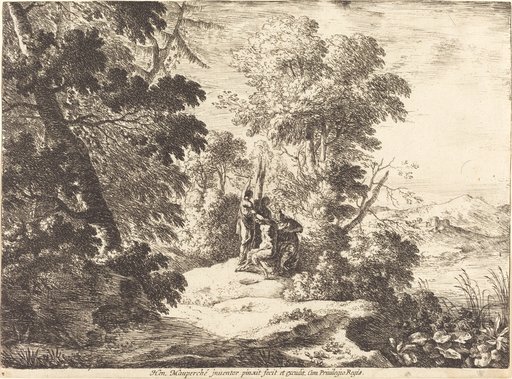
Henri Mauperche is a France Baroque artist. 10 works are cataloged here, principally at National Gallery of Art.
Overview
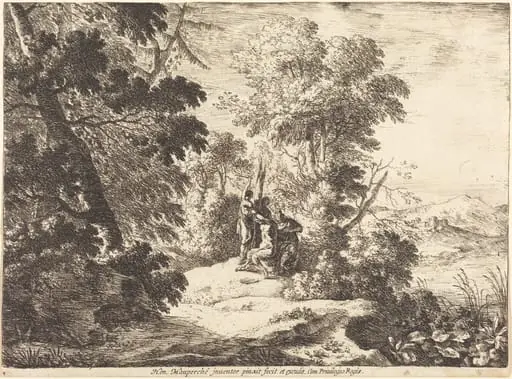
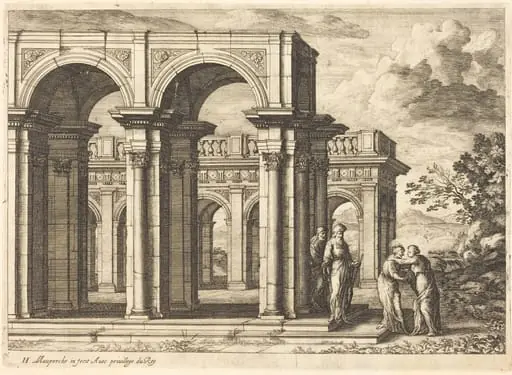
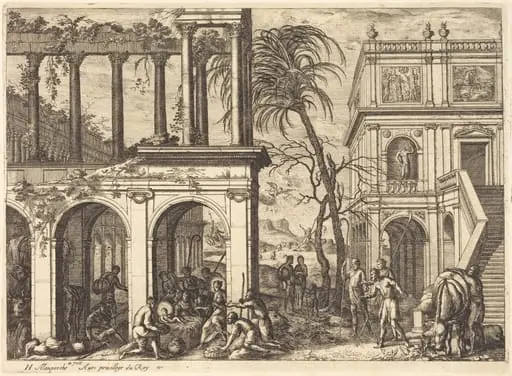
Henri Mauperché (c. 1602, Paris, 26 December Orbital 1686, Paris) was a French landscape painter and engraver whose career spanned one of the most formative periods in French classical landscape painting. Known also under the variants Henri Maupercher and Henri Montpercher, he specialized in capriccios, imaginary architectural landscapes that combined topographical observation with inventive composition. His significance lies in his role as a bridge between the Roman classical landscape tradition, particularly that of Claude Lorrain, and its dissemination in France through major decorative commissions, academic institutionalization, and printmaking. As one of the few landscape painters to achieve the rank of Professor at the Académie royale de peinture et de sculpture, Mauperché helped elevate the genre from a subsidiary craft to a respected academic discipline.
Biography & dates
Mauperché was born in Paris around 1602 and trained under Daniel Rabel. In 1634, he traveled to Rome in the company of Louis Boullogne, where he associated with Sébastien Bourdon, Herman van Swanevelt, and the circle known as the Bambocheurs or Bambochade. He returned to Paris in 1639, and on 12 March of that year signed a contract to decorate the guard room and antechamber of the Palais-Cardinal, Cardinal Richelieu's residence, alongside Jean Blanchard; by this date he was already designated peintre du roi.
On 17 January 1645, Mauperché married Magdeleine Garnot. The couple initially resided on the rue de la Tixanderie, near the painter Pierre Patel, then from 1649 to 1656 on the île Saint-Louis, where he maintained a press for producing landscape engravings. Between 1646 and 1647, he contributed to the decoration of the lower register of the Cabinet de l'Amour at the Hôtel Lambert, collaborating with Pierre Patel, Jan Asselyn, and Herman van Swanevelt. In the late 1640s, he possibly worked alongside Laurent de La Hyre on decorations for the bishop's palace at Lisieux, commissioned by Bishop Léonor de Matignon.
Mauperché was admitted to the Académie royale de peinture et de sculpture in 1648 and presented his reception piece, A la Première demande de l'Académie, in 1653. He became Professor in 1655, an exceptional distinction for a landscape painter. Around 1660, he executed nine large mythological landscapes for the queen's apartment at the Louvre, including octagonal compositions depicting Acis and Galatea and Polyphemus. From 1663 to 1664, he painted fourteen large historiated landscapes for the grand cabinet of Queen Mother Anne of Austria at Fontainebleau. His wife died in 1671. By 1686, illness prevented him from attending Académie sessions, and he was formally excused. He died on 26 December 1686 in his lodgings on the rue Saint-Antoine and was buried at the cemetery of Saint-Paul-des-Champs.
Style & movement
Mauperché's artistic identity centered on the capriccio, the imaginary landscape that liberated the painter from topographical fidelity in favor of architectural and natural invention. His work reflects the classical landscape tradition developed in Rome during the 1630s, characterized by ordered compositions, atmospheric perspective, and the integration of antique ruins with pastoral or narrative elements. The French Wikipedia characterizes him as a "paysagiste caméléon," suggesting an adaptability that allowed him to work across different decorative contexts and scales.
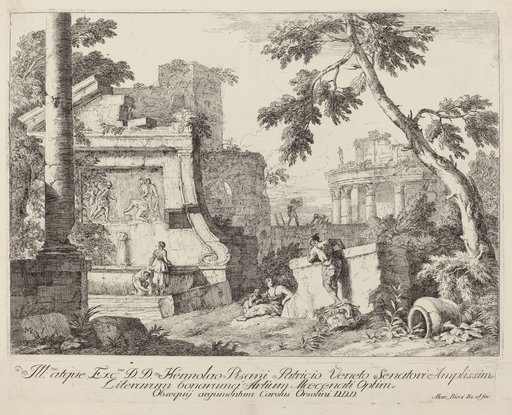
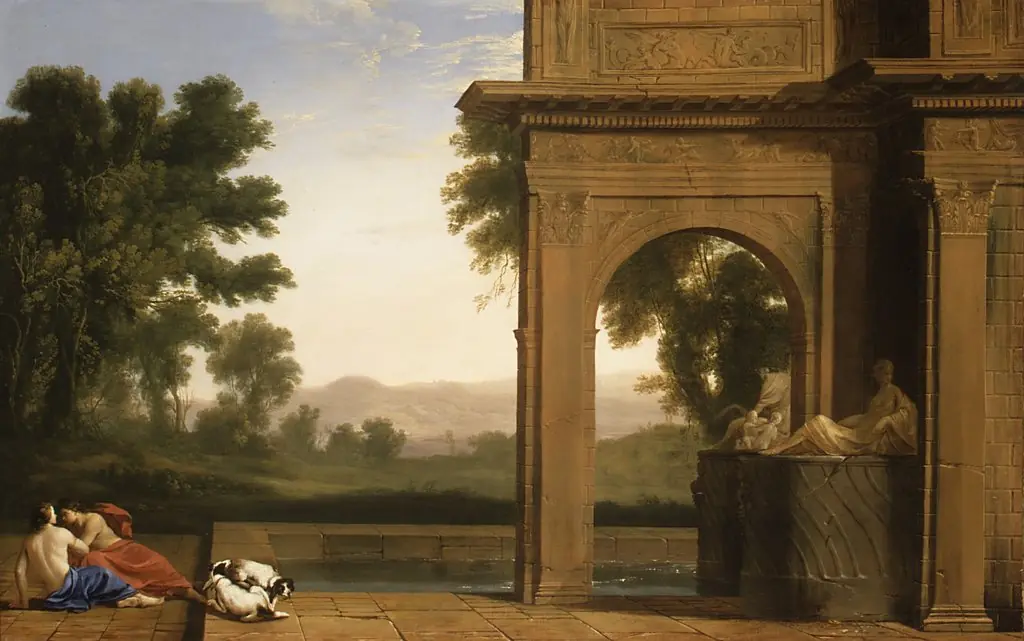
His technical approach combined painting and printmaking; he produced approximately fifty engravings, with Le plan de Liancourt of 1654 as his only dated work. The press he maintained on the île Saint-Louis enabled him to circulate his landscape compositions widely, contributing to the popularization of the classical landscape idiom in Paris. Together with Laurent de La Hyre and Pierre Patel, he helped transplant the Roman classical landscape, particularly as practiced by Claude Lorrain, into French artistic culture. His academic position further institutionalized this approach, establishing conventions that would influence French landscape painting for generations.
Major works
Securely attributed paintings by Mauperché are rare, and his prints constitute an essential resource for understanding his oeuvre. His documented works include:
Paysage avec l'ânesse de Balaam (c. 1640, for Fontainebleau), oil on canvas, 113 × 84 cm, now at the Musée du Berry, Bourges.
Paysage sur les marches d'un palais en ruines (c. 1645), 128 × 113 cm, Musée des Beaux-Arts, Rennes.
Paysage avec le temple de la Sibylle de Tivoli, oil on canvas, Musée Bossuet, Meaux.
Paysage au pont (1646, for the Hôtel Lambert), oil on canvas, 74 × 46 cm, Musée du Louvre, Paris.
Paysage aux ruines (1646, for the Hôtel Lambert), oil on canvas, private collection.
Paysage (c. 1650), oil on canvas, 115 × 94 cm, Musée du Petit Palais, Paris.
Paysage avec le repos pendant la fuite en Égypte (1671), oil on canvas, 135 × 147 cm, Musée du Louvre, Paris.
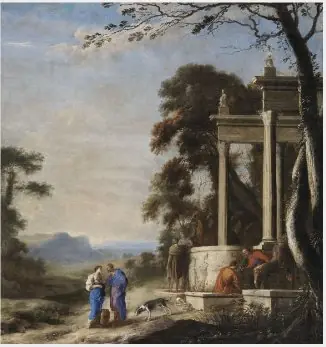
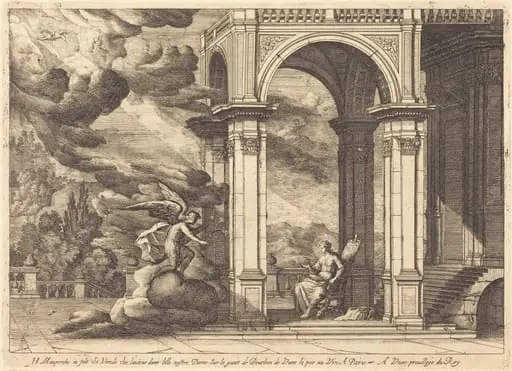
For Fontainebleau, he painted Le Christ et la Samaritaine and Le Christ et les Pélerins d'Emmaüs, both now in the National Gallery of Fine Arts, Sofia; Tobie et l'Ange, also possibly for Fontainebleau, is in the same Sofia collection. Two landscapes from the Fontainebleau series may be preserved there as well.
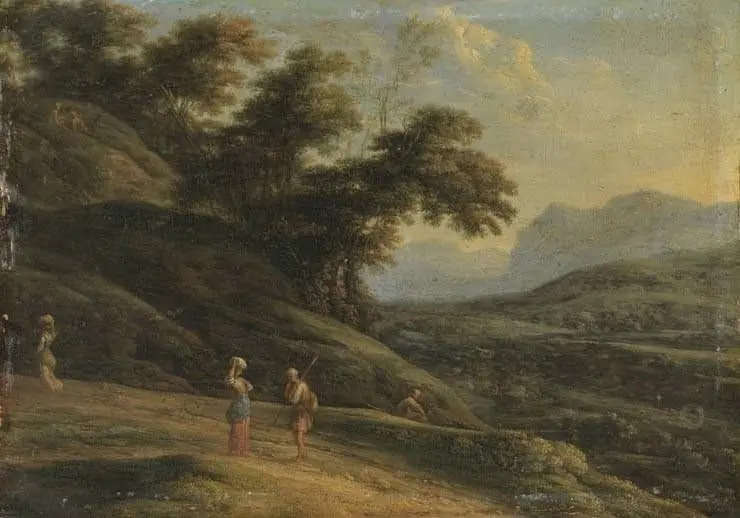
Additional works include Paysage avec baigneuses at Grasse; a Paysage at the Musée d'Art et d'Histoire, Lisieux; a Paysage at Birmingham; and Paysage au torrent in a private collection.
Influences & students
Mauperché's formation came through Daniel Rabel in Paris, and his decisive Roman sojourn of 1634-1639 placed him in contact with the international community of northern painters in Italy. His associations with Sébastien Bourdon and the Bambocheurs connected him to a network of artists working in a naturalistic, often low-life mode, while his collaboration with Herman van Swanevelt and later Pierre Patel aligned him with the classical landscape tradition. Laurent de La Hyre appears as both collaborator and fellow propagator of Claude Lorrain's classical landscape in France. The sources do not record specific pupils of Mauperché, though his academic position and printmaking activity would have provided models for younger artists. His influence operated more through institutional presence and the circulation of his engraved landscapes than through a documented teaching studio.
Legacy
Mauperché's legacy rests on three achievements: the elevation of landscape painting within the French academic hierarchy, the dissemination of the classical landscape through major decorative commissions and prints, and the survival, however fragmentary, of a body of work that documents the transition of French painting from mannerism to classicism. His appointment as Professor in 1655 was genuinely unusual for a landscape specialist and signaled the genre's rising prestige.
The destruction or disappearance of most of his decorative work, particularly at the Hôtel Lambert and Fontainebleau, has complicated assessment of his achievement; the French Wikipedia notes that the greater part of these works has vanished. What survives, along with his approximately fifty engravings, permits reconstruction of an artist who moved fluidly between intimate cabinet pictures and large-scale decorative cycles. Scholarly attention has been sporadic but significant: Bernard Biard's 1997 study in L'Objet d'Art and Jean-François Barrielle's 2010 essay, collected in Le beau langage de la nature, have done much to clarify his oeuvre, while Natalie Coural's entry in Grove Art Online provides authoritative biographical and critical framing. Pierre Rosenberg's identification of a Gabriel de Saint-Aubin drawing after a Mauperché composition further attests to his recognition by later artists.
Works by Henri Mauperche
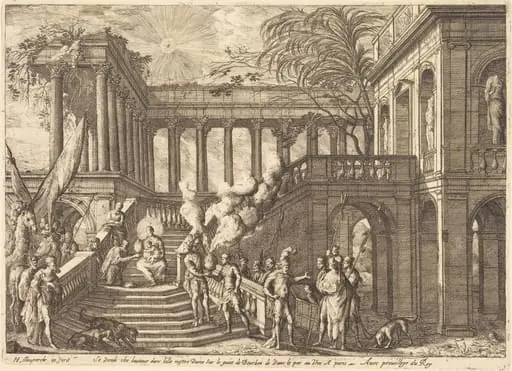
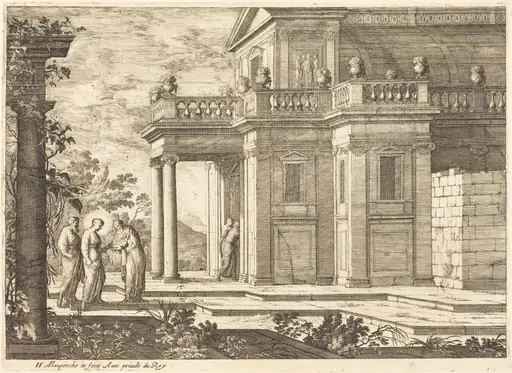
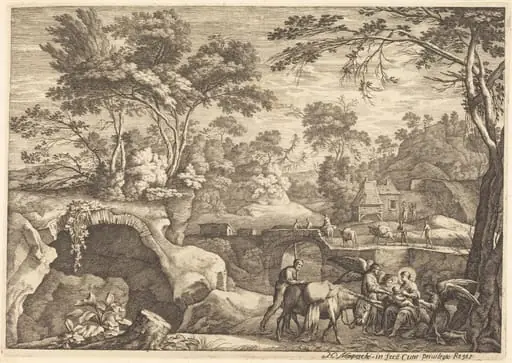
Collections represented


Artists in a similar vein